

Trade The World
EUR/USD nudges higher as the Fed decision comes into focus
作者 Guillermo Alcala
發布日期: 15 Sep 2025 | 修改日期: 15 Sep 2025


POPULAR ARTICLES

The EUR/USD pair trades at right above, ahead of Monday's US session opening, after bouncing at 1.1720 lows earlier in the day.
- The Euro ticks h¡igher as the impact of France's debt downgrade eases.
- The US Dollar drifts lower with traders positioning for a "dovish cut" by the Fed.
- The calendar is light on Monday, with only ECB's Schnabel and President Lagarde's public appearances on tap.
The EUR/USD pair trades at right above, ahead of Monday's US session opening, after bouncing at 1.1720 lows earlier in the day. The common currency opened the week on a hesitant note but is gathering momentum as the market shifts its focus from France's political crisis to the US Federal Reserve (Fed) monetary policy meeting due on Wednesday.
On Friday, the Fitch rating agency downgraded France's debt ranking to A+, its lowest level on record, citing its uncertain political situation – President Emmanuelle Macron named Sebastien Lecornu as the third Prime Minister of his term last week –, and a fiscal deficit that is only expected to continue growing.
The impact of Fitch's announcement on the Euro (EUR) has been limited, as the Fed's decision remains front and center in financial markets. Investors have already priced in a 25 basis points cut, but the interest rate projections and Chairman Jerome Powell's press conference are likely to reveal changes in the forward guidance that might determine the US Dollar's near-term direction.
The macroeconomic docket is light on Monday. ECB President Lagarde will take part in a panel at the Institute Montaigne in Paris, and during the European afternoon, Isabel Schnabel will speak at an economic meeting in Luxembourg. Their comments about France's situation and the bank's next monetary policy plans are likely to provide some guidance for the Euro.
Euro Price Today
The table below shows the percentage change of Euro (EUR) against listed major currencies today. Euro was the strongest against the US Dollar.
| USD | EUR | GBP | JPY | CAD | AUD | NZD | CHF | |
|---|---|---|---|---|---|---|---|---|
| USD | -0.16% | -0.42% | -0.18% | -0.09% | -0.21% | -0.08% | -0.18% | |
| EUR | 0.16% | -0.22% | -0.05% | 0.09% | -0.01% | 0.04% | -0.03% | |
| GBP | 0.42% | 0.22% | 0.24% | 0.30% | 0.21% | 0.27% | 0.08% | |
| JPY | 0.18% | 0.05% | -0.24% | 0.06% | 0.00% | 0.08% | -0.01% | |
| CAD | 0.09% | -0.09% | -0.30% | -0.06% | -0.02% | -0.04% | -0.22% | |
| AUD | 0.21% | 0.01% | -0.21% | -0.01% | 0.02% | 0.06% | -0.06% | |
| NZD | 0.08% | -0.04% | -0.27% | -0.08% | 0.04% | -0.06% | -0.18% | |
| CHF | 0.18% | 0.03% | -0.08% | 0.00% | 0.22% | 0.06% | 0.18% |
The heat map shows percentage changes of major currencies against each other. The base currency is picked from the left column, while the quote currency is picked from the top row. For example, if you pick the Euro from the left column and move along the horizontal line to the US Dollar, the percentage change displayed in the box will represent EUR (base)/USD (quote).
Daily digest market movers: The US Dollar weakens with markets awaiting the Fed
- The US Dollar is drifting lower, yet with trading volumes at relatively low levels as investors remain wary of placing large USD directional bets ahead of Wednesday's Fed decision. In the absence of first-tier data, some ECB speakers might move the Euro, but the US Dollar is likely to remain at current levels, at least until Tuesday's US Retail Sales release.
- Data released on Friday by the University of Michigan revealed that U.S. consumer sentiment deteriorated well beyond expectations, dropping to a four-month low in September. The survey signaled that higher product prices stemming from tariffs are weighing on consumption, which is likely to dampen economic growth.
- Last week, a rather moderate increase in US consumer prices and an unexpectedly soft US Producer Prices Index (PPI) report, all in all, contributed to setting the conditions for a Fed rate cut this week and probably to a more dovish monetary policy stance going forward.
- In Europe, France's 10-year bond yield has jumped 5 basis points to levels past 3.5%, and the yield of the 30-year bond increased nearly 10 basis points to 4.33%, following the downgrade of its sovereign debt rating. These levels are below the early September highs that triggered a significant Euro reversal, but still are likely to keep EUR bulls in check.
Technical Analysis: EUR/USD extends gains within a bullish channel
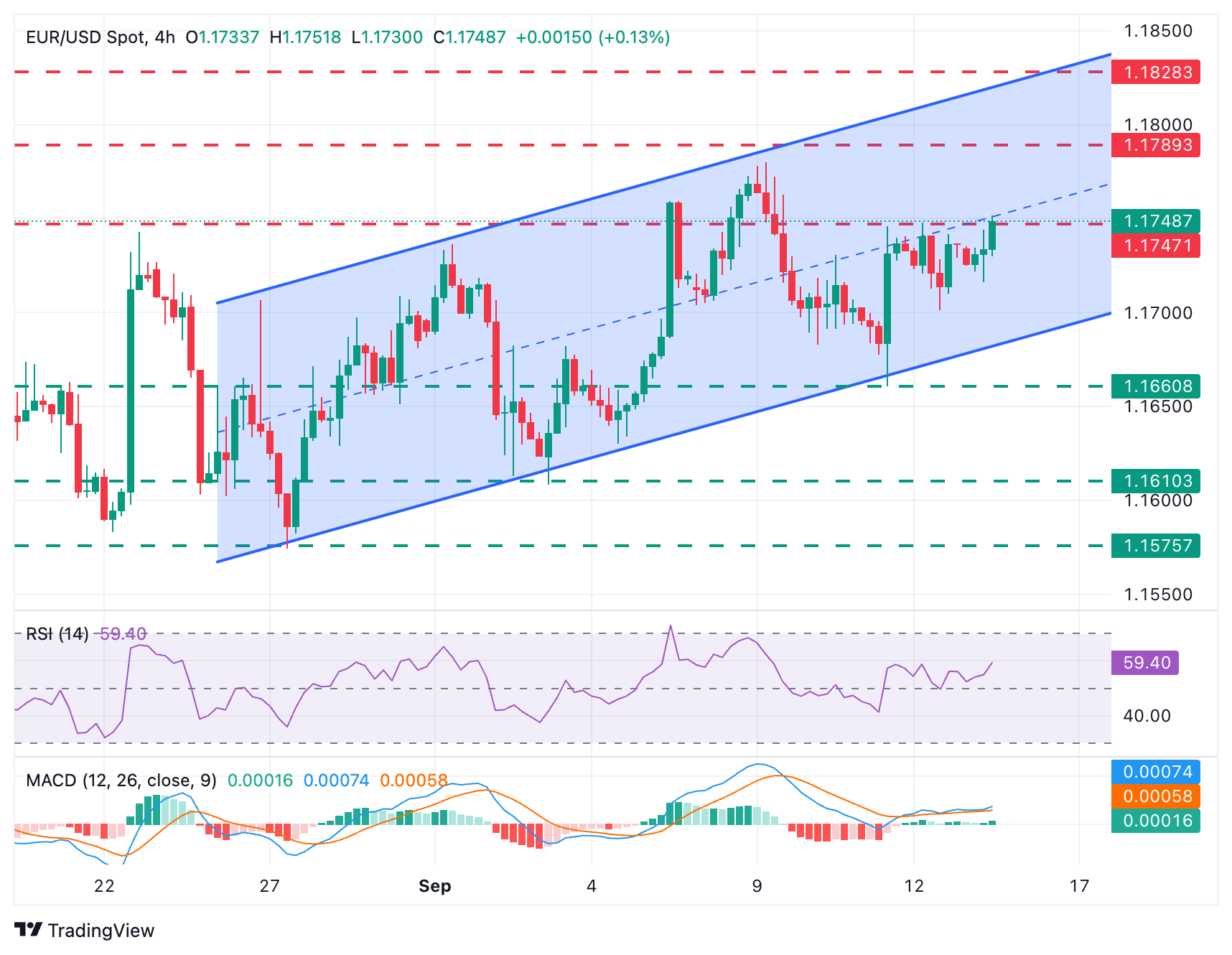
EUR/USD has resumed its bullish trend, extending gains beyond the 1.1750 resistance level. US Dollar's weakness is contributing to the Euro rally, but a significant rally looks unlikely as investors will remain wary of keeping larger USD shorts, heading into a key Fed meeting.
If bulls manage to consolidate at current levels, the next upside target would be the 1.1780-1.1790 area (September 8, July 24 highs). Beyond here, the top of the ascending channel meets the July 1 high at the 1.1830 area.
To the downside, Friday's low near 1.1700, and the bottom of the channel, at 1.1675, are likely to challenge bears in the coming sessions. Further down, the September 11 low near 1.1660 comes into view ahead of the 1.1610-1.1630 area that encloses the lows of September 2,3, and 4.
Fed FAQs
Monetary policy in the US is shaped by the Federal Reserve (Fed). The Fed has two mandates: to achieve price stability and foster full employment. Its primary tool to achieve these goals is by adjusting interest rates. When prices are rising too quickly and inflation is above the Fed’s 2% target, it raises interest rates, increasing borrowing costs throughout the economy. This results in a stronger US Dollar (USD) as it makes the US a more attractive place for international investors to park their money. When inflation falls below 2% or the Unemployment Rate is too high, the Fed may lower interest rates to encourage borrowing, which weighs on the Greenback.
The Federal Reserve (Fed) holds eight policy meetings a year, where the Federal Open Market Committee (FOMC) assesses economic conditions and makes monetary policy decisions. The FOMC is attended by twelve Fed officials – the seven members of the Board of Governors, the president of the Federal Reserve Bank of New York, and four of the remaining eleven regional Reserve Bank presidents, who serve one-year terms on a rotating basis.
In extreme situations, the Federal Reserve may resort to a policy named Quantitative Easing (QE). QE is the process by which the Fed substantially increases the flow of credit in a stuck financial system. It is a non-standard policy measure used during crises or when inflation is extremely low. It was the Fed’s weapon of choice during the Great Financial Crisis in 2008. It involves the Fed printing more Dollars and using them to buy high grade bonds from financial institutions. QE usually weakens the US Dollar.
Quantitative tightening (QT) is the reverse process of QE, whereby the Federal Reserve stops buying bonds from financial institutions and does not reinvest the principal from the bonds it holds maturing, to purchase new bonds. It is usually positive for the value of the US Dollar.

FXStreet
超過一百萬用戶依賴 FXStreet 獲取即時市場數據、圖表工具、專家洞見與外匯新聞。其全面的經濟日曆與教育網路研討會協助交易者保持資訊領先、做出審慎決策。FXStreet 擁有約 60 人的團隊,分布於巴塞隆納總部及全球各地。
Read More








