

Trade The World
USD/INR flattens amid uncertainty over US-India trade deal
作者 Sagar Dua
發布日期: 7 Nov 2025 | 修改日期: 7 Nov 2025


POPULAR ARTICLES

The Indian Rupee (INR) trades almost flat against the US Dollar (USD) during late trading hours in India on Friday. The USD/INR pair wobbles to near 88.75 despite hints from United States (US) President Donald Trump that his relations with Indian Prime Minister (PM) Narendra Modi are stable.
- The Indian Rupee consolidates against the US Dollar despite hopes of a trade deal between the US and India soon.
- FIIs turned out to be net sellers in the Indian stock market for the third trading day in a row.
- Signs of an accelerating US lay-off trend weigh on the US Dollar.
The Indian Rupee (INR) trades almost flat against the US Dollar (USD) during late trading hours in India on Friday. The USD/INR pair wobbles to near 88.75 despite hints from United States (US) President Donald Trump that his relations with Indian Prime Minister (PM) Narendra Modi are stable.
While speaking to reporters at the Oval Office on Thursday, US President Trump said, "He (PM Modi) largely stopped buying from Russia. And he is a friend of mine, and we speak. Prime Minister Narendra Modi is a great man. He is a friend of mine, and we speak, and he wants me to go there. We will figure that out, I will go... Prime Minister Modi is a great man and I will be going," India Today reported. Later, Trump expressed positive that he could visit India next year.
These comments from US President Trump came at a time when overseas investors have been hard on the Indian stock market due to a delay in a trade agreement between India and the US. Top negotiators from both nations have been expressing that they are close to reaching a consensus for months, but have not agreed on all terms yet.
On Thursday, Foreign Institutional Investors (FIIs) turned out to be net sellers again and sold shares worth Rs. 3,263.21 crore. Cumulatively, FIIs have pared stake worth Rs. 6,214 crore so far in three trading days this month.
Daily digest market movers: Escalating US labor market concerns weigh on US Dollar
- The Indian Rupee trades calmly against the US Dollar even as the latter corrects further, following the release of the US Challenger job cuts data for October. This suggests that the overall trend of the Indian Rupee is bearish.
- During the press time, the US Dollar Index (DXY), which tracks the Greenback’s value against six major currencies, ticks higher to near 99.80. However, it fell sharply to near 99.60 on Thursday,
- The US Challenger job cuts report showed that 153,074 employees were laid off in October, a 183% surge from September and 175% higher than seen in the same month of the previous year. This marks the highest level for any October since 2003. This has been the worst year for announced layoffs since 2009.
- The report also signaled that the adoption of Artificial Intelligence (AI) by the private sector has led to a significant number of lay-offs in the economy, with job market conditions in the last quarter of the year becoming more unfavorable.
- Historically, the impact of the US Challenger jobs data on the US Dollar remained limited. However, its influence has accelerated in the wake of the ongoing US federal shutdown, which has become the longest in history.
- Signs of a cooling job market have slightly boosted expectations of another interest rate cut by the Federal Reserve (Fed) in the December policy meeting.
- The CME FedWatch tool shows that the probability of the Fed cutting interest rates by 25 basis points (bps) to 3.50%-3.75% in the December meeting has increased to 67% from 62% seen on Wednesday.
Technical Analysis: USD/INR trades broadly stable below 89.00
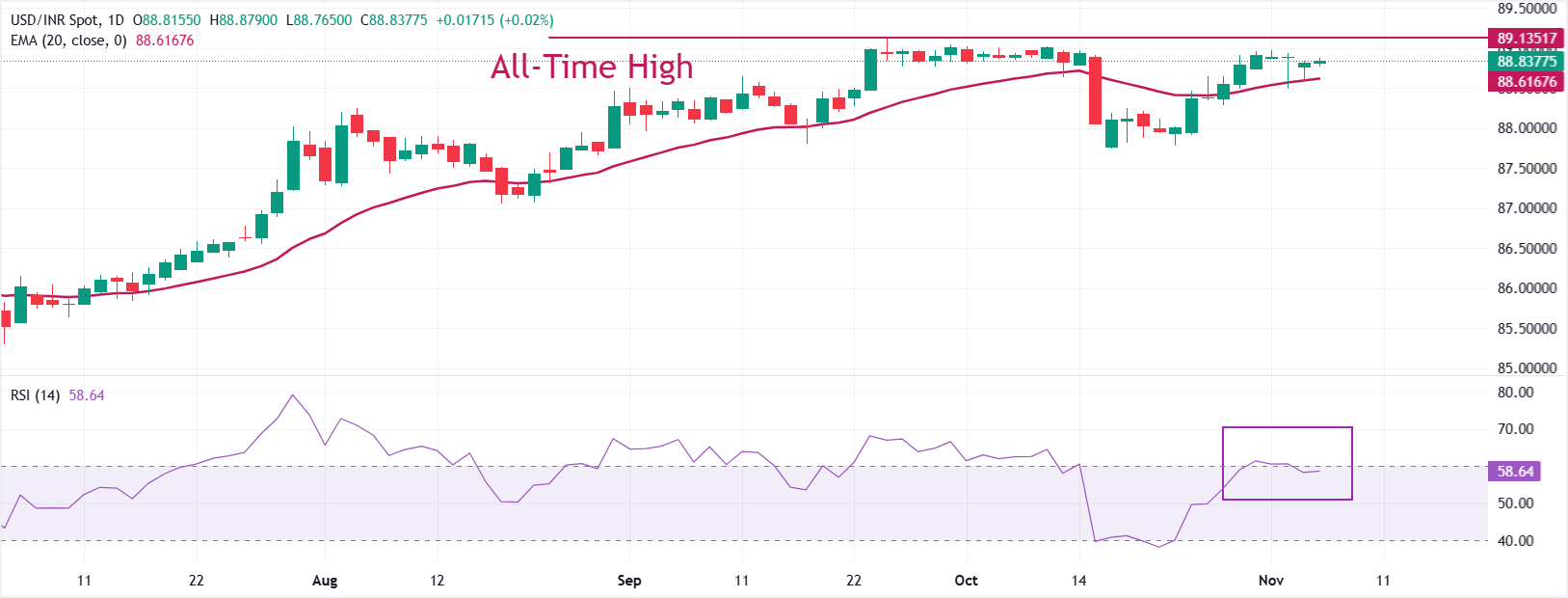
USD/INR trades flat 88.75 on Friday. The pair continues to find support near the 20-day Exponential Moving Average (EMA), which trades around 88.60.
The 14-day Relative Strength Index (RSI) strives to return above 60.00. A fresh bullish momentum would emerge if the RSI (14) manages to do so.
Looking down, the August 21 low of 87.07 will act as key support for the pair. On the upside, the all-time high of 89.12 will be a key barrier.
US Dollar FAQs
The US Dollar (USD) is the official currency of the United States of America, and the ‘de facto’ currency of a significant number of other countries where it is found in circulation alongside local notes. It is the most heavily traded currency in the world, accounting for over 88% of all global foreign exchange turnover, or an average of $6.6 trillion in transactions per day, according to data from 2022. Following the second world war, the USD took over from the British Pound as the world’s reserve currency. For most of its history, the US Dollar was backed by Gold, until the Bretton Woods Agreement in 1971 when the Gold Standard went away.
The most important single factor impacting on the value of the US Dollar is monetary policy, which is shaped by the Federal Reserve (Fed). The Fed has two mandates: to achieve price stability (control inflation) and foster full employment. Its primary tool to achieve these two goals is by adjusting interest rates. When prices are rising too quickly and inflation is above the Fed’s 2% target, the Fed will raise rates, which helps the USD value. When inflation falls below 2% or the Unemployment Rate is too high, the Fed may lower interest rates, which weighs on the Greenback.
In extreme situations, the Federal Reserve can also print more Dollars and enact quantitative easing (QE). QE is the process by which the Fed substantially increases the flow of credit in a stuck financial system. It is a non-standard policy measure used when credit has dried up because banks will not lend to each other (out of the fear of counterparty default). It is a last resort when simply lowering interest rates is unlikely to achieve the necessary result. It was the Fed’s weapon of choice to combat the credit crunch that occurred during the Great Financial Crisis in 2008. It involves the Fed printing more Dollars and using them to buy US government bonds predominantly from financial institutions. QE usually leads to a weaker US Dollar.
Quantitative tightening (QT) is the reverse process whereby the Federal Reserve stops buying bonds from financial institutions and does not reinvest the principal from the bonds it holds maturing in new purchases. It is usually positive for the US Dollar.

FXStreet
超過一百萬用戶依賴 FXStreet 獲取即時市場數據、圖表工具、專家洞見與外匯新聞。其全面的經濟日曆與教育網路研討會協助交易者保持資訊領先、做出審慎決策。FXStreet 擁有約 60 人的團隊,分布於巴塞隆納總部及全球各地。
Read More








