

Trade The World
WTI Price Forecast: Bearish bias intact below 50 and 100-day SMAs
作者 Vishal Chaturvedi
發布日期: 4 Nov 2025 | 修改日期: 4 Nov 2025


POPULAR ARTICLES

West Texas Intermediate (WTI) trades on the back foot on Tuesday as traders digest the latest OPEC+ decision to pause planned supply increases, with lingering oversupply concerns capping upside momentum.
- WTI slips toward $60.00 as traders react to OPEC+’s pause in planned output hikes.
- Oversupply fears persist, with the decision seen as insufficient to tighten the market.
- Technical outlook remains bearish below key moving averages, with near-term support seen near $59.65.
West Texas Intermediate (WTI) trades on the back foot on Tuesday as traders digest the latest OPEC+ decision to pause planned supply increases, with lingering oversupply concerns capping upside momentum. At the time of writing, WTI is changing hands around $60.20 per barrel, staging a mild recovery after briefly slipping to $59.79, down nearly 1.10% on the day.
Adding to the downside pressure, a stronger US Dollar (USD) is weighing on commodity prices, making dollar-denominated assets like Crude Oil more expensive for overseas buyers. The US Dollar Index (DXY), which tracks the Greenback's strength against a basket of six major currencies, is hovering near 100.08, its highest level since early August.
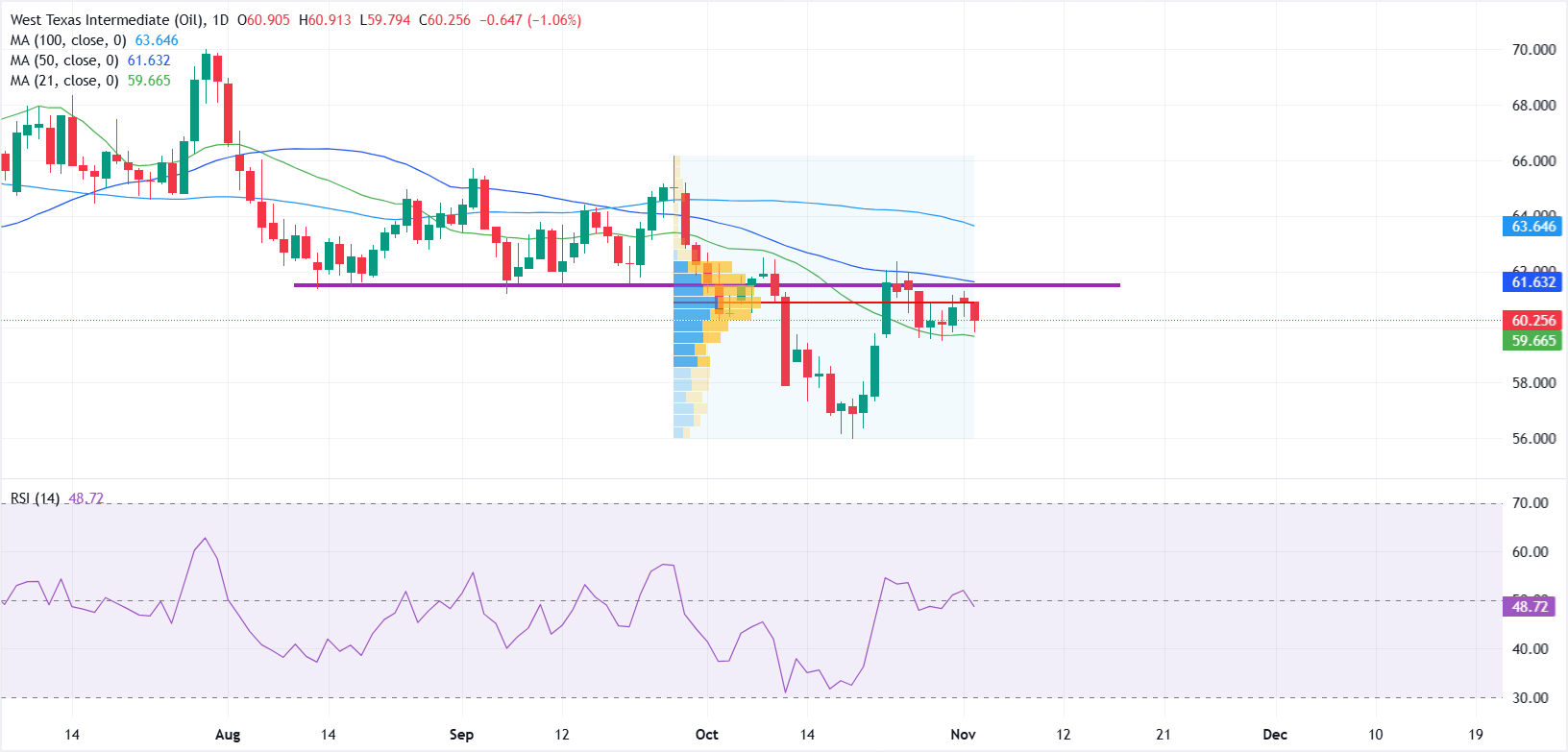
From a technical perspective, WTI’s near-term outlook appears bearish as the price continues to trade below the 50-day and 100-day Simple Moving Averages (SMAs). The failed attempt to sustain gains above the $61.50-$62.00 area, a key former support now turned resistance, highlights persistent selling pressure. This zone also aligns closely with the 50-day SMA, reinforcing it as a strong ceiling for any near-term recovery attempts.
The 21-day SMA around $59.65 is acting as immediate support, having provided a floor in recent sessions. A sustained break below this level could invite fresh selling pressure, exposing the October 22 low near $57.31, followed by the October swing low around $56.00. A daily close below the latter would reaffirm the bearish trend and open the door for deeper losses toward the mid-$50s.
On the upside, a clear break and daily close above the $61.50-$62.00 barrier would be required to ease the prevailing downside bias. Even then, the 100-day SMA near $63.65 remains a crucial hurdle that bulls must reclaim to regain control.
Meanwhile, the Fixed Range Volume Profile shows the heaviest trading activity clustered between $60.00 and $62.50, suggesting strong supply in that region. The Relative Strength Index (RSI) stands near 47, reflecting neutral-to-bearish momentum.
WTI Oil FAQs
WTI Oil is a type of Crude Oil sold on international markets. The WTI stands for West Texas Intermediate, one of three major types including Brent and Dubai Crude. WTI is also referred to as “light” and “sweet” because of its relatively low gravity and sulfur content respectively. It is considered a high quality Oil that is easily refined. It is sourced in the United States and distributed via the Cushing hub, which is considered “The Pipeline Crossroads of the World”. It is a benchmark for the Oil market and WTI price is frequently quoted in the media.
Like all assets, supply and demand are the key drivers of WTI Oil price. As such, global growth can be a driver of increased demand and vice versa for weak global growth. Political instability, wars, and sanctions can disrupt supply and impact prices. The decisions of OPEC, a group of major Oil-producing countries, is another key driver of price. The value of the US Dollar influences the price of WTI Crude Oil, since Oil is predominantly traded in US Dollars, thus a weaker US Dollar can make Oil more affordable and vice versa.
The weekly Oil inventory reports published by the American Petroleum Institute (API) and the Energy Information Agency (EIA) impact the price of WTI Oil. Changes in inventories reflect fluctuating supply and demand. If the data shows a drop in inventories it can indicate increased demand, pushing up Oil price. Higher inventories can reflect increased supply, pushing down prices. API’s report is published every Tuesday and EIA’s the day after. Their results are usually similar, falling within 1% of each other 75% of the time. The EIA data is considered more reliable, since it is a government agency.
OPEC (Organization of the Petroleum Exporting Countries) is a group of 12 Oil-producing nations who collectively decide production quotas for member countries at twice-yearly meetings. Their decisions often impact WTI Oil prices. When OPEC decides to lower quotas, it can tighten supply, pushing up Oil prices. When OPEC increases production, it has the opposite effect. OPEC+ refers to an expanded group that includes ten extra non-OPEC members, the most notable of which is Russia.

FXStreet
超過一百萬用戶依賴 FXStreet 獲取即時市場數據、圖表工具、專家洞見與外匯新聞。其全面的經濟日曆與教育網路研討會協助交易者保持資訊領先、做出審慎決策。FXStreet 擁有約 60 人的團隊,分布於巴塞隆納總部及全球各地。
Read More








