

Indian Rupee advances as fading risk aversion weighs on US Dollar
- USD/INR falls as a surprise US-Iran peace agreement eased global safe-haven demand, weakening the US Dollar.
- The US Dollar could rebound amid increasing market expectations of additional Fed interest rate hikes later this year.
- Lower oil prices are expected to ease depreciation pressures on the Indian Rupee by lowering the country's import bill.
The Indian Rupee (INR) gains ground after registering modest losses in the previous day against the US Dollar (USD) on Thursday. The USD/INR pair depreciates as the US Dollar (USD) declines on easing safe-haven demand following the BBC report late Wednesday, suggesting that the White House confirmed that US President Donald Trump and Iranian President Masoud Pezeshkian signed a preliminary memorandum of understanding designed to end the US-Israel war on Iran.

Fed rate hike odds in 2026
However, the USD/INR pair may regain its ground as the US Dollar could rebound on rising odds of rate hikes by the Federal Reserve (Fed) later this year. The Fed’s June Summary of Economic Projections showed half of FOMC members expect at least one rate hike this year. Despite economic disruptions linked to the conflict in Iran, resilient labor market data and persistent underlying inflation measures continue to drive tightening pressures.
The Federal Open Market Committee (FOMC) voted unanimously to maintain its benchmark federal funds rate in the range of 3.5% to 3.75%. In his first meeting since taking the helm of the US central bank, the newly appointed Federal Reserve Chairman, Kevin Warsh, vowed to aggressively restore price stability.
Indian equities fall following the Federal Reserve's decision to hold interest rates steady, amid signals that the central bank could still hike borrowing costs later this year. The prospect of higher-for-longer US rates typically sours the appeal of emerging markets like India, keeping investor risk appetite firmly in check.
WTI declines on easing supply risks
The Indian Rupee is expected to see relief from depreciation pressures as global crude oil prices extend their decline. This drop follows a landmark interim agreement between the United States and Iran, which halted their active military conflict and fully reopened the vital Strait of Hormuz, successfully calming global energy supply anxieties.
UK-India trade deal to start in July
The landmark free trade agreement between Britain and India will officially take effect next month on July 15. The rollout was locked in after India confirmed its concerns had been resolved regarding the UK’s upcoming steel tariff regime, which had previously threatened to delay the deal. Signed last year, the long-awaited economic pact unites the world’s fifth- and sixth-largest economies.
RBI rejects offshore settlement for sovereign bonds
The Reserve Bank of India (RBI) remains opposed to enabling the direct settlement of local government bonds through offshore platforms like Euroclear, according to Reuters sources. Despite recent tax incentives designed to lure foreign capital, the central bank is holding its ground: it wants overseas investors to trade directly on its domestic NDS-OM electronic platform rather than using international clearing houses.
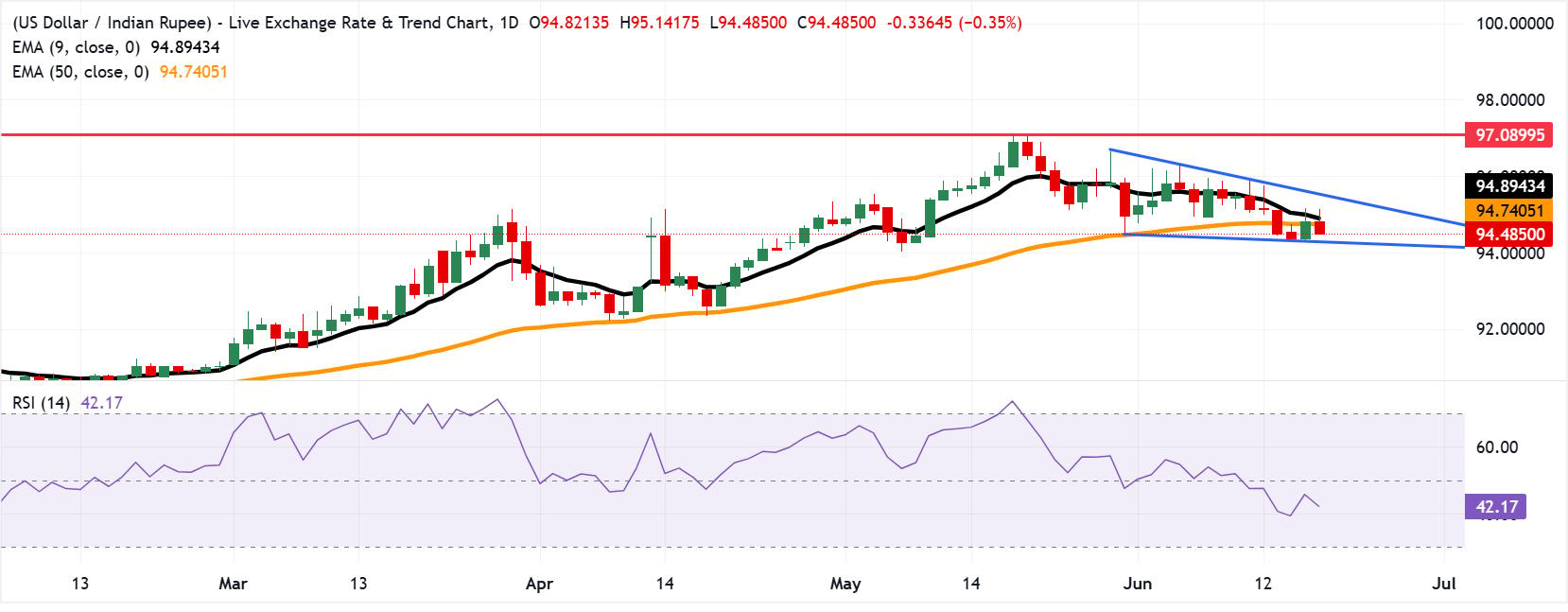
Technical Analysis: USD/INR trades near 94.50 below moving averages
USD/INR depreciates after registering modest gains the previous day, trading around 94.60 at the time of writing. The technical analysis of the daily chart suggests that the spot price remains within the descending triangle, indicating a consolidation phase.
The 14-day Relative Strength Index (RSI) around 43 suggests weak momentum, reinforcing the risk of further downside as long as price remains suppressed beneath these moving averages.
The immediate support lies at the lower boundary of the descending triangle around 94.30, while the initial resistance lies at the 50-day EMA of 94.74, followed by the nine-day EMA at 94.89.
US Dollar Price Today
The table below shows the percentage change of US Dollar (USD) against listed major currencies today. US Dollar was the weakest against the Indian Rupee.
| USD | EUR | GBP | JPY | CAD | AUD | NZD | INR | |
|---|---|---|---|---|---|---|---|---|
| USD | -0.18% | -0.16% | -0.03% | -0.00% | -0.32% | -0.41% | -0.43% | |
| EUR | 0.18% | 0.02% | 0.15% | 0.17% | -0.15% | -0.29% | 0.03% | |
| GBP | 0.16% | -0.02% | 0.11% | 0.13% | -0.16% | -0.31% | -0.30% | |
| JPY | 0.03% | -0.15% | -0.11% | 0.05% | -0.30% | -0.44% | -0.10% | |
| CAD | 0.00% | -0.17% | -0.13% | -0.05% | -0.34% | -0.48% | -0.13% | |
| AUD | 0.32% | 0.15% | 0.16% | 0.30% | 0.34% | -0.14% | 0.23% | |
| NZD | 0.41% | 0.29% | 0.31% | 0.44% | 0.48% | 0.14% | 0.02% | |
| INR | 0.43% | -0.03% | 0.30% | 0.10% | 0.13% | -0.23% | -0.02% |
The heat map shows percentage changes of major currencies against each other. The base currency is picked from the left column, while the quote currency is picked from the top row. For example, if you pick the US Dollar from the left column and move along the horizontal line to the Japanese Yen, the percentage change displayed in the box will represent USD (base)/JPY (quote).
Indian Rupee FAQs
The Indian Rupee (INR) is one of the most sensitive currencies to external factors. The price of Crude Oil (the country is highly dependent on imported Oil), the value of the US Dollar – most trade is conducted in USD – and the level of foreign investment, are all influential. Direct intervention by the Reserve Bank of India (RBI) in FX markets to keep the exchange rate stable, as well as the level of interest rates set by the RBI, are further major influencing factors on the Rupee.
The Reserve Bank of India (RBI) actively intervenes in forex markets to maintain a stable exchange rate, to help facilitate trade. In addition, the RBI tries to maintain the inflation rate at its 4% target by adjusting interest rates. Higher interest rates usually strengthen the Rupee. This is due to the role of the ‘carry trade’ in which investors borrow in countries with lower interest rates so as to place their money in countries’ offering relatively higher interest rates and profit from the difference.
Macroeconomic factors that influence the value of the Rupee include inflation, interest rates, the economic growth rate (GDP), the balance of trade, and inflows from foreign investment. A higher growth rate can lead to more overseas investment, pushing up demand for the Rupee. A less negative balance of trade will eventually lead to a stronger Rupee. Higher interest rates, especially real rates (interest rates less inflation) are also positive for the Rupee. A risk-on environment can lead to greater inflows of Foreign Direct and Indirect Investment (FDI and FII), which also benefit the Rupee.
Higher inflation, particularly, if it is comparatively higher than India’s peers, is generally negative for the currency as it reflects devaluation through oversupply. Inflation also increases the cost of exports, leading to more Rupees being sold to purchase foreign imports, which is Rupee-negative. At the same time, higher inflation usually leads to the Reserve Bank of India (RBI) raising interest rates and this can be positive for the Rupee, due to increased demand from international investors. The opposite effect is true of lower inflation.














