

Gold price crashes as Waller warning sparks Fed hike fears
- Waller says hot core CPI could force hike consideration.
- Oil surge revives inflation risks after renewed Hormuz attacks.
- CPI and Warsh testimony could decide Gold’s next break.
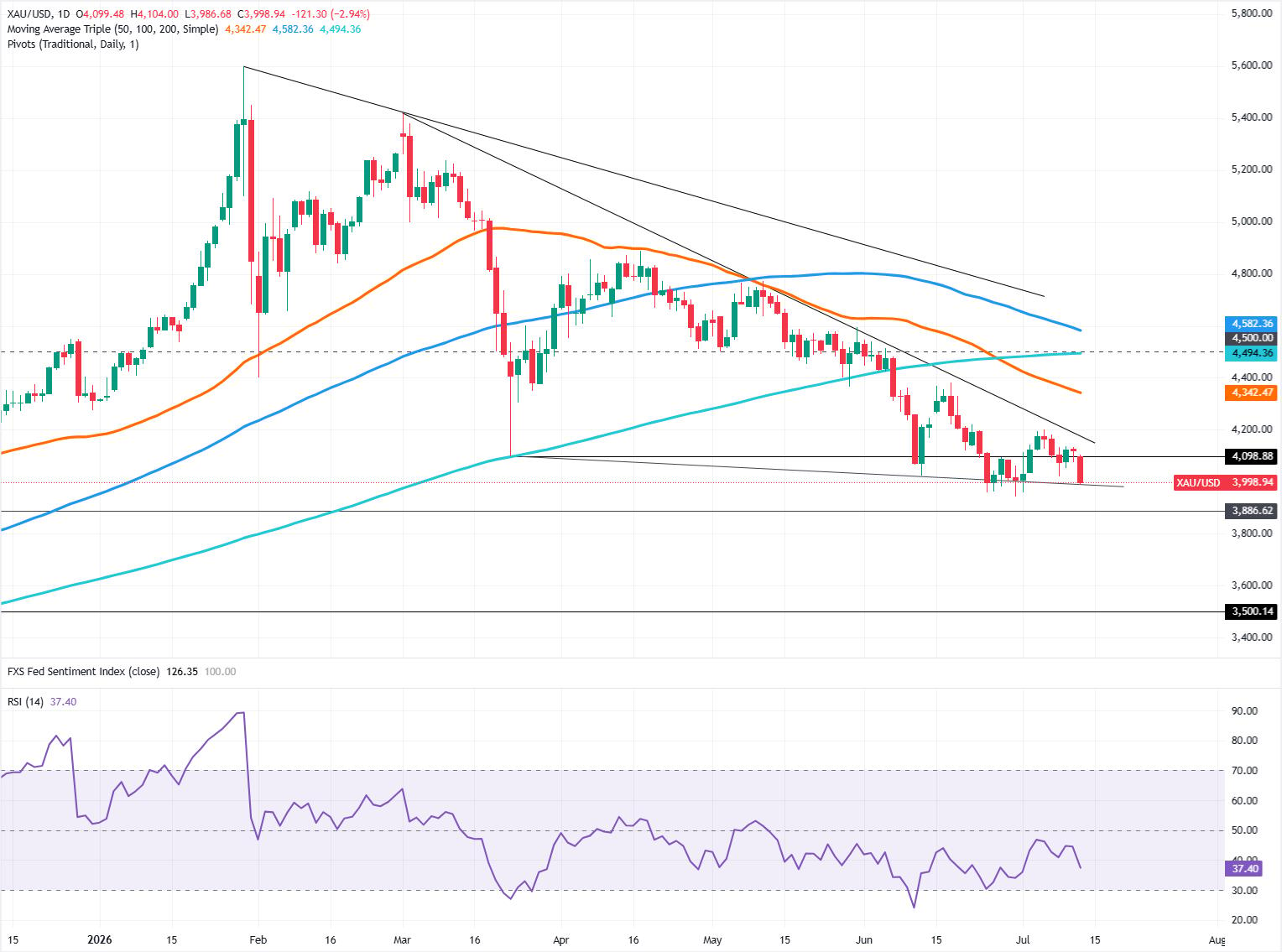
Gold price (XAU/USD) plunges on Monday after remarks by Federal Reserve (Fed) Governor Christopher Waller, who revealed that if the Consumer Price Index (CPI) rises this week, the Fed should consider interest rate hikes. The XAU/USD drops nearly 3% below $4,000 as traders eye a retest of the yearly low near $3,900.
XAU/USD dives as Waller ties CPI upside to rate hikes.
Governor Waller stated that a high reading in core inflation “would force near-term consideration of a rate hike.” Despite being hawkish, he still sees it as credible that inflation could reach the 2% goal without higher rates and stated that the labour market is closer to the Fed’s maximum-employment goal.

In the meantime, geopolitics continued to drive Gold prices. The US and Iran exchanged fire over the weekend despite signing a memorandum of understanding (MOU) that intended to keep the ceasefire going.
Tehran’s attacks on shipping vessels prompted retaliation from the US. US CENTCOM confirmed the attacks on more than 100 military targets, aimed at dismantling Iran’s forces near the Strait of Hormuz.
Iran then attacked gulf region nations that host US bases. Tehran said over the weekend that it had closed the Strait of Hormuz to tanker traffic. Energy prices have jumped since the resumption of hostilities amid fears of a supply disruption, with the US crude Oil benchmark, Western Texas Intermediate (WTI), rising nearly 6% on Monday to $75.70.
Given the backdrop, investors had priced in 33 basis points of Fed tightening toward the end of the year, according to Prime Terminal data.
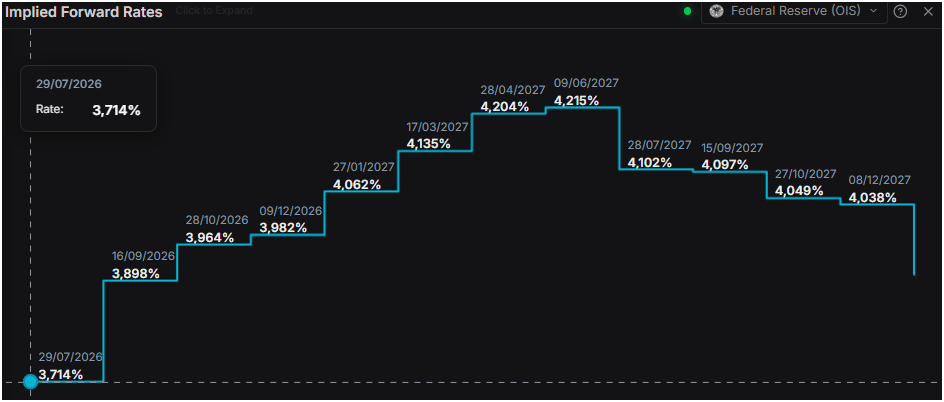
Catalysts for the Gold price
Ahead this week, the release of US inflation data and Fed Chair Kevin Warsh's testimony in front of the US Congress could be the main drivers of XAU’s price action. A rise in inflation and a hawkish Warsh could set the table for a rate hike, sooner rather than later.
XAU/USD technical outlook: Gold drops below $4,000 on Fed's hawkish tilt
Price action shows that the series of successive lower highs and lower lows is being respected, with Gold poised to continue its downtrend. Bears continued to gather momentum as measured by the Relative Strength Index (RSI), which is approaching oversold territory.
All that said, XAU/USD first support would be the year-to-date (YTD) low of $3,941. A breach of the latter will expose the October 28, 2025 swing low of $3,886 ahead of dropping toward the $3,500 mark.
For a bullish continuation, Gold must surpass the $4,000 figure, followed by a downslope resistance trendline at around $4,170. Above the latter, the $4,200 psychological level looms.
Gold FAQs
Gold has played a key role in human’s history as it has been widely used as a store of value and medium of exchange. Currently, apart from its shine and usage for jewelry, the precious metal is widely seen as a safe-haven asset, meaning that it is considered a good investment during turbulent times. Gold is also widely seen as a hedge against inflation and against depreciating currencies as it doesn’t rely on any specific issuer or government.
Central banks are the biggest Gold holders. In their aim to support their currencies in turbulent times, central banks tend to diversify their reserves and buy Gold to improve the perceived strength of the economy and the currency. High Gold reserves can be a source of trust for a country’s solvency. Central banks added 1,136 tonnes of Gold worth around $70 billion to their reserves in 2022, according to data from the World Gold Council. This is the highest yearly purchase since records began. Central banks from emerging economies such as China, India and Turkey are quickly increasing their Gold reserves.
Gold has an inverse correlation with the US Dollar and US Treasuries, which are both major reserve and safe-haven assets. When the Dollar depreciates, Gold tends to rise, enabling investors and central banks to diversify their assets in turbulent times. Gold is also inversely correlated with risk assets. A rally in the stock market tends to weaken Gold price, while sell-offs in riskier markets tend to favor the precious metal.
The price can move due to a wide range of factors. Geopolitical instability or fears of a deep recession can quickly make Gold price escalate due to its safe-haven status. As a yield-less asset, Gold tends to rise with lower interest rates, while higher cost of money usually weighs down on the yellow metal. Still, most moves depend on how the US Dollar (USD) behaves as the asset is priced in dollars (XAU/USD). A strong Dollar tends to keep the price of Gold controlled, whereas a weaker Dollar is likely to push Gold prices up.













