

Australia unemployment rate expected to hold at 4.4% in July
- The Australian Unemployment Rate is forecast to hold steady at 4.4% in July.
- Australia is expected to have added 15K jobs in the month, fewer than the 76.3K gained in June.
- AUD/USD gains upward momentum ahead of the Australian employment report.
Australia will release the July monthly employment report on Thursday at 01:30 GMT. Ahead of the announcement, analysts anticipate a modest 15K increase in job creation, while the Unemployment Rate is expected to remain steady at 4.4%. The Australian Bureau of Statistics (ABS) report is also expected to show that the Participation Rate stood at 66.9% in the month following the 67% recorded in the previous month.

ABS separately reports full-time and part-time positions through the monthly Employment Change. Generally speaking, full-time jobs entail working 38 hours or more per week, usually include additional benefits, and typically provide a consistent income. On the other hand, part-time employment generally means higher hourly rates but lacks consistency and benefits. That’s why the economy prefers full-time jobs. In June, Australia added 47K part-time positions and a modest 29.3K full-time ones.
Australian unemployment rate seen steady in July
The soft anticipated figures could have a near-term negative impact on the Australian Dollar (AUD), although market attention remains elsewhere: the Middle East.
While Australian employment data can shape future Reserve Bank of Australia (RBA) monetary policy decisions, policymakers are clearly focusing on inflation. At the August meeting, the Board decided to keep the Official Cash Rate (OCR) unchanged at 4.35%, as expected.
“While the impact of the Middle East conflict on inflation has so far been less than expected, headline inflation is still too high. Trimmed mean inflation also remains elevated and is little changed from the March quarter. Oil and most related commodity prices remain higher than they were prior to the Middle East conflict,” the RBA’s August statement reads.
Inflation risks are tilted to the upside, while “labour market conditions have eased by a little more than expected in recent months. Labour market leading indicators point to only limited easing in the near term,” the statement adds, suggesting that the anticipated soft outcome will be considered encouraging by the RBA rather than a new point of concern.
Regarding the United States (US)-Iran war, there’s not much new going on, and that’s actually concerning. Both sides refrain from launching fresh attacks on the other, yet negotiations to end the conflict seem utopian at this point. Each side's demands are a line the other side will not cross. As a result, Oil prices are slowly but steadily rising, which ultimately exacerbates and confirms inflation-related concerns.
Back to the Australian employment data release, and as previously mentioned, the anticipated figures are expected to have a negative, yet temporary impact. A much better-than-anticipated outcome could spur some near-term AUD demand, yet whether the currency could sustain such gains will depend on risk-related sentiment and US Dollar (USD) weakness or strength.
When will the Australian employment report be released and how could it affect AUD/USD?
The ABS July employment report will be released early on Thursday. As previously noted, the Australian economy is expected to have added 15K new jobs in the month, while the Unemployment Rate is forecast at 4.4%. Market participants will also be attentive to the breakdown of full-time and part-time positions.
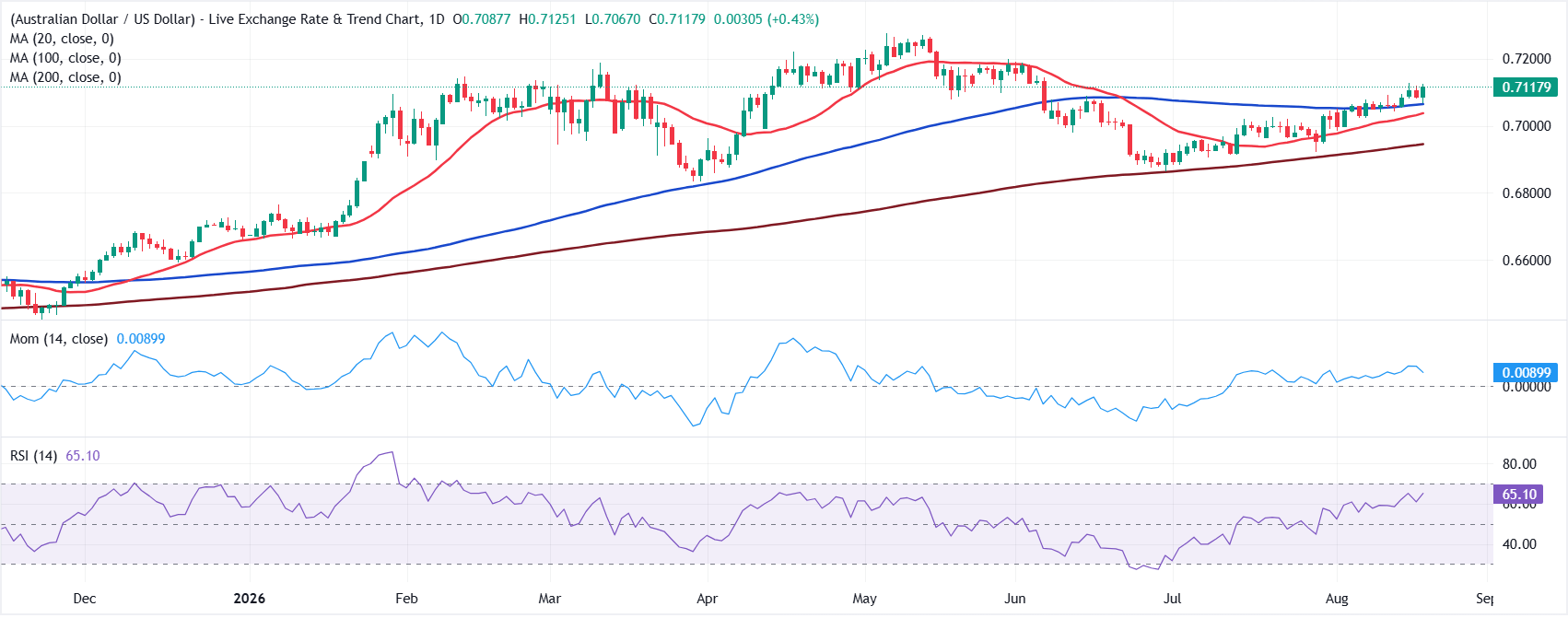
Valeria Bednarik, Chief Analyst at FXStreet, notes: “The AUD/USD pair trades around the 0.7100 mark amid broad USD weakness, not far below the August peak at 0.7129. Technically, the pair is bullish, with the daily chart showing buyers aligned around the 100-day Simple Moving Average (SMA) at around 0.7060. The 20-day SMA meanwhile advances below the longer one, signaling increased buying interest. Finally, technical indicators in the same chart remain within positive levels, although lacking clear directional strength.”
Bednarik adds: “ As long as the pair holds above the mentioned 0.7060 region, the bullish stance will remain in place regardless of intraday movements. Below the level, however, the retracement can extend towards the 0.7030 price zone before buying interest shows signs. Immediate near-term resistance is located at 0.7030, while additional gains could see AUD/USD reaching 0.7070 before some selling interest appears.”
Employment FAQs
Labor market conditions are a key element to assess the health of an economy and thus a key driver for currency valuation. High employment, or low unemployment, has positive implications for consumer spending and thus economic growth, boosting the value of the local currency. Moreover, a very tight labor market – a situation in which there is a shortage of workers to fill open positions – can also have implications on inflation levels and thus monetary policy as low labor supply and high demand leads to higher wages.
The pace at which salaries are growing in an economy is key for policymakers. High wage growth means that households have more money to spend, usually leading to price increases in consumer goods. In contrast to more volatile sources of inflation such as energy prices, wage growth is seen as a key component of underlying and persisting inflation as salary increases are unlikely to be undone. Central banks around the world pay close attention to wage growth data when deciding on monetary policy.
The weight that each central bank assigns to labor market conditions depends on its objectives. Some central banks explicitly have mandates related to the labor market beyond controlling inflation levels. The US Federal Reserve (Fed), for example, has the dual mandate of promoting maximum employment and stable prices. Meanwhile, the European Central Bank’s (ECB) sole mandate is to keep inflation under control. Still, and despite whatever mandates they have, labor market conditions are an important factor for policymakers given its significance as a gauge of the health of the economy and their direct relationship to inflation.
Economic Indicator
Unemployment Rate s.a.
The Unemployment Rate, released by the Australian Bureau of Statistics, is the number of unemployed workers divided by the total civilian labor force, expressed as a percentage. If the rate increases, it indicates a lack of expansion within the Australian labor market and a weakness within the Australian economy. A decrease in the figure is seen as bullish for the Australian Dollar (AUD), while an increase is seen as bearish.
Read more.Next release: Thu Aug 20, 2026 01:30
Frequency: Monthly
Consensus: 4.4%
Previous: 4.4%
Source: Australian Bureau of Statistics
The Australian Bureau of Statistics (ABS) publishes an overview of trends in the Australian labour market, with unemployment rate a closely watched indicator. It is released about 15 days after the month end and throws light on the overall economic conditions, as it is highly correlated to consumer spending and inflation. Despite the lagging nature of the indicator, it affects the Reserve Bank of Australia’s (RBA) interest rate decisions, in turn, moving the Australian dollar. Upbeat figure tends to be AUD positive.










