

Australian Dollar holds early losses driven by weak job data
- The Australian Dollar is down against its major peers due to weak employment data for July.
- Australian employers fired 15.8K workers, and the Unemployment Rate jumped to 4.5%.
- Market sentiment turns risk-on as US Treasury plans to double bond-buying operations.
The Australian Dollar (AUD) remains under pressure against its major currency peers during the early European trading session on Thursday. As of writing, the antipodean is down 0.17% to near 0.7110 against the US Dollar (USD).
Australian Dollar Price Today
The table below shows the percentage change of Australian Dollar (AUD) against listed major currencies today. Australian Dollar was the weakest against the New Zealand Dollar.
| USD | EUR | GBP | JPY | CAD | AUD | NZD | CHF | |
|---|---|---|---|---|---|---|---|---|
| USD | 0.04% | 0.02% | 0.33% | -0.06% | 0.14% | -0.29% | 0.37% | |
| EUR | -0.04% | -0.02% | 0.30% | -0.09% | 0.10% | -0.33% | 0.32% | |
| GBP | -0.02% | 0.02% | 0.30% | -0.08% | 0.11% | -0.31% | 0.33% | |
| JPY | -0.33% | -0.30% | -0.30% | -0.40% | -0.19% | -0.63% | 0.01% | |
| CAD | 0.06% | 0.09% | 0.08% | 0.40% | 0.21% | -0.22% | 0.42% | |
| AUD | -0.14% | -0.10% | -0.11% | 0.19% | -0.21% | -0.42% | 0.21% | |
| NZD | 0.29% | 0.33% | 0.31% | 0.63% | 0.22% | 0.42% | 0.66% | |
| CHF | -0.37% | -0.32% | -0.33% | -0.01% | -0.42% | -0.21% | -0.66% |
The heat map shows percentage changes of major currencies against each other. The base currency is picked from the left column, while the quote currency is picked from the top row. For example, if you pick the Australian Dollar from the left column and move along the horizontal line to the US Dollar, the percentage change displayed in the box will represent AUD (base)/USD (quote).

The Australian currency fell sharply in the Asian session after the release of the employment data for July, which showed that employers laid off 15.8K workers. Financial markets anticipated the economy to have created 15K fresh jobs, lower than 80.2K in June.
Australia’s Unemployment Rate also increased to 4.5%, while it was expected to remain steady at 4.4%.
Weak Australian employment data is expected to ease fears of Reserve Bank of Australia (RBA) interest rate hike expectations.
On Wednesday, RBA Deputy Governor Andrew Hauser warned of upside inflation risks, adding that the central bank needs to raise interest rates to bring price pressures down.
Meanwhile, market sentiment turns risk-on after the announcement from the United States (US) Treasury Department that it will accelerate its long-dated bond-buying operations to curb high borrowing costs.
The US Treasury Department said it would at least double the size of liquidity-support buyback operations covering securities with maturities from 10 to 30 years, as the recent surge in yields heightened concerns over market liquidity and stability, The Wall Street Journal (WSJ) reported.
At press time, S&P 500 futures are up 0.15% to near 7,720, reflecting a favorable environment for riskier assets. Asian stock markets are also significantly higher.
AUD/USD Technical Analysis
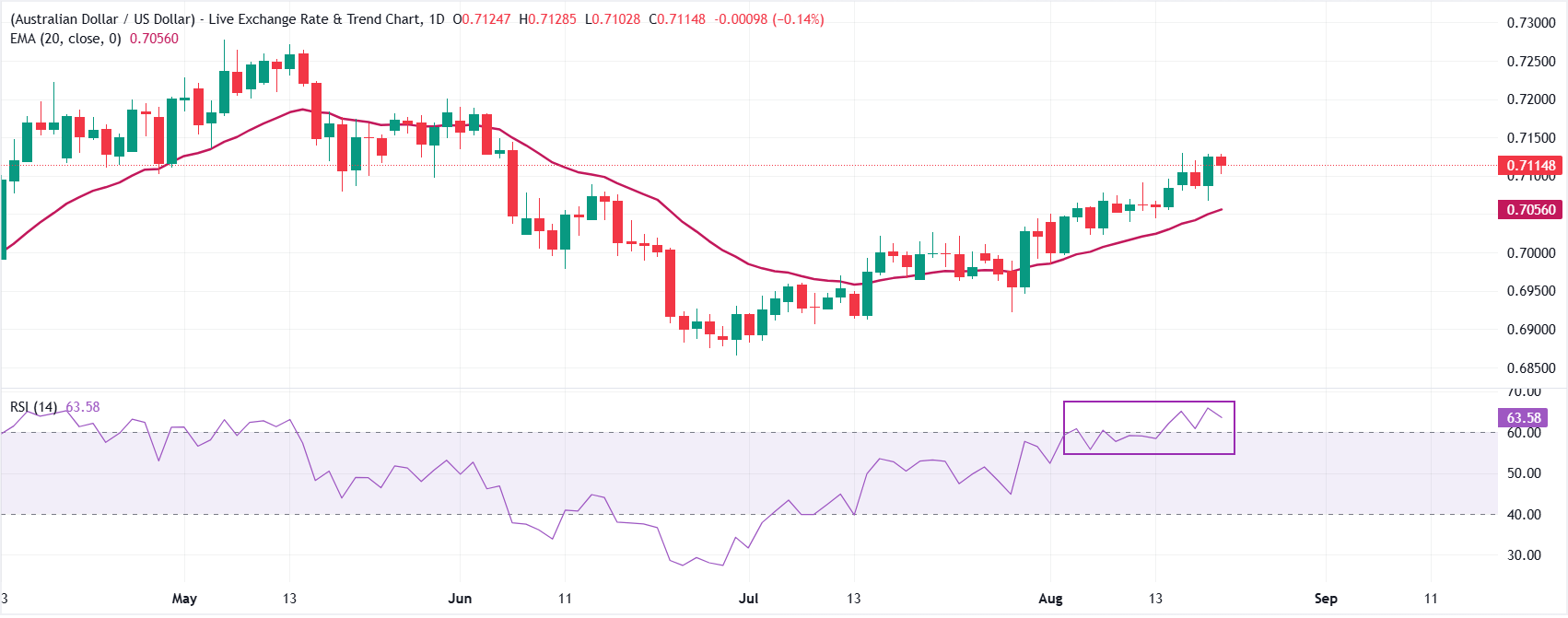
In the daily chart, AUD/USD trades at 0.7115, extending its advance above the 20-day Exponential Moving Average (EMA) at 0.7056 and keeping a bullish near-term bias intact. The pair holds comfortably above this dynamic support, while the Relative Strength Index (RSI) at 63.6 stays in bullish territory without yet reaching overbought, suggesting buyers retain control after the recent push higher.
On the downside, initial support is located at the 20-day EMA at 0.7056, where a deeper pullback would likely be assessed by dip buyers to preserve the broader constructive tone. As long as AUD/USD defends this floor on daily closes, scope remains open for the pair to probe higher levels, with momentum readings hinting that any corrective phase could be relatively shallow before the uptrend resumes.
(The technical analysis of this story was written with the help of an AI tool. Know more.)
Economic Indicator
Employment Change s.a.
The Employment Change released by the Australian Bureau of Statistics is a measure of the change in the number of employed people in Australia. The statistic is adjusted to remove the influence of seasonal trends. Generally speaking, a rise in Employment Change has positive implications for consumer spending, stimulates economic growth, and is bullish for the Australian Dollar (AUD). A low reading, on the other hand, is seen as bearish.
Read more.Last release: Thu Aug 20, 2026 01:30
Frequency: Monthly
Actual: -15.8K
Consensus: 15K
Previous: 76.3K
Source: Australian Bureau of Statistics










