
News & AnalysisCareer

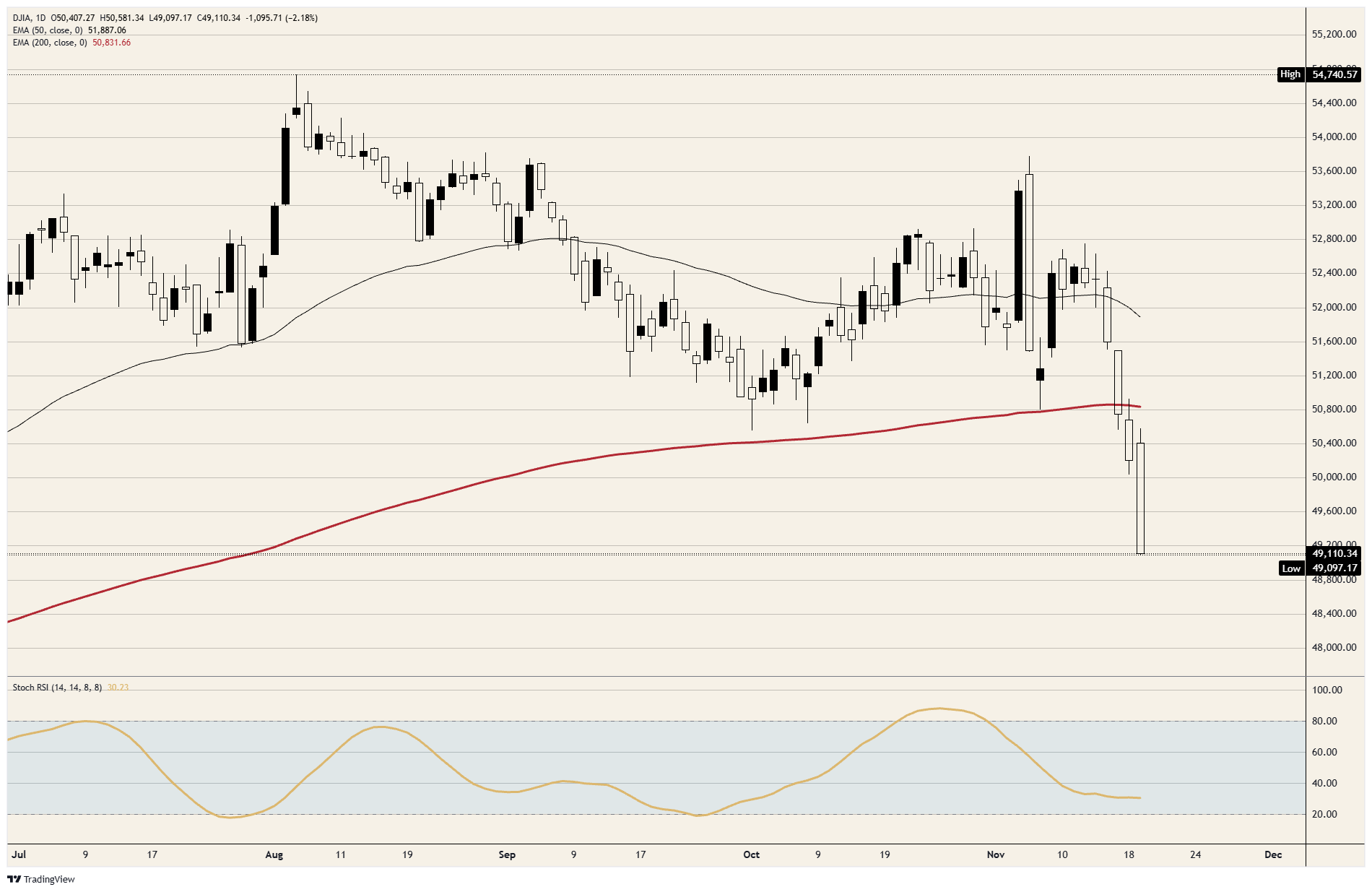
A decline of more than 1,000 points has left the Dow Jones Industrial Average near 49,100, taking it below 50,000 for the first time in more than four months. Having advanced ahead of the largest initial public offering (IPO) on record, US equities have retreated since trading in its shares opened. The S&P 500 stands near 7,175, while a fall of about 1,250 points from the session high has taken the Nasdaq 100 to around 26,500.

After pricing at $83 on Wednesday, above its $70-$78 range, Anthropic (ANT) raised a record sum of about $81 billion. The shares opened on the Nasdaq at $111.50, a 34% premium. Within minutes, all three indices had touched fresh session lows as artificial intelligence (AI) stocks relinquished their gains. Anthropic is now changing hands near $97, retaining a 17% premium to its IPO price. However, that advance contributes nothing to indices in which the stock is not included.
Both Nvidia (NVDA) and Microsoft (MSFT), which feature in all three indices, surrendered their gains. Nvidia has fallen 27% in November, the month in which Chief Executive Jensen Huang resigned. A decline of more than 7% hit Advanced Micro Devices (AMD) after Hunterbrook Capital revealed a short position and alleged violations of US export controls involving China. Separately from the AI-related moves, UnitedHealth (UNH) weighed on the price-weighted Dow Jones Industrial Average: its shares were down more than 5%, bringing their fall since Friday's close to almost 19%.
Friday's calendar includes the University of Michigan's final November consumer sentiment figure, scheduled for 15:00 GMT. Stock and index options also reach their monthly expiry that day, with all three indices at their lowest levels of the month. Anthropic, meanwhile, faces its first full trading session.
A quarter-point Fed rate rise from 3.75%-4.00% at the December 8-9 meeting is fully reflected in traders' pricing. Speaking on Thursday, Chicago Fed President Goolsbee said inflation was not heading back towards 2% and that wealth generated by AI, alongside demand for data centres, was adding to inflationary pressure.
Since November 13, the Dow Jones Industrial Average has shed about 3,000 points, breaking below its 200-day Exponential Moving Average (EMA) near 50,800 on Tuesday. Its decline from the August high near 54,750 now exceeds 10%. Having opened the session above its 200-day EMA near 7,350, the S&P 500 now trades about 175 points beneath that level. The Nasdaq 100, meanwhile, has slipped under its early-November low near 26,600 and stands about 15% below its October peak.
Comprising the 30 most traded US stocks, the Dow Jones Industrial Average ranks among the world's oldest stock market indices. Rather than using market capitalisation, it weights its constituents by share price: their prices are added together and divided by a factor that currently stands at 0.152. Charles Dow, who also established the Wall Street Journal, founded the index. Its narrow coverage has drawn criticism in later years, as tracking only 30 conglomerates makes it less broadly representative than wider indices such as the S&P 500.
Of the numerous influences on the Dow Jones Industrial Average (DJIA), the most important is the combined performance of its constituent companies, as shown in their quarterly earnings reports. Macroeconomic releases from the US and elsewhere also shape the index through their effect on investor sentiment. Another influence is the level of interest rates set by the Federal Reserve (Fed), which determines borrowing costs for the many corporations that rely heavily on credit. Inflation can therefore be a significant driver, alongside other indicators that inform the Fed's decisions.
Developed by Charles Dow to establish the stock market's primary trend, Dow Theory relies on comparing the direction of the Dow Jones Industrial Average (DJIA) with that of the Dow Jones Transportation Average (DJTA). It calls for following a trend only when both indices move in the same direction, with trading volume providing confirmation. Analysis of peaks and troughs also forms part of the approach. Dow's theory divides trends into three phases: accumulation, when smart money begins buying or selling; public participation, as the wider public follows; and distribution, when smart money withdraws.
Investors can gain exposure to the DJIA through several instruments. ETFs package the index into a single tradable security, removing the need to purchase shares in each of its 30 constituent companies; the SPDR Dow Jones Industrial Average ETF (DIA) is a leading example. Futures contracts allow traders to speculate on the DJIA's future value. Options, by contrast, confer the right, without an obligation, to buy or sell the index at a price agreed in advance for a future date. Through mutual funds, investors can purchase a share of a diversified portfolio of DJIA stocks and thereby gain exposure to the index as a whole.










The information provided on this website is of a general nature only and does not constitute personal financial advice. Before acting on any information on this website, you should consider the suitability of the information in relation to your objectives, financial situation and needs. Investing in CFDs and FX Margin Contracts carries significant risks and is not suitable for all investors. You may lose more than your initial deposit. You do not own, or have, any interest in the underlying asset. We recommend that you seek independent advice and ensure you fully understand the risks involved before trading. It is important that you read and consider the disclosure document before you acquire any product listed on the website. The information and advertisements offered on this website are not intended for use by any person in any country or jurisdiction where such use would be contrary to local laws and regulations. The Products and Services offered on this website are not intended for residents of the United States, Malaysia and Thailand.
TMGM is authorized and regulated in various jurisdictions.
Trademax Australia Limited, trading as TMGM, is regulated by the Australian Securities and Investments Commission (ASIC), AFSL no. 436416 and is located at Level 28, One International Tower, 100 Barangaroo Avenue, 2000 Sydney, NSW Australia.
Email: support@tmgm.com.au
Trademax Global Limited, trading as TMGM, is authorized and regulated by the Vanuatu Financial Services Commission (VFSC), registration number 40356 and registered at 1276, Kumul Highway, Port Vila, Vanuatu, Republic of Vanuatu.
Email: support@tmgm.com
Trademax Global Markets (SE) Limited, trading as TMGM, is authorized and regulated by the Financial Services Authority (FSA) of Seychelles, with license number SD224. The company is registered at Office No 13, Providence Estate ABIS Centre, Mahe, Seychelles.
Email: support@tmgm.com
Trademax Global Markets (International) Pty Ltd, trading as TMGM, is authorized and regulated by the Financial Services Commission, Mauritius (FSC) with license no. GB22201012, and registered at 33, Edith Cavell Street C/o IQ EQ Fund Services (Mauritius) Ltd Port Louis, 11324 Mauritius.
Email: support@tmgm.com
Copyright © TMGM. All rights reserved

