
News & AnalysisCareer

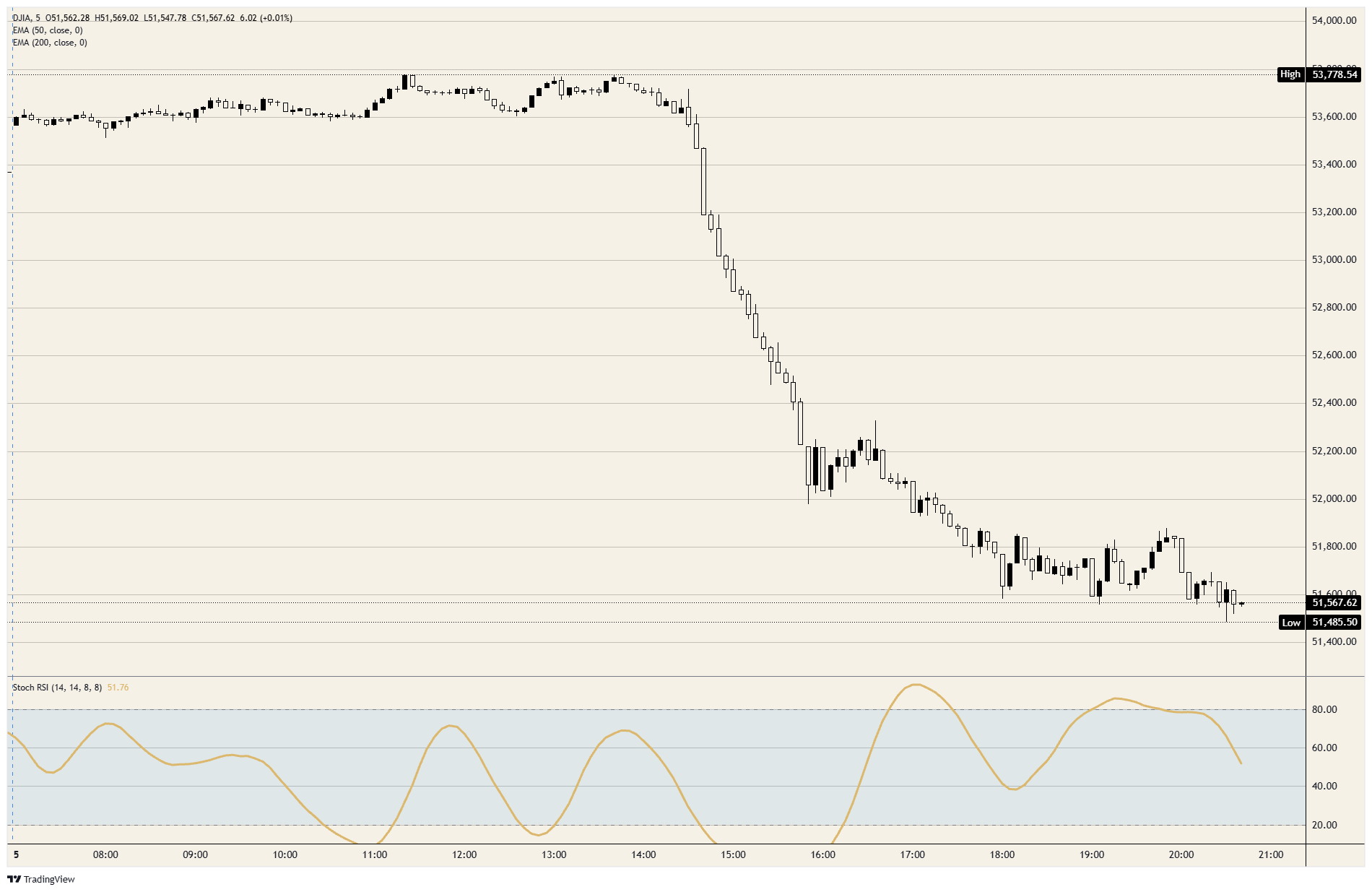
Just above 51,500, the Dow Jones Industrial Average is trading below Tuesday's close at its weakest level since 14 October. Having recorded its strongest session since April 2025 on Wednesday, the index is heading for its worst since that same month on Thursday, with both moves driven by the same election result. Of its thirty constituents, twenty-nine are down; Coca-Cola (KO) is the exception.

What began as a sell-off in chipmakers has spread across the market. Chip stocks collectively are heading for their worst session since March 2020, while the Nasdaq Composite sits more than 10% beneath its October record. At 28, the Cboe Volatility Index (VIX) reached its highest level since 31 March. Tuesday's result is being read by investors as a verdict on the data-centre expansion, although the Dow has less exposure to that trade than the other two indices.
Share prices, rather than company size, determine each constituent's influence on the price-weighted Dow. At about $870 per share, Goldman Sachs (GS) represents a tenth of the index; a decline of about 6% in its shares accounts for roughly a fifth of the points shed. By contrast, Nvidia (NVDA), trading at about $180, carries a 2% weight, so its 9% fall contributes about 6% of the loss. Despite falling more sharply than the bank, the $4 trillion company had only about a third of its impact on the Dow.
The next-largest downward contribution comes from Caterpillar (CAT). In its third-quarter results, reported on 29 October, power generation sales increased 30% to $3.42 billion, chiefly from turbines and large engines for data centres. Among Dow constituents, that gives it the most direct exposure to the expansion now called into question by the election. Apple, Amazon, Alphabet, Microsoft and Nvidia, five of the largest US technology companies, all belong to the index, yet their combined contribution is less than a fifth of the decline. Banks, industrials, healthcare and the remaining constituents account for the other four fifths.
For banks, there is an additional concern: Senator Elizabeth Warren is expected to take over the Senate Banking Committee in January and has already called on regulators to withdraw three bank capital proposals. JPMorgan (JPM) has lost about 4%. Together, JPMorgan and Goldman carry about 14% of the price-weighted Dow, compared with about 2% of the S&P 500. As a result, the committee's stance on bank capital has a much greater influence on the Dow than on the broader index.
On 25 March, Senator Bernie Sanders and Representative Alexandria Ocasio-Cortez introduced the AI Data Center Moratorium Act. The bill would stop new construction until Congress enacts artificial intelligence (AI) regulation. Following the results on Wednesday, Sanders renewed his call for a halt. By that point, lawmakers in at least 11 states had put forward their own proposed pauses.
Voters supported restrictions in nearly all of the more than 40 local data-centre measures on Tuesday's ballots. In Texas and Ohio, both centres of the construction boom, Democrats secured the Senate seat and the governor's office after campaigns that featured data centres as an issue. According to Fitch, regulatory obstacles may affect a major share of planned capacity in Texas, Georgia and Ohio. UBS puts the share of capacity planned for 2028 that could be at risk from construction pauses at about 30%. Even Alphabet (GOOGL), which unveiled a $17 billion data centre in Wyoming during the session, saw its shares decline alongside the rest.
Initial jobless claims dropped to 189K in the week to 31 October, below the 196K forecast and matching the lowest figure since 1969. The encouraging economic releases on Thursday drew no trading response. Productivity in the third quarter increased 3.6%, exceeding the expected 2.5%, while unit labour costs declined 0.7%, their first fall since the second quarter of 2025. Nevertheless, the 10-year Treasury yield slipped to about 4.85%.
Inflationary pressure is spreading through the economy and the labour market could strengthen, according to Cleveland Fed President Beth Hammack. Richmond Fed President Tom Barkin identified inflation as the Fed's foremost risk, adding that the AI expansion has increased demand. He also noted that data centres employ too few people to develop natural constituencies within their host communities. After the Fed left rates at 3.75%-4.00% on 28 October, futures were assigning close to an 80% probability to an increase at the 9 December meeting as the session began.
Friday's October payrolls release, due at 13:30 GMT, is expected to show 65K jobs added, up from 29K in September. Forecasts put unemployment unchanged at 4.2% and average hourly earnings at 0.3% MoM. A reading close to expectations would keep the December increase on course, adding higher borrowing costs to Thursday's concerns about a slower buildout. A miss would reduce the likelihood of an increase but shift the concern towards a slowing economy, offering a different reason to sell the same index. This is the first of two payrolls reports available to the Fed before 9 December; futures have already priced the meeting without either release.
Resistance: Near 52,150, the 50-day Exponential Moving Average (EMA) presents the first barrier. The index closed above it on Wednesday for the first time since 29 October, but held that position for only one session. Further up sit the late-October peak near 52,900 and Thursday's pre-open peak just below 53,800, the point at which the results-driven rally ran out of momentum.
Support: Having set its lowest level since 14 October just below 51,500 on Thursday, the index next faces the 14 October low near 51,400. Beneath that lie the early-October lows around 51,000, which formed the foundation for the advance that began on 1 October.
Bias: A short bias remains appropriate while closing levels stay capped by the 50-day EMA near 52,150. The early-October lows near 51,000 provide the first target, followed by the 200-day EMA near 50,800, a level not traded since 7 April. Around 57, the daily Stochastic Relative Strength Index (Stoch RSI) has fallen halfway from its late-October peak and continues to decline. If the index closes a day back above 52,150, Thursday's move becomes a single-session event, like Wednesday's, and the short position ends.
Comprising the 30 most actively traded US stocks, the Dow Jones Industrial Average ranks among the world's oldest stock market indices. Its weighting is based on share prices, not market capitalisation: the constituent share prices are added together and divided by a factor that currently stands at 0.152. Charles Dow, who also established the Wall Street Journal, founded the index. More recently, critics have argued that tracking just 30 conglomerates makes it insufficiently representative compared with broader benchmarks such as the S&P 500.
The combined performance of its constituent companies, as reported in quarterly earnings releases, is the principal influence on the Dow Jones Industrial Average (DJIA). Other drivers include US and international macroeconomic figures, which shape investor sentiment. Because many companies depend heavily on borrowing, the interest rates set by the Federal Reserve (Fed) also affect the DJIA through the cost of credit. Inflation can therefore play a significant role, alongside other indicators that influence Fed policy decisions.
Developed by Charles Dow, Dow Theory seeks to establish the stock market's primary trend. It involves comparing the direction of the Dow Jones Industrial Average (DJIA) with that of the Dow Jones Transportation Average (DJTA), following a trend only when both indices move the same way. Trading volume provides confirmation, and analysis of peaks and troughs also forms part of the approach. Dow's framework divides a trend into three phases: accumulation, as smart money begins buying or selling; public participation, as the wider public enters; and distribution, as smart money withdraws.
Investors can gain access to the DJIA through several instruments. ETFs offer a way to trade the index as one security without purchasing shares in each of its 30 constituent companies; the SPDR Dow Jones Industrial Average ETF (DIA) is a leading example. Traders can also use DJIA futures contracts to speculate on the index's future value. Options confer the right, without any obligation, to buy or sell the index at a price set in advance for a future date. Alternatively, mutual funds provide exposure to the overall index by allowing investors to purchase a share in a diversified portfolio of DJIA stocks.










The information provided on this website is of a general nature only and does not constitute personal financial advice. Before acting on any information on this website, you should consider the suitability of the information in relation to your objectives, financial situation and needs. Investing in CFDs and FX Margin Contracts carries significant risks and is not suitable for all investors. You may lose more than your initial deposit. You do not own, or have, any interest in the underlying asset. We recommend that you seek independent advice and ensure you fully understand the risks involved before trading. It is important that you read and consider the disclosure document before you acquire any product listed on the website. The information and advertisements offered on this website are not intended for use by any person in any country or jurisdiction where such use would be contrary to local laws and regulations. The Products and Services offered on this website are not intended for residents of the United States, Malaysia and Thailand.
TMGM is authorized and regulated in various jurisdictions.
Trademax Australia Limited, trading as TMGM, is regulated by the Australian Securities and Investments Commission (ASIC), AFSL no. 436416 and is located at Level 28, One International Tower, 100 Barangaroo Avenue, 2000 Sydney, NSW Australia.
Email: support@tmgm.com.au
Trademax Global Limited, trading as TMGM, is authorized and regulated by the Vanuatu Financial Services Commission (VFSC), registration number 40356 and registered at 1276, Kumul Highway, Port Vila, Vanuatu, Republic of Vanuatu.
Email: support@tmgm.com
Trademax Global Markets (SE) Limited, trading as TMGM, is authorized and regulated by the Financial Services Authority (FSA) of Seychelles, with license number SD224. The company is registered at Office No 13, Providence Estate ABIS Centre, Mahe, Seychelles.
Email: support@tmgm.com
Trademax Global Markets (International) Pty Ltd, trading as TMGM, is authorized and regulated by the Financial Services Commission, Mauritius (FSC) with license no. GB22201012, and registered at 33, Edith Cavell Street C/o IQ EQ Fund Services (Mauritius) Ltd Port Louis, 11324 Mauritius.
Email: support@tmgm.com
Copyright © TMGM. All rights reserved


