
News & AnalysisCareer

At around 1.1166 against the US Dollar (USD), the Euro (EUR) remains at Tuesday’s depressed levels as Wednesday’s European trading session gets under way.
Tuesday’s strong United States (US) Consumer Price Index (CPI) figures for October have fuelled concerns that the Federal Reserve (Fed) could deliver an outsized interest rate rise at its December policy meeting. The resulting strength in the US Dollar is weighing on EUR/USD.

Having reached a fresh 12-day high of 102.41 on Tuesday, the US Dollar Index (DXY) is trading near that level at the time of writing. The index measures the Greenback against six major currencies.
TD Securities sees little doubt over a December increase, arguing that the “strong upside surprise in the US CPI makes a December hike all but certain,” and reiterating that “today's data certainly seals a Dec rate hike by the Fed.” Governor Waller’s comments ahead of the CPI release have brought the possible need for a “catch-up” move into sharper focus. As the bank’s strategists put it, “after Waller's speech, the debate has now shifted to whether the FOMC will go 25 or 50bps,” with attention turning to the scale of the increase. TD Securities says the choice is now between a “catch-up 50bps rate hike in December, or whether to maintain course with a 25bps rate increase and provide strong guidance toward a potential January follow-through.” Its current preference remains unchanged: “we still favor a 25bp hike with a rising risk of another hike in January.”
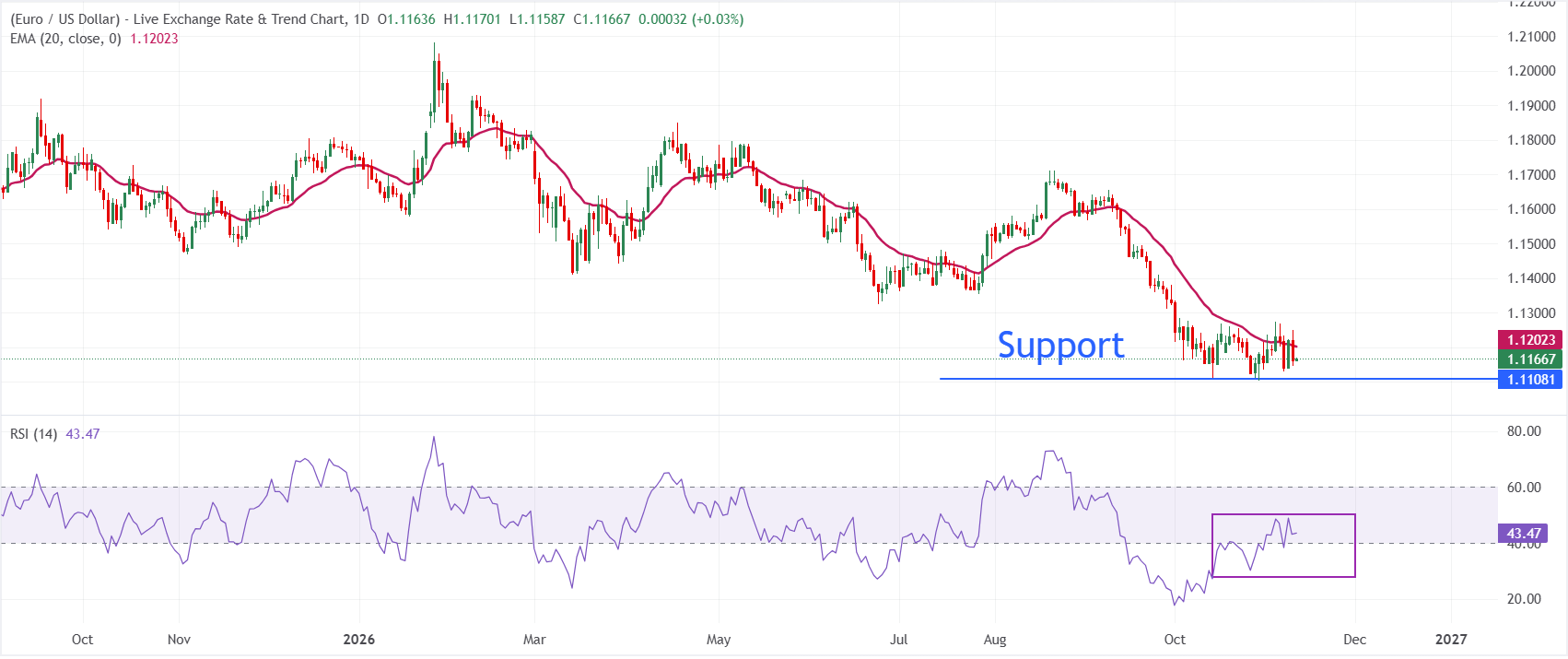
Trading at 1.1167 on the daily chart, EUR/USD retains a bearish short-term bias below its 20-day Exponential Moving Average (EMA) of 1.1202. Until the pair recovers this short-term trend indicator, pressure is likely to persist. Meanwhile, the Relative Strength Index (RSI) stands at 43, below its midline, suggesting modest downward momentum rather than outright oversold conditions.
A daily close above the 20-day EMA at 1.1202, the first clear resistance level, would be required to relieve immediate selling pressure and allow a more substantial recovery. On the downside, key support lies at the 17-month low of 1.1104. A breach of that level would leave the psychological 1.1000 mark exposed.
(The technical analysis of this story was written with the help of an AI tool. Know more.)
A 9/10 FXS Speechtracker score, compared with a historical average of 7.3/10, highlighted the markedly more hawkish tone of Fed Governor Waller’s remarks and his strong inclination towards further tightening. Waller explicitly left open a half-point December rate rise should core CPI come in at around 0.3% or above, while backing at least a quarter-point increase even if the data improve. That stance suggests a low threshold for further increases and a clear determination to raise real interest rates, with policy having “not been nearly as restrictive” as previously believed. His focus on widespread price pressures, continuing risks from producer and energy costs, and a still-firm labour market strengthens the case for upside risks to US yields. It also lends support to the Dollar through the prospect of diverging monetary policy.
An increase of 3.17 points took the FXS Fed Sentiment Index to 145.50, signalling a pronounced move further into hawkish territory that matches the high FXS Speechtracker reading. This leaves the index well above its neutral 100 level. Markets are therefore likely to assign greater odds to a December rate increase, and potentially a larger one, supporting the Dollar against lower-yielding currencies.










The information provided on this website is of a general nature only and does not constitute personal financial advice. Before acting on any information on this website, you should consider the suitability of the information in relation to your objectives, financial situation and needs. Investing in CFDs and FX Margin Contracts carries significant risks and is not suitable for all investors. You may lose more than your initial deposit. You do not own, or have, any interest in the underlying asset. We recommend that you seek independent advice and ensure you fully understand the risks involved before trading. It is important that you read and consider the disclosure document before you acquire any product listed on the website. The information and advertisements offered on this website are not intended for use by any person in any country or jurisdiction where such use would be contrary to local laws and regulations. The Products and Services offered on this website are not intended for residents of the United States, Malaysia and Thailand.
TMGM is authorized and regulated in various jurisdictions.
Trademax Australia Limited, trading as TMGM, is regulated by the Australian Securities and Investments Commission (ASIC), AFSL no. 436416 and is located at Level 28, One International Tower, 100 Barangaroo Avenue, 2000 Sydney, NSW Australia.
Email: support@tmgm.com.au
Trademax Global Limited, trading as TMGM, is authorized and regulated by the Vanuatu Financial Services Commission (VFSC), registration number 40356 and registered at 1276, Kumul Highway, Port Vila, Vanuatu, Republic of Vanuatu.
Email: support@tmgm.com
Trademax Global Markets (SE) Limited, trading as TMGM, is authorized and regulated by the Financial Services Authority (FSA) of Seychelles, with license number SD224. The company is registered at Office No 13, Providence Estate ABIS Centre, Mahe, Seychelles.
Email: support@tmgm.com
Trademax Global Markets (International) Pty Ltd, trading as TMGM, is authorized and regulated by the Financial Services Commission, Mauritius (FSC) with license no. GB22201012, and registered at 33, Edith Cavell Street C/o IQ EQ Fund Services (Mauritius) Ltd Port Louis, 11324 Mauritius.
Email: support@tmgm.com
Copyright © TMGM. All rights reserved


