




Indian Rupee starts the week with a bang on US-Iran peace 2.0
- The Indian Rupee starts the week on a strong note against the US Dollar due to multiple tailwinds.
- US President Trump halts attacks on Iran as it agrees to the nuclear deal and the Hormuz reopening.
- Investors await the RBI’s policy, which will be announced on Wednesday.
The Indian Rupee (INR) opens strongly against the US Dollar (USD) at the start of the week. The USD/INR extends its losing streak for the third trading day, is down 0.25% to near 95.15, the lowest level seen in over three weeks.
The Indian currency is strengthening as the announcement of a ceasefire between the United States (US) and Iran after renewed hostilities in the Middle East in July has pushed oil prices sharply lower.
In the opening trade, the MCX Crude Oil contract expiring on August 19 trades over 6% lower to near Rs. 7,600.
Currencies from economies, such as India, which rely heavily on oil imports to meet their energy needs, tend to underperform in a high oil price environment.
US halts planned attacks on Iran
Over the weekend, US President Donald Trump announced that planned attacks on Iran have been suspended as the nation has agreed to the nuclear deal and the reopening of the Strait of Hormuz, a vital passage for almost 20% of the global energy supply.
“We have just been asked by Iran, and other Middle Eastern Countries, to hold off any attack in that the perimeters of a deal has been agreed to. This would include the Immediate, Complete, and Total OPENING OF THE HORMUZ STRAIT, and an end to Iran’s nuclear threat,” Trump wrote on Truth Social.
The renewed US-Iran peace hopes appear to have given a lifeline to Indian stock markets. At press time, the Nifty50 Index is up 0.7% at around 24,555.
RBI policy comes into the spotlight
On the domestic front, the major event for the Indian currency this week will be the Reserve Bank of India’s (RBI) monetary policy announcement on Wednesday.
Economists at ING expect the Reserve Bank of India to leave the policy stance unchanged at its upcoming meeting, stating that “we expect the Reserve Bank of India to keep the repo rate unchanged at 5.25% on Wednesday.” They acknowledge that “headline inflation surprised to the upside in June, largely due to higher fuel prices,” but stress that “underlying price pressures remain contained.” In their view, “core inflation continues to run below the RBI's target, providing policymakers with sufficient room to keep policy rates unchanged while monitoring evolving risks to the inflation outlook.”
US Dollar is under pressure despite hawkish Fed bets
The US Dollar Index (DXY) continues last week’s underperformance, trading 0.1% lower at around 99.70 in the Asian session. The Greenback faces pressure even as traders are confident that the Federal Reserve (Fed) will deliver an interest rate hike at the September policy meeting.
According to the CME FedWatch tool, the odds of the Fed hiking interest rates next month are 67.7%.
This week, investors will focus on a slew of US economic data, especially the US Nonfarm Payrolls (NFP) data for July, which will be released on Friday. Later in the day, investors will focus on the US ISM Manufacturing PMI data for July. The Manufacturing PMI is expected to arrive at 54.0, up from 53.3 in June.
Technical Analysis: USD/INR moves far from 20-day EMA on the downside
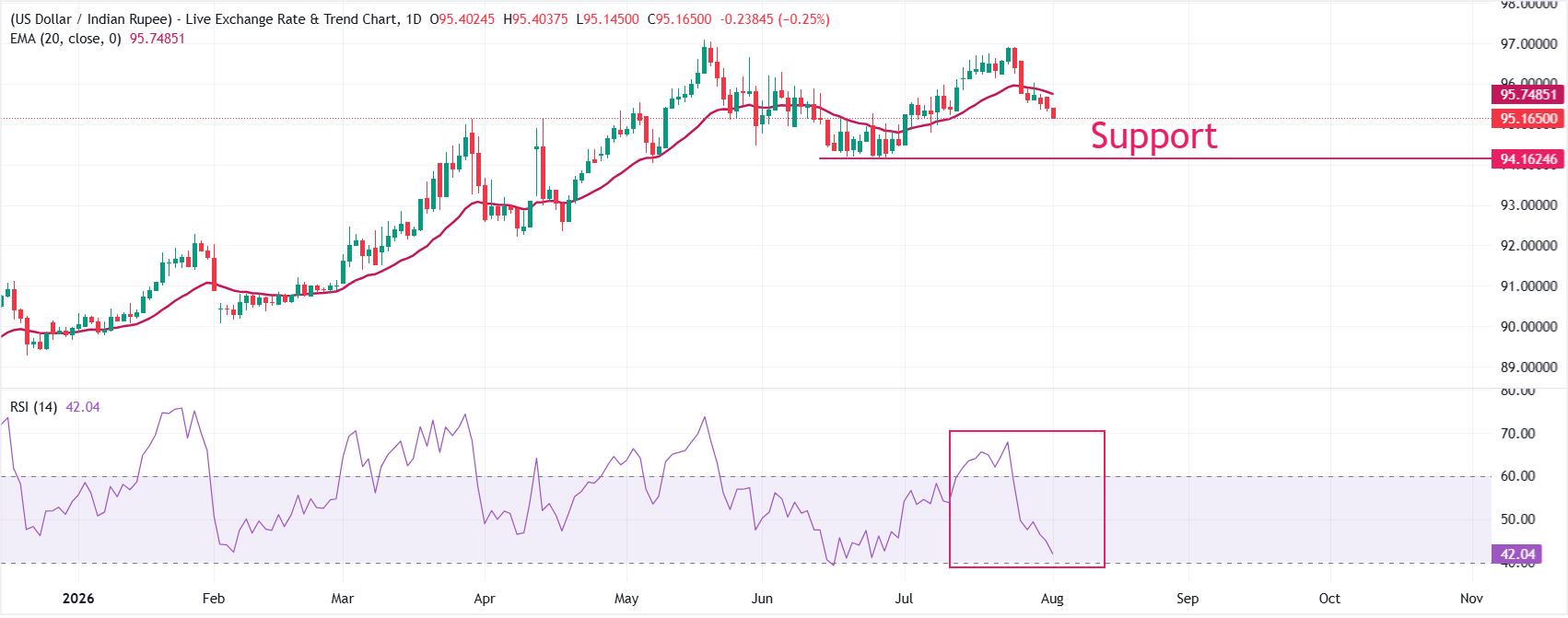
USD/INR trades lower at 95.15, keeping a bearish near-term tone as it holds below the 20-day exponential moving average (EMA) at 95.75. The EMA overhead suggests rallies remain capped for now, while the Relative Strength Index (RSI) at 42 stays below the neutral 50 line, hinting at lingering downside pressure rather than a decisive oversold condition.
On the topside, initial resistance is defined by the 20-day EMA clustered near 95.75, and a daily close above this barrier would be needed to ease the current bearish bias and open the way for a stronger recovery. On the downside, the July 7 low at 94.78 is the key support level, followed by the June 26 low at 94.15.
(The technical analysis of this story was written with the help of an AI tool. Know more.)
Indian Rupee FAQs
The Indian Rupee (INR) is one of the most sensitive currencies to external factors. The price of Crude Oil (the country is highly dependent on imported Oil), the value of the US Dollar – most trade is conducted in USD – and the level of foreign investment, are all influential. Direct intervention by the Reserve Bank of India (RBI) in FX markets to keep the exchange rate stable, as well as the level of interest rates set by the RBI, are further major influencing factors on the Rupee.
The Reserve Bank of India (RBI) actively intervenes in forex markets to maintain a stable exchange rate, to help facilitate trade. In addition, the RBI tries to maintain the inflation rate at its 4% target by adjusting interest rates. Higher interest rates usually strengthen the Rupee. This is due to the role of the ‘carry trade’ in which investors borrow in countries with lower interest rates so as to place their money in countries’ offering relatively higher interest rates and profit from the difference.
Macroeconomic factors that influence the value of the Rupee include inflation, interest rates, the economic growth rate (GDP), the balance of trade, and inflows from foreign investment. A higher growth rate can lead to more overseas investment, pushing up demand for the Rupee. A less negative balance of trade will eventually lead to a stronger Rupee. Higher interest rates, especially real rates (interest rates less inflation) are also positive for the Rupee. A risk-on environment can lead to greater inflows of Foreign Direct and Indirect Investment (FDI and FII), which also benefit the Rupee.
Higher inflation, particularly, if it is comparatively higher than India’s peers, is generally negative for the currency as it reflects devaluation through oversupply. Inflation also increases the cost of exports, leading to more Rupees being sold to purchase foreign imports, which is Rupee-negative. At the same time, higher inflation usually leads to the Reserve Bank of India (RBI) raising interest rates and this can be positive for the Rupee, due to increased demand from international investors. The opposite effect is true of lower inflation.










