
News & AnalysisCareer

At around 0.5620 in Monday’s European session, the New Zealand Dollar (NZD) is trading lower against the US Dollar (USD). A partial recovery in the US Dollar from its earlier losses is weighing on the Kiwi pair, although the US currency itself remains under pressure before Tuesday’s United States (US) midterm elections.

Today’s percentage moves in the New Zealand Dollar (NZD) against the major currencies listed are set out below. Its weakest performance was against the Swiss Franc.
| USD | EUR | GBP | JPY | CAD | AUD | NZD | CHF | |
|---|---|---|---|---|---|---|---|---|
| USD | -0.44% | -0.18% | 0.25% | 0.02% | 0.33% | 0.15% | -0.60% | |
| EUR | 0.44% | 0.27% | 0.67% | 0.45% | 0.77% | 0.59% | -0.13% | |
| GBP | 0.18% | -0.27% | 0.45% | 0.19% | 0.50% | 0.33% | -0.39% | |
| JPY | -0.25% | -0.67% | -0.45% | -0.22% | 0.08% | -0.11% | -0.84% | |
| CAD | -0.02% | -0.45% | -0.19% | 0.22% | 0.32% | 0.12% | -0.58% | |
| AUD | -0.33% | -0.77% | -0.50% | -0.08% | -0.32% | -0.18% | -0.90% | |
| NZD | -0.15% | -0.59% | -0.33% | 0.11% | -0.12% | 0.18% | -0.71% | |
| CHF | 0.60% | 0.13% | 0.39% | 0.84% | 0.58% | 0.90% | 0.71% |
To read the heat map of percentage movements between major currencies, select the base currency in the left-hand column and the quote currency in the top row. Selecting the New Zealand Dollar on the left and following that row across to the US Dollar, for instance, gives the percentage change for NZD (base)/USD (quote).
Despite rebounding from an intraday low of 101.43, the US Dollar Index (DXY) remains 0.3% lower at around 101.70 at the time of writing. The index measures the Greenback against six major currencies.
Betting markets now assign the Democrats a “70-72% chance of taking both the House and the Senate.” Citing those odds, ING’s Chris Turner identifies the US midterm elections as this week’s principal event risk for FX. In his view, “one could make the case that the Dollar should come lower on such an outcome,” since a clean sweep by the Democrats would probably “lead to gridlock on the debt ceiling, a prolonged government shutdown next year and could encourage President Trump to pursue an even more activist foreign policy agenda.” Turner suggests that investors will balance those political risks against factors that continue to support the Dollar and DXY around the 102.00 area: robust US growth, inflation above target and continued Fed tightening.
Due at 15:00 GMT later in the day, October’s US ISM Manufacturing PMI figures will be the next focus for investors.
Wednesday brings New Zealand’s (NZ) Q3 labour market figures, which investors are awaiting. The unemployment rate is forecast to decline from the previous 5.6% reading to 5.5%.
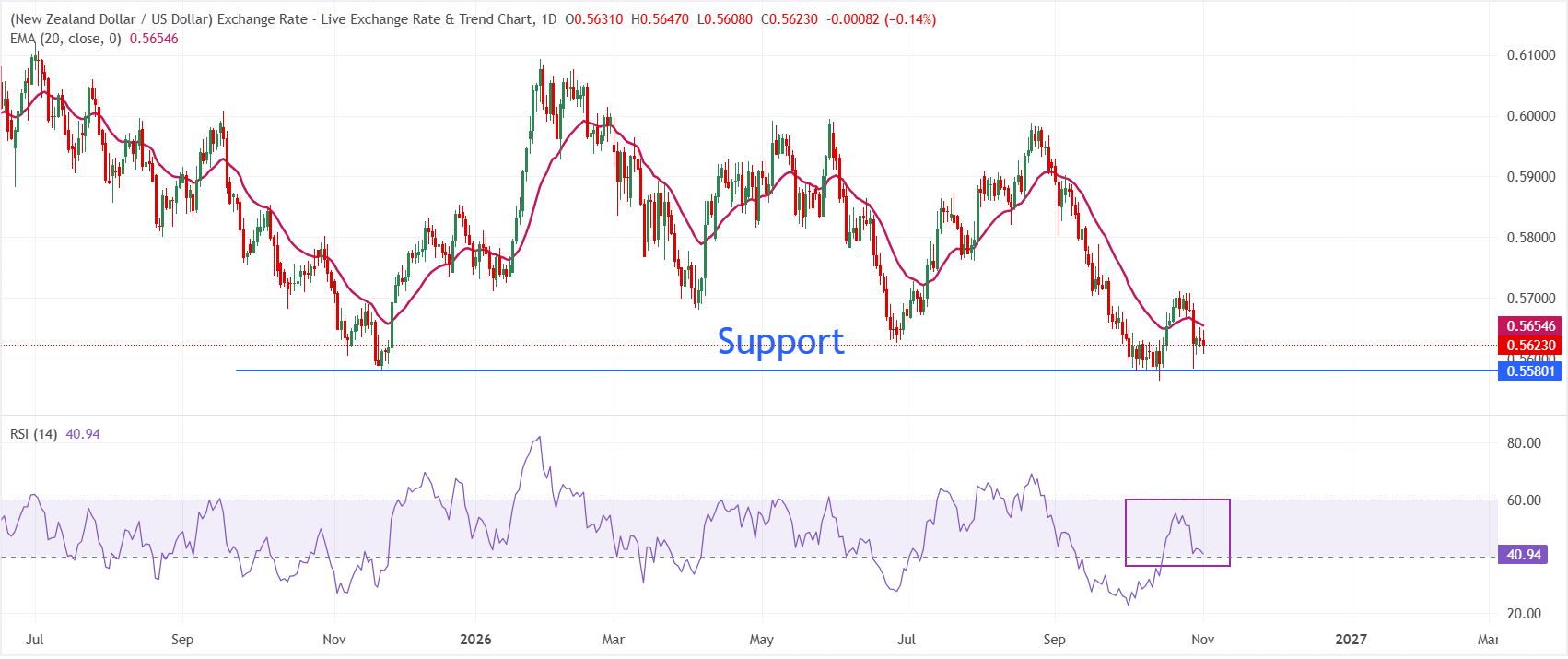
Trading at 0.5623 on the daily chart, NZD/USD remains below its 20-day Exponential Moving Average (EMA) of 0.5655, leaving the near-term outlook bearish. Having failed to hold on to its short-lived mid-October recovery, the pair has continued to edge down. Price action beneath the short-term EMA points to sustained selling pressure.
At roughly 41, the 14-day Relative Strength Index (RSI) is still beneath the neutral 50 threshold. That reading indicates limited upward momentum rather than outright oversold conditions.
A daily close above the 20-day EMA, the immediate resistance near 0.5655, would be required to temper the prevailing bearish bias and allow a more substantial corrective rebound. On the downside, the 14 October low of 0.5564 provides crucial support. A break below that level could mark the start of another leg lower.
(The technical analysis of this story was written with the help of an AI tool. Know more.)
Published by Statistics New Zealand, the unemployment rate expresses unemployed workers as a percentage of the total civilian labour force. A rise signals a lack of growth in New Zealand’s labour market and weakness in its economy. A lower reading is generally regarded as bullish for the New Zealand Dollar (NZD); a higher figure is considered bearish.
Find out more.Forthcoming release: Tue 03 Nov 2026 21:45
Publication frequency: Every quarter
Consensus forecast: 5.5%
Previous reading: 5.6%
Data source: Stats NZ
Quarterly employment figures published by Statistics New Zealand provide insight into the country’s labour market. They cover employment and unemployment rates, demand for labour, and movements in wages and salaries. Through their influence on inflation and the Reserve Bank of New Zealand’s (RBNZ) interest rate decision, these indicators tend to affect the NZD. A stronger-than-expected reading could therefore support the currency.










The information provided on this website is of a general nature only and does not constitute personal financial advice. Before acting on any information on this website, you should consider the suitability of the information in relation to your objectives, financial situation and needs. Investing in CFDs and FX Margin Contracts carries significant risks and is not suitable for all investors. You may lose more than your initial deposit. You do not own, or have, any interest in the underlying asset. We recommend that you seek independent advice and ensure you fully understand the risks involved before trading. It is important that you read and consider the disclosure document before you acquire any product listed on the website. The information and advertisements offered on this website are not intended for use by any person in any country or jurisdiction where such use would be contrary to local laws and regulations. The Products and Services offered on this website are not intended for residents of the United States, Malaysia and Thailand.
TMGM is authorized and regulated in various jurisdictions.
Trademax Australia Limited, trading as TMGM, is regulated by the Australian Securities and Investments Commission (ASIC), AFSL no. 436416 and is located at Level 28, One International Tower, 100 Barangaroo Avenue, 2000 Sydney, NSW Australia.
Email: support@tmgm.com.au
Trademax Global Limited, trading as TMGM, is authorized and regulated by the Vanuatu Financial Services Commission (VFSC), registration number 40356 and registered at 1276, Kumul Highway, Port Vila, Vanuatu, Republic of Vanuatu.
Email: support@tmgm.com
Trademax Global Markets (SE) Limited, trading as TMGM, is authorized and regulated by the Financial Services Authority (FSA) of Seychelles, with license number SD224. The company is registered at Office No 13, Providence Estate ABIS Centre, Mahe, Seychelles.
Email: support@tmgm.com
Trademax Global Markets (International) Pty Ltd, trading as TMGM, is authorized and regulated by the Financial Services Commission, Mauritius (FSC) with license no. GB22201012, and registered at 33, Edith Cavell Street C/o IQ EQ Fund Services (Mauritius) Ltd Port Louis, 11324 Mauritius.
Email: support@tmgm.com
Copyright © TMGM. All rights reserved


