
News & AnalysisCareer

At around 0.7010 at the time of writing, AUD/USD is down 0.33% on Monday and close to one-week lows, with the Australian Dollar (AUD) lagging all its major counterparts. The pressure on the Aussie, despite a weaker US Dollar (USD), likely reflects traders reducing exposure ahead of Tuesday’s monetary policy announcement from the Reserve Bank of Australia (RBA).
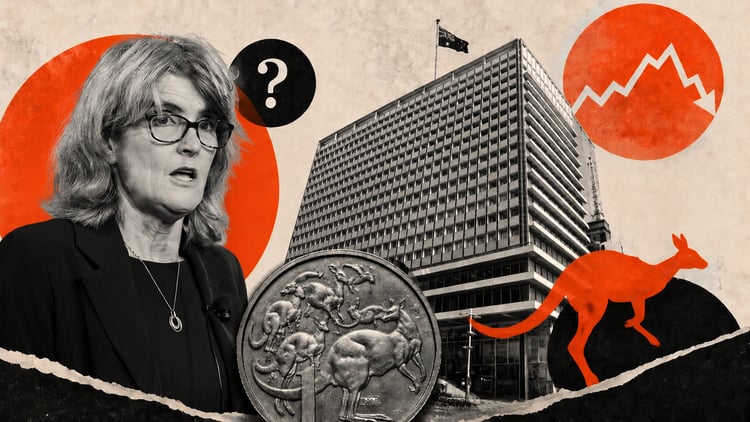
September’s headline CPI rose to 4.3% YoY from 4.0% in August, leaving inflation above the central bank’s 2%-3% target range. Annual trimmed mean inflation increased as well, reaching 3.6% from a revised 3.5%. Against that backdrop, the RBA is widely expected to deliver a 25 basis point (bps) interest rate rise, its fifth this year, lifting the cash rate to 4.85%, the highest since 2008.
According to Rabobank’s FX strategists, “there is risk of subsequent rate hikes, depending on the trajectory of the oil price after the US mid-term elections,” while the recent “lacklustre tone of the AUD” highlights market anxiety that Governor Bullock could voice greater concern about “the health of the real economy.” Their assessment is that “simply put, expectations for further RBA policy tightening are likely to strengthen if Bullock focuses her commentary tomorrow on inflation risks and are likely to fall if, like the RBNZ, she instead focuses on economic headwinds.”
In China, the RatingDog Manufacturing Purchasing Managers’ Index (PMI) slipped from 52.1 to 52.0 in October, still exceeding the 51.6 forecast. Conditions in Australia’s key trading partner were mixed: factory output expanded at its quickest pace in six months, but growth in export orders moderated and business confidence dropped to a nine-month low.
Following an Axios report that US President Donald Trump favours allowing more time for diplomacy with Iran, oil prices dropped more than 4% on Monday. According to ISNA, Iranian President Masoud Pezeshkian also said that the Supreme Leader had given the government certain powers over negotiations. These developments come after last week’s Wall Street Journal report that Washington had told Gulf states to prepare for possible military action against Iran following the US midterm elections.
Despite a hawkish outlook for the Federal Reserve (Fed), caution ahead of Tuesday’s US midterm elections continues to weigh on the US Dollar. The recent AI-led sell-off in technology shares has boosted demand for government bonds, with lower Treasury yields adding to the pressure on the Greenback. Trading around 101.65 and close to one-week lows, the US Dollar Index (DXY) measures the Greenback against a basket of six major currencies.
After the Fed left rates unchanged at 3.75%-4.00% last week, attention turns to US economic releases for indications of its next policy move. Later on Monday, the ISM Manufacturing PMI is due, ahead of Tuesday’s JOLTS Job Openings. ADP Employment Change and the ISM Services PMI follow on Wednesday, before Friday’s Nonfarm Payrolls (NFP) report closes the week.
Today’s percentage movements in the Australian Dollar (AUD) against the major currencies listed are set out below. Its strongest performance was against the Japanese Yen.
| USD | EUR | GBP | JPY | CAD | AUD | NZD | CHF | |
|---|---|---|---|---|---|---|---|---|
| USD | -0.58% | -0.23% | 0.13% | 0.08% | 0.36% | 0.06% | -0.72% | |
| EUR | 0.58% | 0.36% | 0.73% | 0.66% | 0.94% | 0.66% | -0.11% | |
| GBP | 0.23% | -0.36% | 0.40% | 0.31% | 0.58% | 0.30% | -0.46% | |
| JPY | -0.13% | -0.73% | -0.40% | -0.05% | 0.21% | -0.07% | -0.86% | |
| CAD | -0.08% | -0.66% | -0.31% | 0.05% | 0.28% | -0.02% | -0.77% | |
| AUD | -0.36% | -0.94% | -0.58% | -0.21% | -0.28% | -0.27% | -1.05% | |
| NZD | -0.06% | -0.66% | -0.30% | 0.07% | 0.02% | 0.27% | -0.76% | |
| CHF | 0.72% | 0.11% | 0.46% | 0.86% | 0.77% | 1.05% | 0.76% |
Percentage movements between the major currencies are displayed in the heat map. Select the base currency in the left-hand column and the quote currency in the top row. For instance, choosing the Australian Dollar on the left and following its row across to the US Dollar gives the percentage change for AUD (base)/USD (quote) in the intersecting cell.










The information provided on this website is of a general nature only and does not constitute personal financial advice. Before acting on any information on this website, you should consider the suitability of the information in relation to your objectives, financial situation and needs. Investing in CFDs and FX Margin Contracts carries significant risks and is not suitable for all investors. You may lose more than your initial deposit. You do not own, or have, any interest in the underlying asset. We recommend that you seek independent advice and ensure you fully understand the risks involved before trading. It is important that you read and consider the disclosure document before you acquire any product listed on the website. The information and advertisements offered on this website are not intended for use by any person in any country or jurisdiction where such use would be contrary to local laws and regulations. The Products and Services offered on this website are not intended for residents of the United States, Malaysia and Thailand.
TMGM is authorized and regulated in various jurisdictions.
Trademax Australia Limited, trading as TMGM, is regulated by the Australian Securities and Investments Commission (ASIC), AFSL no. 436416 and is located at Level 28, One International Tower, 100 Barangaroo Avenue, 2000 Sydney, NSW Australia.
Email: support@tmgm.com.au
Trademax Global Limited, trading as TMGM, is authorized and regulated by the Vanuatu Financial Services Commission (VFSC), registration number 40356 and registered at 1276, Kumul Highway, Port Vila, Vanuatu, Republic of Vanuatu.
Email: support@tmgm.com
Trademax Global Markets (SE) Limited, trading as TMGM, is authorized and regulated by the Financial Services Authority (FSA) of Seychelles, with license number SD224. The company is registered at Office No 13, Providence Estate ABIS Centre, Mahe, Seychelles.
Email: support@tmgm.com
Trademax Global Markets (International) Pty Ltd, trading as TMGM, is authorized and regulated by the Financial Services Commission, Mauritius (FSC) with license no. GB22201012, and registered at 33, Edith Cavell Street C/o IQ EQ Fund Services (Mauritius) Ltd Port Louis, 11324 Mauritius.
Email: support@tmgm.com
Copyright © TMGM. All rights reserved


