
News & AnalysisCareer

Just above $0.94, XRP is gathering modest recovery momentum, although the $1.00 level continues to limit gains.
Weekly outflows from XRP spot ETFs reach $11 million, while intensifying derivatives selling leaves open interest at 1.87B XRP.
Gradual improvements in the MACD and RSI indicators support XRP’s limited rebound.
At $0.94 on Monday, Ripple (XRP) is trading higher as buyers tentatively return to the wider cryptocurrency market. The token has risen from last week’s lows near $0.86, but remains confined by short-term support at $0.90 and supply at $1.00.

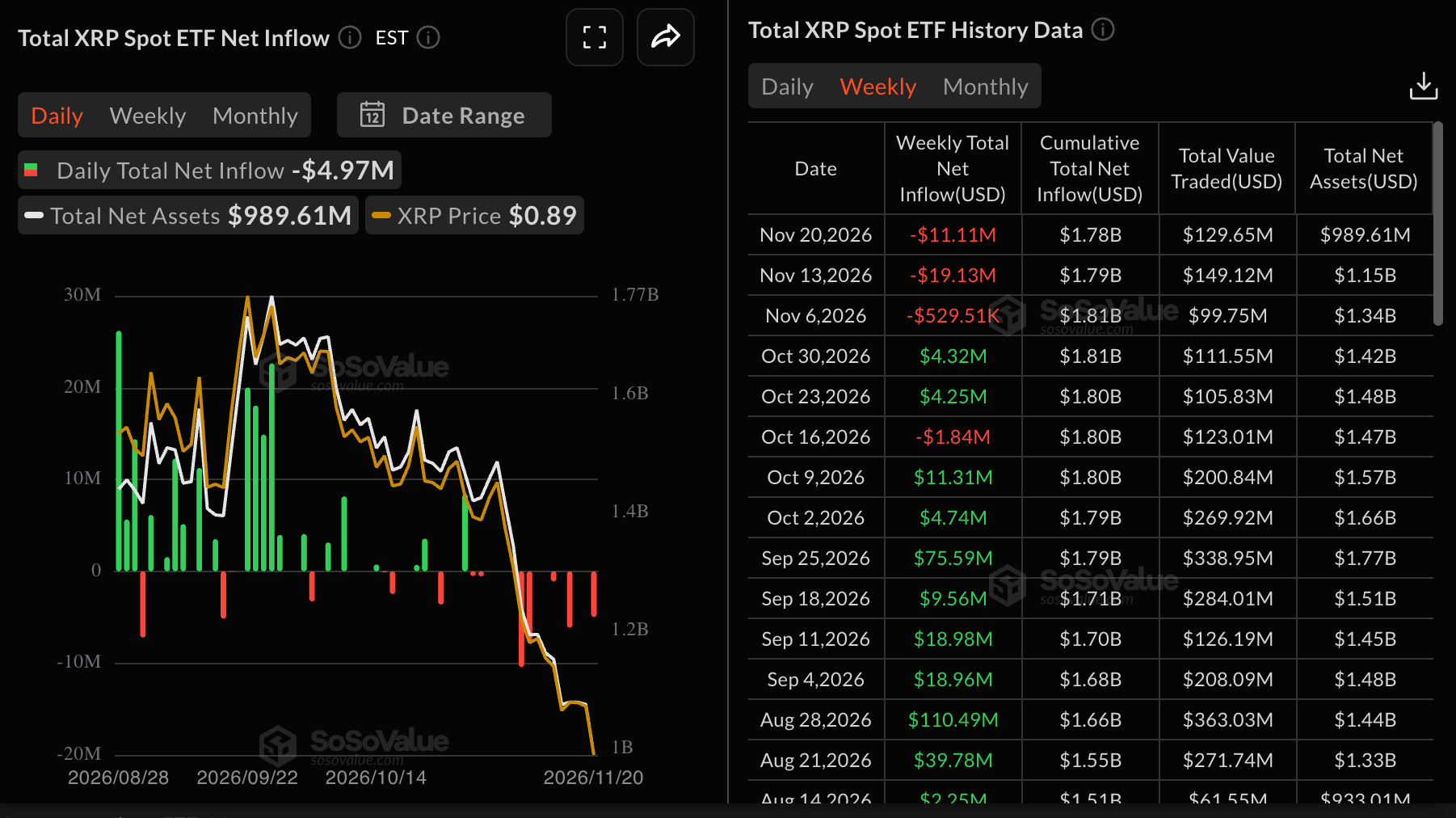
Roughly $11 million was withdrawn from XRP spot exchange-traded funds (ETFs) in the week to Friday, extending the run of weekly outflows to three. The withdrawals reflect a continuing departure of institutional traders.
Similar pressures are affecting other spot ETFs: Bitcoin recorded outflows of $1.8 billion, while Ethereum lost $314 billion. Even so, XRP remains markedly undersubscribed relative to both. According to SoSoValue, cumulative inflows into XRP ETFs total $1.8 billion, with net assets under management of less than $1 billion.
By comparison, inflows into Bitcoin ETFs stand at $53 billion, alongside net assets of $71 million. For Ethereum ETFs, inflows total $11 billion and net assets under management amount to $8.6 billion.
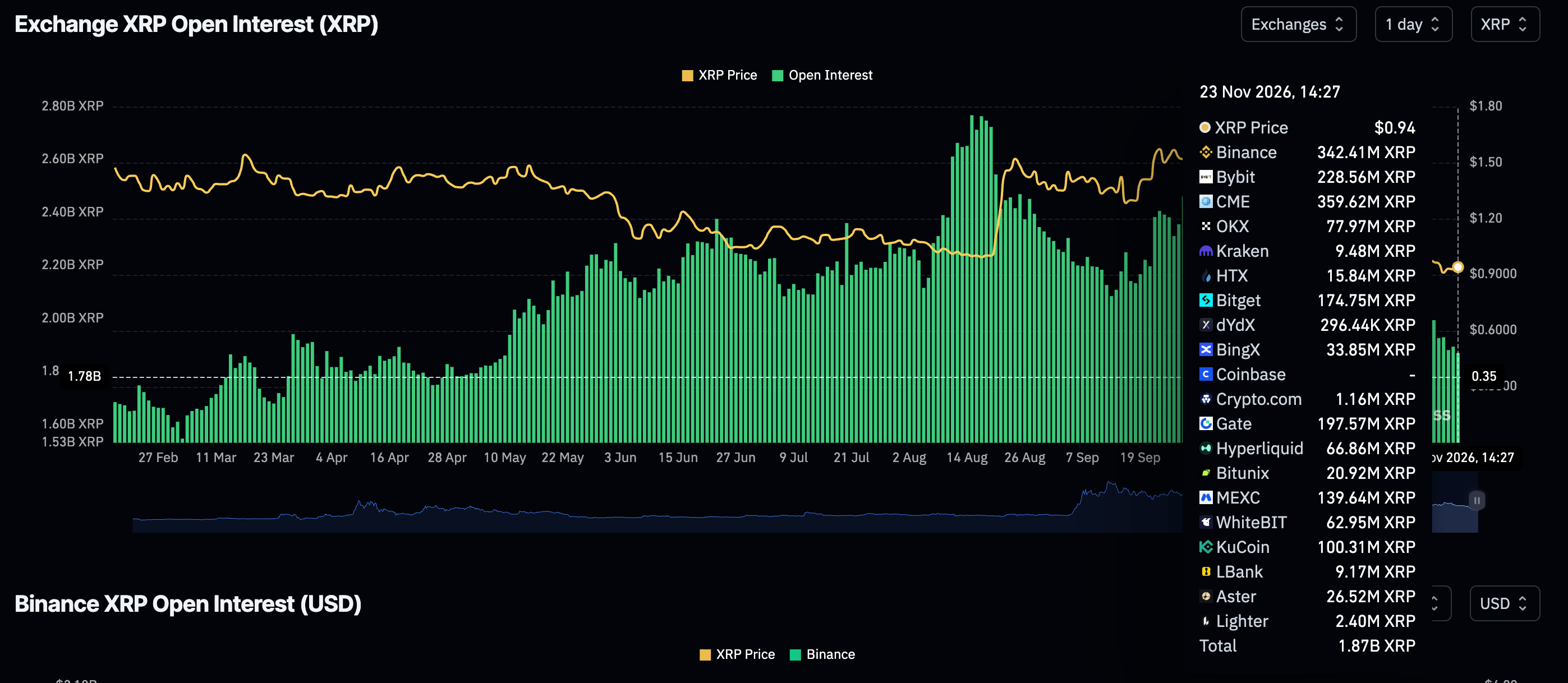
Selling pressure is also building in derivatives as traders adjust their positions after the sell-off of recent weeks. On Monday, perpetual futures open interest (OI) stands at 1.87 billion XRP, compared with 1.88 billion XRP a day earlier. The broader decline from 2.36 billion on 8 November amounts to 21% and is undermining retail demand. Should the trend persist, the downside is likely to remain the path of least resistance, increasing the likelihood of a prolonged correction in XRP’s price.
With XRP trading at $0.94, the near-term outlook remains bearish: the token is still well below its key exponential moving averages (EMAs). Overhead resistance is layered at the 50-day EMA of $1.16, the 100-day EMA of $1.23 and the 200-day EMA of $1.30. These dynamic barriers reinforce the wider downtrend, marked by a descending resistance trendline extending through the $1.19 area.
Momentum has improved, with the Moving Average Convergence Divergence (MACD) edging into positive territory and the Relative Strength Index (RSI) recovering from oversold levels towards 31. For now, however, those changes suggest only consolidation in a market where the upside remains constrained.
The SuperTrend level near $1.09 provides the first resistance, followed by potential supply around the 50-day EMA at $1.16. Clearing that area would bring the descending trendline barrier and the $1.19 region into focus, before the 100-day EMA at $1.23 and the longer-term 200-day EMA around $1.30. The indicators provided do not identify clear support. Against that backdrop, rebounds towards these clusters of overhead resistance are likely to encounter selling unless XRP regains and sustains a position above the mid-$1.10s.
(The technical analysis of this story was written with the help of an AI tool. Know more.)
Investors use an exchange-traded fund (ETF), an investment vehicle or index, to gain exposure to an underlying asset by tracking its price. A fund can follow a single asset, several assets or sectors. A Bitcoin ETF, for instance, tracks the price of Bitcoin.
Yes. In October 2021, the US Securities & Exchange Commission approved the first US Bitcoin futures ETF. Seven Bitcoin futures ETFs have received approval in total, while more than 20 are still awaiting the regulator’s permission. According to the SEC, the cryptocurrency industry is new and vulnerable to manipulation, prompting it to delay crypto-related futures ETFs over the past few years.
Yes. Several Bitcoin spot exchange-traded funds received SEC approval for listing and trading in January 2024. The move enabled institutional capital and mainstream investors to trade the leading cryptocurrency, and the industry welcomed the decision as a game changer.
Exposure to a cryptocurrency without owning it is the chief benefit of crypto ETFs, lowering the risks and costs of holding the asset directly. They also require less learning and offer investors greater security, as the funds are responsible for safeguarding the underlying holdings. The principal drawback is the absence of direct ownership, summed up by the crypto expression “not your keys, not your coins.” Fees for active management are another disadvantage, adding to the costs associated with holding crypto. Finally, although ETFs reduce the risks of holding an asset, movements in the underlying cryptocurrency’s price are likely to feed through to the investment vehicle as well.










The information provided on this website is of a general nature only and does not constitute personal financial advice. Before acting on any information on this website, you should consider the suitability of the information in relation to your objectives, financial situation and needs. Investing in CFDs and FX Margin Contracts carries significant risks and is not suitable for all investors. You may lose more than your initial deposit. You do not own, or have, any interest in the underlying asset. We recommend that you seek independent advice and ensure you fully understand the risks involved before trading. It is important that you read and consider the disclosure document before you acquire any product listed on the website. The information and advertisements offered on this website are not intended for use by any person in any country or jurisdiction where such use would be contrary to local laws and regulations. The Products and Services offered on this website are not intended for residents of the United States, Malaysia and Thailand.
TMGM is authorized and regulated in various jurisdictions.
Trademax Australia Limited, trading as TMGM, is regulated by the Australian Securities and Investments Commission (ASIC), AFSL no. 436416 and is located at Level 28, One International Tower, 100 Barangaroo Avenue, 2000 Sydney, NSW Australia.
Email: support@tmgm.com.au
Trademax Global Limited, trading as TMGM, is authorized and regulated by the Vanuatu Financial Services Commission (VFSC), registration number 40356 and registered at 1276, Kumul Highway, Port Vila, Vanuatu, Republic of Vanuatu.
Email: support@tmgm.com
Trademax Global Markets (SE) Limited, trading as TMGM, is authorized and regulated by the Financial Services Authority (FSA) of Seychelles, with license number SD224. The company is registered at Office No 13, Providence Estate ABIS Centre, Mahe, Seychelles.
Email: support@tmgm.com
Trademax Global Markets (International) Pty Ltd, trading as TMGM, is authorized and regulated by the Financial Services Commission, Mauritius (FSC) with license no. GB22201012, and registered at 33, Edith Cavell Street C/o IQ EQ Fund Services (Mauritius) Ltd Port Louis, 11324 Mauritius.
Email: support@tmgm.com
Copyright © TMGM. All rights reserved


