
News & AnalysisCareer

October’s United States (US) Consumer Price Index (CPI) figures exceeded forecasts, driving US Treasury yields sharply higher and intensifying debate over whether the Federal Reserve (Fed) could deliver an outsized interest rate increase at its December policy meeting. Despite this backdrop, Silver (XAG/USD) has gained almost 3% to trade near $53.00 in Wednesday’s European session.

The latest sell-off in bonds was chiefly triggered by the inflation release, according to Deutsche Bank strategists, who observe that “that US CPI print drove the biggest moves of the day, with the monthly core CPI print for October above consensus at +0.30% (vs. +0.2% expected).”
Highlighting the persistence of price pressures, Deutsche Bank adds that “moreover, it was the third consecutive month with core CPI at +0.3%, and if you take those three months together, the annualised pace for core CPI is running at +3.75%.” The bank concludes that “that’s the fastest pace on that measure since April 2024, so it made it increasingly difficult to dismiss this as a blip.”
Headline inflation was stronger still, the bank notes: “meanwhile, the headline CPI numbers were faster still, with monthly headline CPI at +0.35% (vs. +0.3% expected), with the 3-month annualised pace at +5.72%.” Assessing the market response, its strategists say that “for markets, the clearest impact could be seen in US Treasuries, with yields surging across the curve.”
At the time of writing, the yield on 10-year US Treasuries stands at around 5%, up 2.4%. Higher returns on interest-bearing US assets reduce the relative attraction of non-yielding holdings such as Silver.
Price pressures in the US remain uncomfortably strong, Commerzbank economists warn, noting that “prices are still rising too quickly, even though the increase was somewhat smaller than in September.” Their assessment is that underlying inflation has stopped improving rather than continued to ease: “core inflation, a key gauge of the underlying trend, thus remains (too) high and is no longer trending downward,” they say. Looking ahead, they argue that “the strong economy and the ongoing conflict in the Middle East suggest that inflation is unlikely to ease in the near term,” adding that “inflation is not expected to decline until 2027, and even then, it is likely to remain above a level consistent with price stability.”
Silver prices are likely to remain under pressure if that scenario materialises.
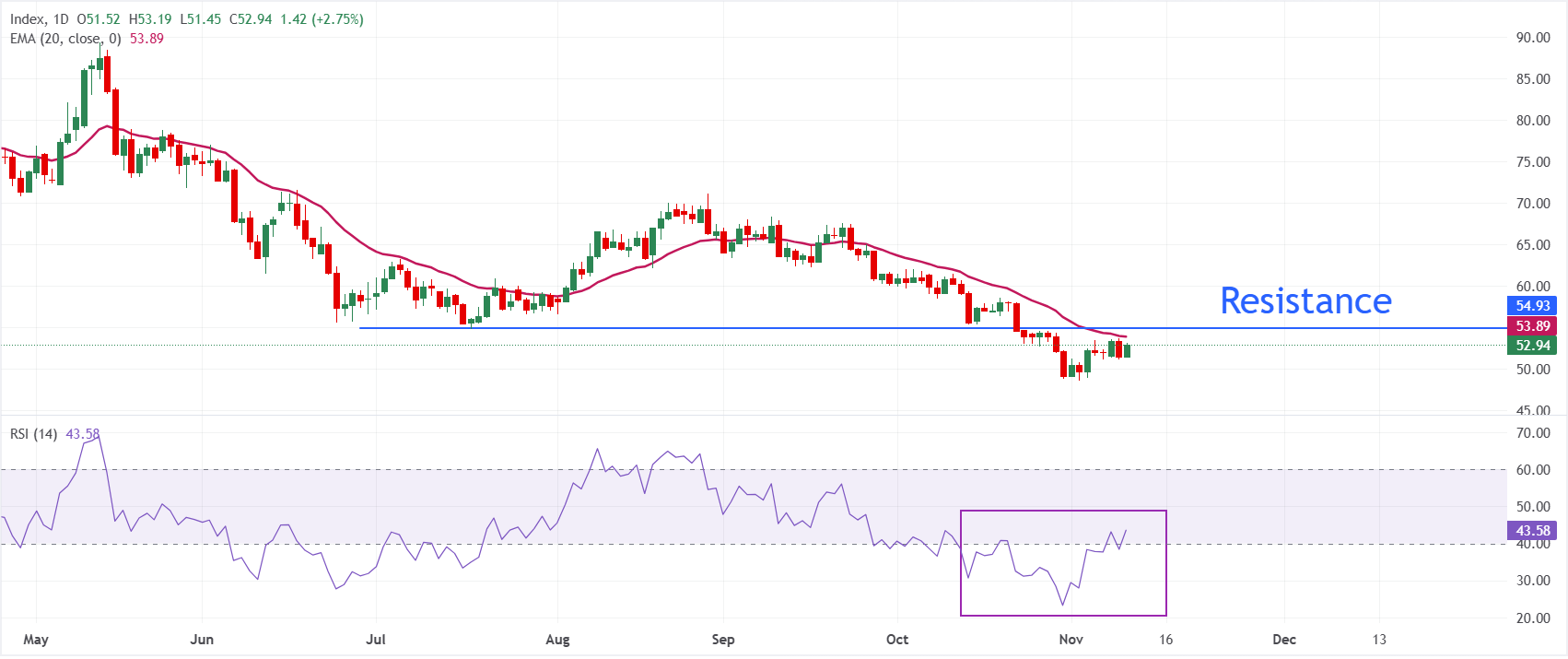
Trading at $52.94 on the daily chart, XAG/USD remains beneath its 20-day Exponential Moving Average (EMA) of $53.89. Recent efforts to stabilise have yet to overcome this dynamic resistance, leaving the near-term outlook bearish. Although the Relative Strength Index (RSI) has rebounded from oversold territory to 43.6, it is still below the 50 threshold. This points to a modest reduction in downward momentum, rather than confirmation of a change in trend.
A sustained move through the 20-day EMA at $53.89, the first resistance on the upside, would be required to temper the prevailing bearish bias and pave the way for a more substantial recovery. The supplied indicators identify no clear structural support nearby. Consequently, trading below the EMA leaves XAG/USD vulnerable to additional losses should sellers renew pressure beneath recent lows.
(The technical analysis of this story was written with the help of an AI tool. Know more.)
Widely traded by investors, Silver is a precious metal with a long history as both a store of value and a means of exchange. Gold attracts greater interest, but traders may choose Silver for its intrinsic value, to diversify their portfolios or as a possible hedge against periods of high inflation. Exposure can be obtained by purchasing physical Silver coins or bars, or by trading instruments such as Exchange Traded Funds that follow its price in international markets.
A broad set of influences can drive Silver prices. Its safe-haven characteristics mean geopolitical unrest or concerns about a severe recession can lift its price, though generally less strongly than Gold’s. Lower interest rates also tend to support Silver because it pays no yield. With the metal quoted in US Dollars (USD) as XAG/USD, movements in the currency matter too: Dollar strength tends to restrain Silver prices, while a weaker Dollar is likely to lift them. Investment demand, mine output and recycling rates are further influences on pricing; Silver is considerably more abundant than Gold.
Among metals, Silver has one of the highest levels of electrical conductivity, exceeding both Copper and Gold, which makes it widely used in industrial applications, notably electronics and solar energy. Stronger demand can push prices higher, whereas weaker demand tends to pull them lower. Developments in the US, Chinese and Indian economies can also generate price fluctuations. Large industrial sectors in the US and, especially, China employ Silver in a range of processes, while Indian consumers’ demand for Silver jewellery is another important influence on prices.
Gold’s price movements are generally mirrored by Silver: a rise in Gold typically brings a corresponding increase in Silver, reflecting their similar safe-haven status. Relative valuations can be assessed using the Gold/Silver ratio, which measures how many ounces of Silver have the same value as one ounce of Gold. A high reading may be interpreted by some investors as a sign that Silver is undervalued or Gold overvalued. Conversely, a low reading could indicate that Gold is undervalued compared with Silver.










The information provided on this website is of a general nature only and does not constitute personal financial advice. Before acting on any information on this website, you should consider the suitability of the information in relation to your objectives, financial situation and needs. Investing in CFDs and FX Margin Contracts carries significant risks and is not suitable for all investors. You may lose more than your initial deposit. You do not own, or have, any interest in the underlying asset. We recommend that you seek independent advice and ensure you fully understand the risks involved before trading. It is important that you read and consider the disclosure document before you acquire any product listed on the website. The information and advertisements offered on this website are not intended for use by any person in any country or jurisdiction where such use would be contrary to local laws and regulations. The Products and Services offered on this website are not intended for residents of the United States, Malaysia and Thailand.
TMGM is authorized and regulated in various jurisdictions.
Trademax Australia Limited, trading as TMGM, is regulated by the Australian Securities and Investments Commission (ASIC), AFSL no. 436416 and is located at Level 28, One International Tower, 100 Barangaroo Avenue, 2000 Sydney, NSW Australia.
Email: support@tmgm.com.au
Trademax Global Limited, trading as TMGM, is authorized and regulated by the Vanuatu Financial Services Commission (VFSC), registration number 40356 and registered at 1276, Kumul Highway, Port Vila, Vanuatu, Republic of Vanuatu.
Email: support@tmgm.com
Trademax Global Markets (SE) Limited, trading as TMGM, is authorized and regulated by the Financial Services Authority (FSA) of Seychelles, with license number SD224. The company is registered at Office No 13, Providence Estate ABIS Centre, Mahe, Seychelles.
Email: support@tmgm.com
Trademax Global Markets (International) Pty Ltd, trading as TMGM, is authorized and regulated by the Financial Services Commission, Mauritius (FSC) with license no. GB22201012, and registered at 33, Edith Cavell Street C/o IQ EQ Fund Services (Mauritius) Ltd Port Louis, 11324 Mauritius.
Email: support@tmgm.com
Copyright © TMGM. All rights reserved


