CFDs let traders take a position on price movement without owning the underlying asset. Traders who want a quick refresher on how CFD trading works and the CFD markets traders can access can review those guides before applying the strategy ideas below.
This guide separates strategy from style, then explains the main setups, beginner friendly choices, practical trading tips, and risk controls that matter most when using CFDs.
What Is a CFD Trading Strategy?
A CFD trading strategy is a structured method for deciding what to trade, when to enter, where to exit, and how much capital to risk. In practice, a strategy should define the market condition, the setup trigger, the invalidation point, and the profit target before the trade is placed.
• Strategy: the setup logic a trader uses to find an opportunity, such as a breakout, a pullback in a trend, or a price reaction around news.
• Style: the pace and holding period used to trade that setup, such as scalping, day trading, swing trading, or position trading.
• Trading tips: the habits that improve execution, such as building a plan, preparing before the trade, and avoiding overtrading.
• Risk management: the rules that protect capital, such as position sizing, stop loss placement, and total portfolio exposure.
This distinction matters because the same strategy can be traded in different styles. For example, a breakout can be traded intraday by a day trader or held for several days by a swing trader, but the setup logic remains the same.
What Are the Main Types of CFD Trading Strategies?
The main CFD trading strategies focus on different market behaviours. Some work best in trending conditions, some in ranges, and some during sharp event driven volatility.
| Strategy | Best Market Condition | Typical Holding Time | Main Trigger | Beginner Suitability | Main Risk |
|---|---|---|---|---|---|
| Trend following | Strong directional markets | Hours to weeks | Continuation after pullback or break of structure | Good | Late entries after the move is already mature |
| Breakout trading | Range to expansion transition | Minutes to days | Break of support, resistance, or consolidation range | Good | False breakouts and whipsaws |
| Mean reversion | Ranges and stretched short term moves | Minutes to days | Return toward average or key range level | Moderate | Fading a genuine trend too early |
| News trading | High impact event volatility | Minutes to hours | Economic release, earnings update, or policy surprise | Lower | Slippage, wider spreads, and rapid reversals |
| Price action trading | All market conditions when levels are clear | Any | Candlestick behaviour and market structure | Moderate | Subjective interpretation and inconsistent rules |
| Hedging with CFDs | Risk reduction around existing exposure | Short to medium term | Offset part of a market risk already held elsewhere | Lower | Extra complexity and added cost |
Traders who want to see how entry, exit, position size, and trading costs interact in real market scenarios can review these worked CFD trade examples before applying a strategy to live conditions.
Trend Following
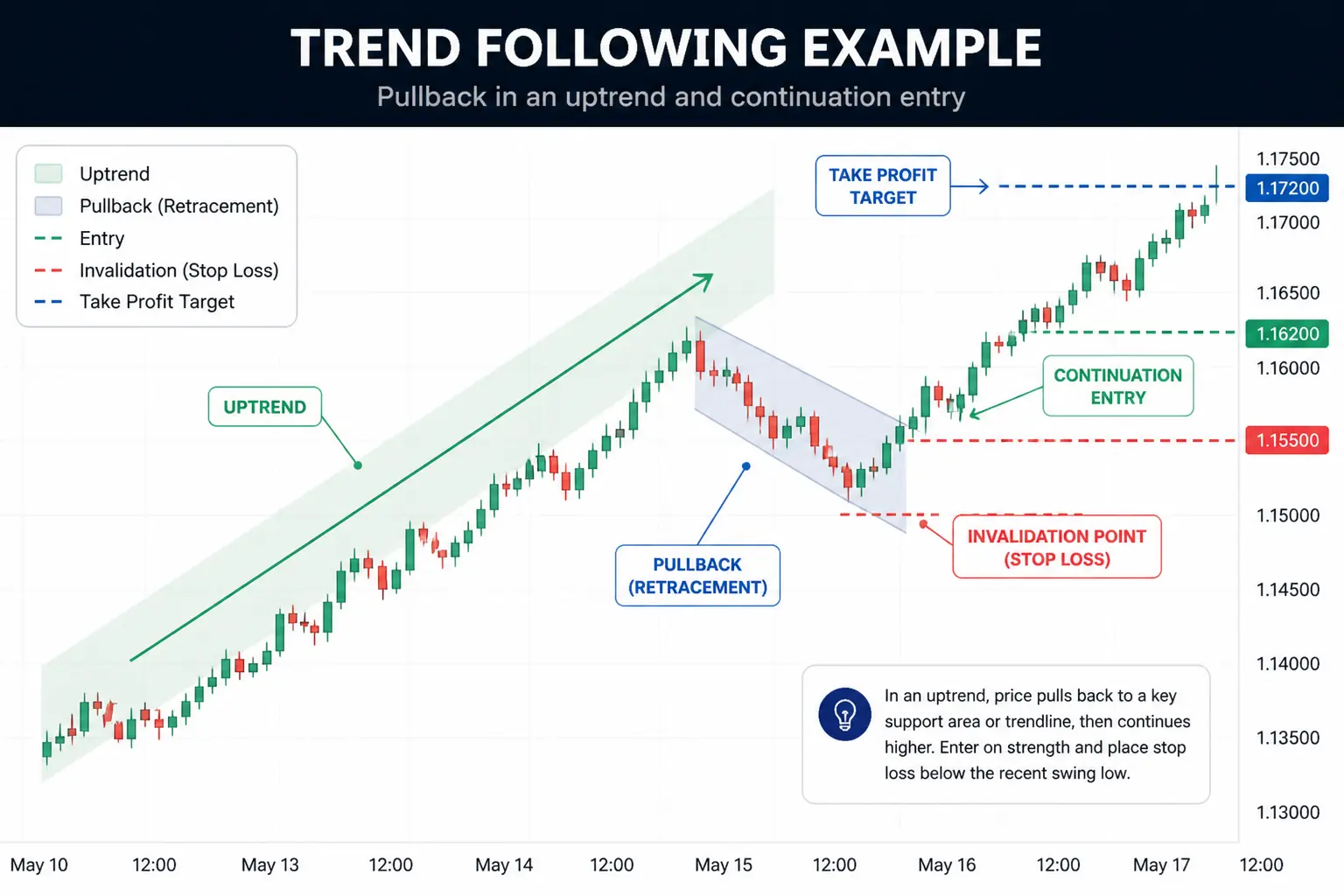
Trend following tries to trade in the same direction as the prevailing move. Traders usually look for higher highs and higher lows in an uptrend, or lower highs and lower lows in a downtrend, then wait for a pullback or continuation signal before entering.
Breakout Trading
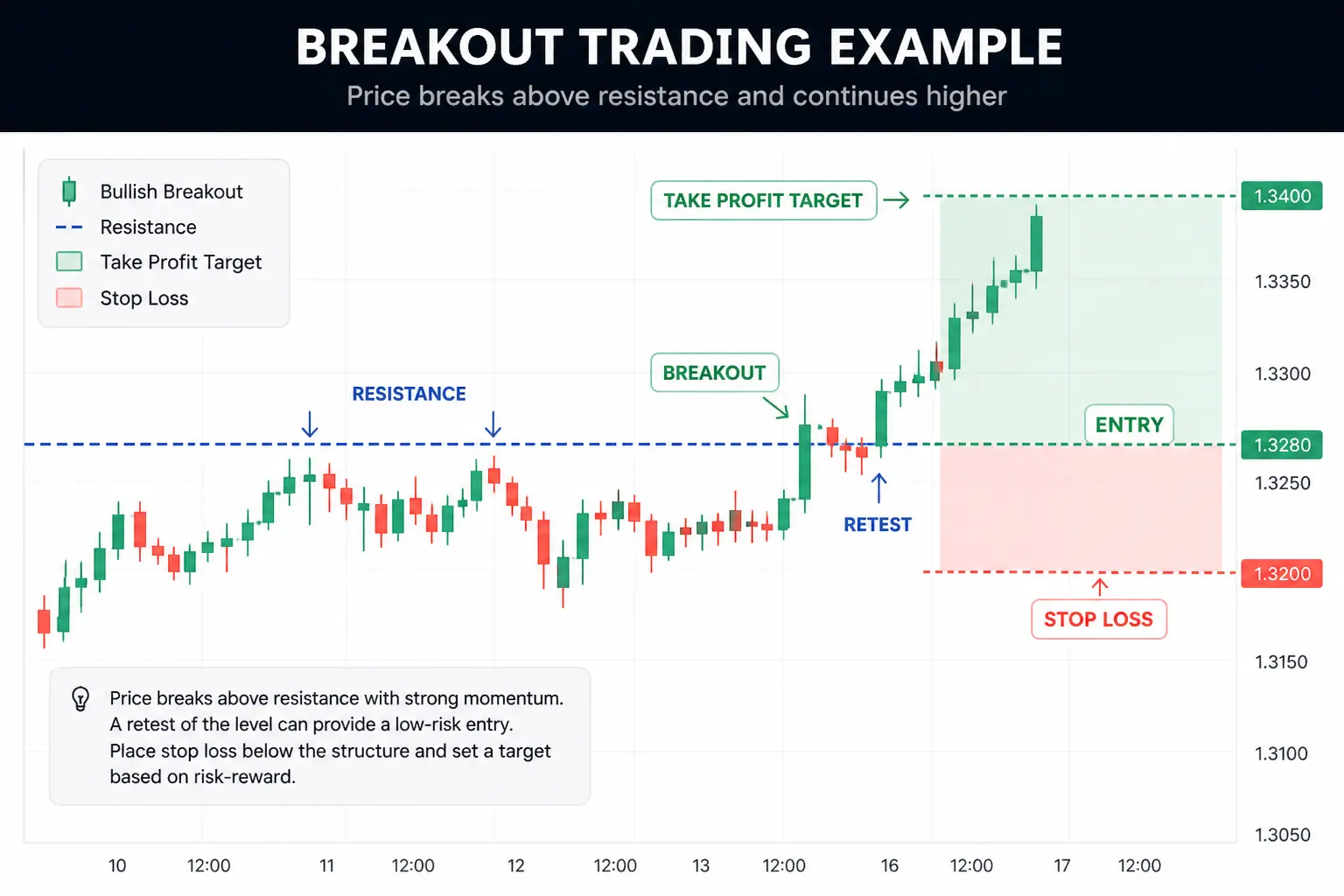
Breakout trading focuses on moments when price moves beyond a well defined support or resistance level. The idea is that a period of compression often leads to expansion, but the main challenge is avoiding false breaks that fail quickly.
Mean Reversion
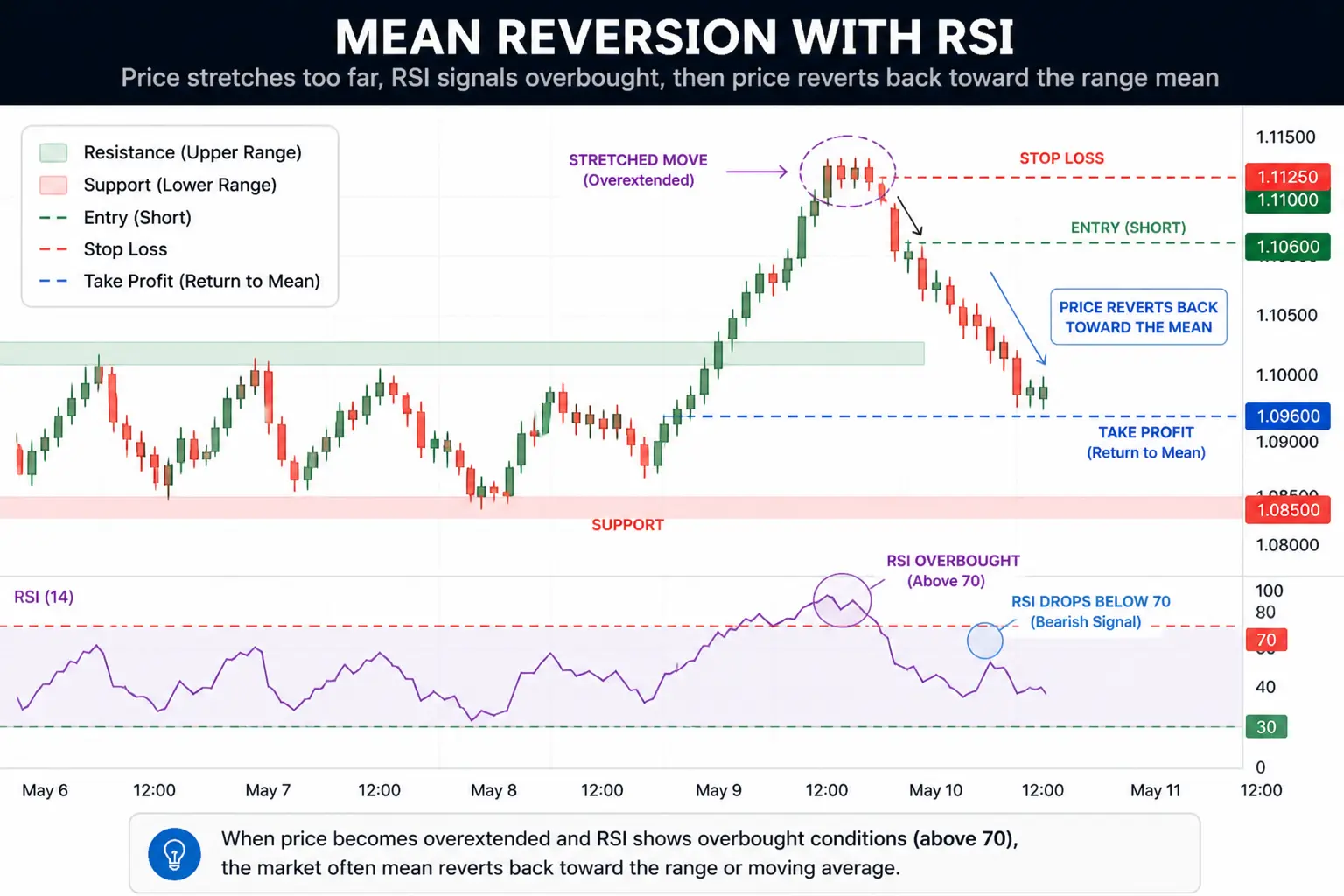
Mean reversion assumes that a sharp short term move may stretch too far from its average and then pull back toward a normal range. Many traders combine support and resistance with RSI overbought and oversold signals to judge whether a move is extended or whether price may still have room to continue.
News Trading
News trading focuses on price moves around scheduled releases such as inflation data, central bank decisions, employment reports, or company earnings. It can create fast opportunity, but it also carries higher execution risk because spreads may widen and price can move before a trader reacts.
Price Action Trading
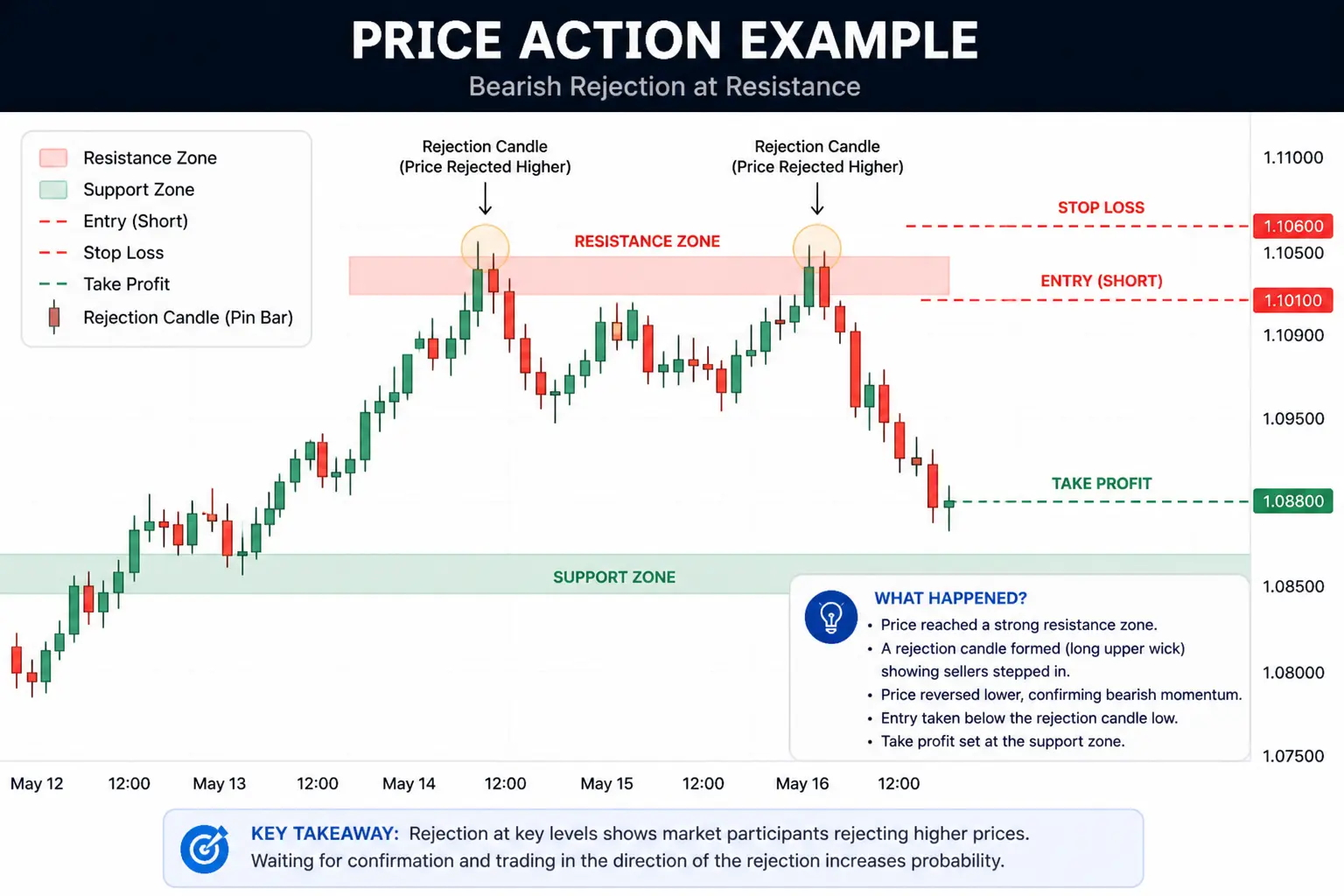
Price action trading uses raw chart structure rather than relying only on indicators. Traders read swing highs, swing lows, rejection candles, consolidation ranges, and key levels to decide whether buyers or sellers are taking control.
Hedging with CFDs
Hedging with CFDs is usually a defensive use of the product rather than a core beginner strategy. A trader may use a CFD position to offset some risk in another holding, but the method requires a clear understanding of correlation, cost, and the size of the hedge.
Which CFD Trading Style Fits Different Traders?
A trading style describes how quickly a trader acts and how long a position is usually held. The same strategy can be traded in different styles, so style should be chosen around time availability, temperament, and the speed of decision making a trader can handle well.
| Style | Typical Holding Time | Screen Time | Best Fit | Main Challenge |
|---|---|---|---|---|
| Scalping | Seconds to minutes | Very high | Traders comfortable with rapid execution | Spread sensitivity and mental fatigue |
| Day trading | Minutes to hours | High | Traders who do not want overnight exposure | Overtrading and reaction to noise |
| Swing trading | Days to weeks | Medium | Part time traders with a slower process | Wider stops and overnight risk |
| Position trading | Weeks to months | Lower | Traders using broader directional views | Patience, financing cost, and larger interim swings |
Scalping
Scalping aims to capture very small price moves many times during a session. Traders interested in fast paced scalping methods should remember that execution speed, spread cost, and discipline become more important as the holding time gets shorter.
Day Trading
Day trading opens and closes positions within the same session. Traders who prefer intraday trading methods often like the fact that no position is held overnight, but the style still requires preparation, focus, and strong control over trade frequency.
Swing Trading
Swing trading holds positions for several days or longer so the trade has more time to develop. Traders exploring a slower swing trading approach usually focus on clearer trend structure, support and resistance, and better quality setups rather than frequent entries.
Position Trading
Position trading uses a longer holding period and a broader market view. It suits traders who are comfortable with larger interim price swings and who can hold a position through normal volatility without reacting to every short term move.
Which CFD Trading Strategies Are Better for Beginners?
Most beginners do better with simpler strategies that leave enough time to think. Trend following, basic breakout setups, and swing trading are often easier starting points because the rules can be defined clearly and the pace is slower than scalping or reactive news trading.
| Approach | Why It Can Suit Beginners | Main Watch Point |
|---|---|---|
| Trend following | Clear directional bias and simple continuation logic | Avoid chasing a move that is already extended |
| Basic breakout setup | Easy to define entry, invalidation, and target around visible levels | False breaks are common when confirmation is weak |
| Swing trading | Lower screen time and less pressure to react instantly | Stops are often wider and trades may face overnight risk |
Beginners usually struggle when the method requires instant decision making, constant monitoring, or aggressive leverage. That is why scalping and fast news trading are often poor starting points even though they may look attractive on paper.
A beginner should start with one market, one setup, and one fixed risk rule. Traders who need a practical walkthrough of how to place a CFD trade step by step can review that process before applying any specific strategy.
Pro Tip: Use one strategy on one market until execution becomes consistent, then expand only after results and discipline are stable.
What Trading Tips Help Traders Use CFD Strategies More Consistently?
Good strategy selection matters, but consistency usually comes from execution habits. The best CFD trading tips are the ones that make a trader more disciplined, more prepared, and less reactive under pressure.
Build a Trading Plan and Stick to It
A trading plan should state which market will be traded, what setup qualifies, how much capital is at risk, and what conditions cancel the trade. Without a plan, a strategy becomes an opinion rather than a repeatable process.
Start Small and Choose Leverage Carefully
Starting small keeps early mistakes manageable while the trader learns how the strategy behaves in live conditions. Leverage should support the plan, not control it, because a small margin requirement does not reduce the size of the actual market exposure.
Prepare Before the Trade
Preparation should include checking market structure, important levels, scheduled news, and the size of the stop relative to the target. A setup may look attractive at first glance, but it is weaker if the trade is placed without context.
Use Support and Resistance Before Entering
Support and resistance help traders define where price may react and where a setup becomes invalid. Drawing these levels before entry improves trade selection because the stop loss and target can be planned with more logic.
Do Not Overtrade
Overtrading often appears when a trader forces setups, increases frequency after losses, or trades low quality conditions out of boredom. A smaller number of clear trades is usually better than constant activity with weak reasoning.
Keep a Trading Journal
A journal helps traders review whether a strategy is actually followed the same way each time. Recording the setup, entry reason, size, outcome, and execution mistakes makes it easier to see whether losses come from the strategy itself or from poor discipline.
How Should Traders Manage Risk When Using CFD Strategies?
Risk management determines whether a strategy survives long enough to matter. In CFD trading, capital preservation matters because leverage can amplify gains and losses far beyond the margin deposited to open the position.
Important: Margin is the deposit needed to open the trade, but profit and loss still depend on the full position size and the total price move.
Position Sizing
Position sizing should be based on account risk, not on how confident the trade feels. When the size is too large, a normal market fluctuation can force poor decisions even if the setup was sound.
Stop Loss Placement
A stop loss should sit at a price level that proves the original trade idea is wrong, not at a random distance chosen for convenience. Stops that are too tight get hit by normal noise, while stops that are too wide may distort the risk profile of the trade.
Risk Reward Ratio
The risk reward ratio helps traders judge whether the possible return justifies the amount being put at risk. It should be assessed together with probability, because a large target is not useful if the setup rarely reaches it.
Correlation and Concentration Risk
Risk can increase when several positions depend on the same market theme. For example, holding multiple trades that all rise or fall on the same macro driver can create more exposure than it first appears.
Trading costs should also be included in the risk decision. Spread, commission, and overnight financing can reduce the net return of a setup, especially when the target is small or the holding period is longer.
How Should Traders Choose a CFD Broker for Their Strategy?
Broker selection should match the way the strategy is traded. Traders who want a fuller overview of what a CFD broker actually does can review that guide, but the key checks are usually straightforward.
• Regulation and account protections: the broker should operate under clear regulatory standards and explain account terms transparently.
• Execution quality: fast strategies are more sensitive to slippage, requotes, and spread changes than slower swing based approaches.
• Platform tools: charting, order types, alerts, and risk controls should support the way the trader plans and manages positions.
• Pricing transparency: spreads, commissions, and financing charges should be easy to understand before the trade is placed.
• Market coverage: the available instruments should fit the trader’s chosen strategy rather than encouraging random switching between unrelated markets.
Ready to start trading CFDs?
Open a live trading account with TMGM or practise first with a demo account before trading live markets.
Open a trading accountOr try our demo account first.