What does leverage mean in Forex?
Leverage in Forex means controlling a large amount of position with a relatively small amount of capital. It is a Forex trading tool that allows traders to access a position size greater than their account balance.
How does leverage work in Forex?
Leverage in Forex works through a margin system. Margin is the portion of capital a trader deposits to open and hold a position. A Forex broker provides the remaining market exposure beyond that deposited amount.
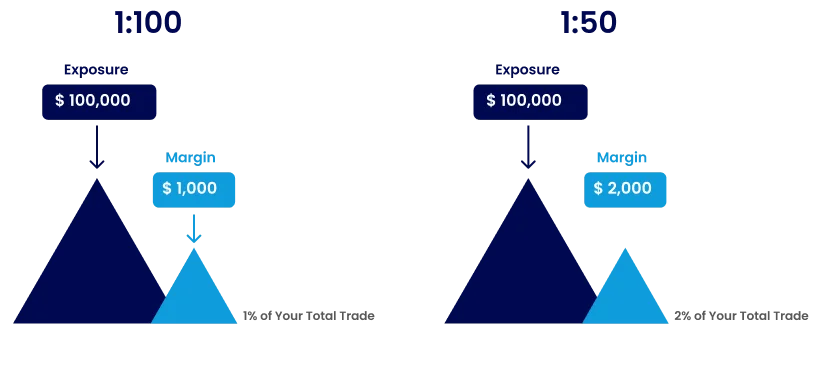
Leverage is expressed as a ratio of total position size to margin required. For example, a 1:100 leverage ratio allows control of $100,000 in currency value with $1,000 of margin. The $1,000 acts as collateral, and the broker covers the remaining exposure.
Leverage can be applied directly when opening a trade through a regulated Forex trading account. Profits and losses are calculated on the full $100,000 position size, not on the $1,000 margin.
How do I calculate leverage in Forex?
Leverage in Forex is calculated by dividing the total trade value by the margin used to open the position. The calculation shows how large a position is relative to the capital committed.
There are 2 ways to calculate leverage in Forex:
1. Calculate leverage using a formula
The formula for calculating leverage in Forex is:
Leverage = Trade Value ÷ Margin Required
For example, if the trade value is $100,000 and the margin required is $1,000, the calculation is 100,000 ÷ 1,000 = 1:100. This means the exposure is 100 times the capital committed as margin.
2. Calculate leverage using a Forex calculator
Leverage can also be calculated using a Forex leverage calculator. The trader inputs 4 values:
Trade size (lot size)
Currency pair
Account currency
Leverage ratio
The calculator returns the margin required to open the trade. A leverage ratio lower than the broker's minimum will not allow the trade to open. A higher ratio can be used if the broker permits it.
Example of trading Forex using leverage
Assume a trader uses 1:100 leverage to open a $100,000 EUR/USD position. At this leverage ratio, the margin required to open the trade is $1,000.
Scenario 1: the trade moves in favor of the trader:
If EUR/USD rises by 1%, the position gains: 1% × $100,000 = $1,000 profit. The return on the $1,000 margin is 100%. A 1% market movement produces a 100% return because gains are calculated on the full $100,000 position size, not just the margin.
Scenario 2: the trade moves against the trader:
If EUR/USD falls by 1%, the position loses: 1% × $100,000 = $1,000 loss. The entire $1,000 margin is wiped out. A move of just 1% against the position results in a 100% loss of the committed capital.
This example shows that leverage amplifies both profits and losses. The leverage ratio does not change the market’s percentage movement. It increases the financial impact of that movement relative to the margin used.
What are leverage ratios in Forex?
Leverage ratios in Forex are numerical multiples that show how much total market exposure is controlled relative to the margin required to open a position. Leverage is expressed as a ratio, such as 1:10, 1:50, 1:100, or 1:500, and measures how large a position is compared to the capital committed.
A leverage ratio is calculated by dividing the total position value by the margin required to open it. For example, a 1:100 leverage means a $100,000 position requires $1,000 in margin. The equivalent margin requirement is 1%, and the position size is 100 times the capital used. Available leverage ratios vary by broker and regulation.
Leverage ratios are commonly grouped into 4 categories: low, moderate, high, and extreme.
What are the benefits of using leverage in Forex?
The 6 benefits of using leverage in Forex include:
Increased buying power
Capital efficiency and preservation
Higher potential returns
Ability to profit from small price moves
Portfolio diversification across currency pairs
Access to Forex markets as a retail trader
1. Increased buying power
Leverage allows control of larger position sizes by requiring only a fraction of the total trade value as margin. This expands market exposure without requiring the full notional value upfront.
2. Capital efficiency and preservation
Leverage requires only a fraction of the total trade value as margin. The remaining capital stays in the account, available as a cash buffer or allocated to other positions. This reduces the risk of a single position depleting the full account balance.
3. Higher potential returns
Leverage amplifies potential gains because profits are calculated on the full position size, not just the margin used. Small price movements can generate proportionally larger returns on invested capital.
4. Ability to profit from small price moves
Forex markets move in fractions of a percent daily. Leverage makes these movements financially meaningful for retail traders. Without leverage, a 0.5% price move on an unlevered position produces negligible returns relative to the capital required to open it.
5. Portfolio diversification across currency pairs
Lower margin requirements allow traders to open positions across multiple currency pairs simultaneously with the same account balance. Without leverage, the same capital could only fund one or two positions at full trade value.
6. Access to Forex markets as a retail trader
Leverage makes Forex trading accessible at the retail level. Standard Forex contracts are sized at $100,000 per lot. Without leverage, retail traders with smaller account balances could not participate in standard lot trading at all.
What are the risks of using leverage in Forex?
The 4 risks of using leverage in Forex include:
Amplified losses and rapid capital loss
Margin calls, stop-out, and forced liquidation
High probability of retail losses
Emotional pressure and impulsive decisions
1. Amplified losses and rapid capital loss
Leverage amplifies both profits and losses. Short-term volatility can quickly erode account equity because losses are calculated on the full position size, not the margin used. Daily price fluctuations in major currency pairs range between 0.5% and 1% under normal conditions, which is enough to produce significant losses at high leverage.
2. Margin calls, stop-out, and forced liquidation
When account equity falls below required margin levels, brokers trigger a margin call as a warning. If equity continues to fall and reaches the stop-out level, the broker automatically closes open positions to prevent further losses. This locks in losses and accelerates account depletion. Some regulated brokers offer negative balance protection, which prevents the account from falling below zero even if losses exceed the deposited margin.
3. High probability of retail losses
Regulatory data shows that a majority of retail CFD and Forex traders lose money. European Securities and Markets Authority (ESMA) disclosures indicate that approximately 74% to 89% of retail accounts lose money when trading leveraged products. This outcome is closely linked to excessive leverage and inadequate risk control.
4. Emotional pressure and impulsive decisions
Trading with high leverage amplifies the emotional impact of price fluctuations. Larger profit and loss swings increase stress, leading to impulsive decision-making and inconsistent execution.
How can I minimize leverage risk in Forex trading?
There are 6 things you can do to minimize leverage risk in Forex trading:
Practice using demo Forex accounts
Use conservative leverage ratios
Set stop-loss orders
Limit position size
Monitor margin levels
Utilize risk-reward ratios
1. Practice using demo Forex accounts
Demo trading in Forex allows testing leverage effects without risking real capital. It builds execution discipline before trading live funds.
2. Use conservative leverage ratios
Lower leverage reduces exposure per trade. Smaller multiples decrease the speed at which losses accumulate during adverse price movements.
3. Set stop-loss orders
Stop-loss orders cap downside risk at a predefined level. This prevents small losses from escalating into large equity drawdowns.
4. Limit position size
Smaller position sizes reduce the financial impact of each price movement. Exposure stays aligned with total account equity.
5. Monitor margin levels
Tracking free margin and margin level percentage helps prevent margin calls and forced liquidations. Early adjustments protect account stability.
6. Utilize risk-reward ratios
Defined risk-reward ratios improve mathematical expectancy. For example, risking 1 unit to target 2 units (1:2 risk-reward) produces positive expectancy at a 40% win rate: (0.40 × 2) − (0.60 × 1) = +0.20 per trade.