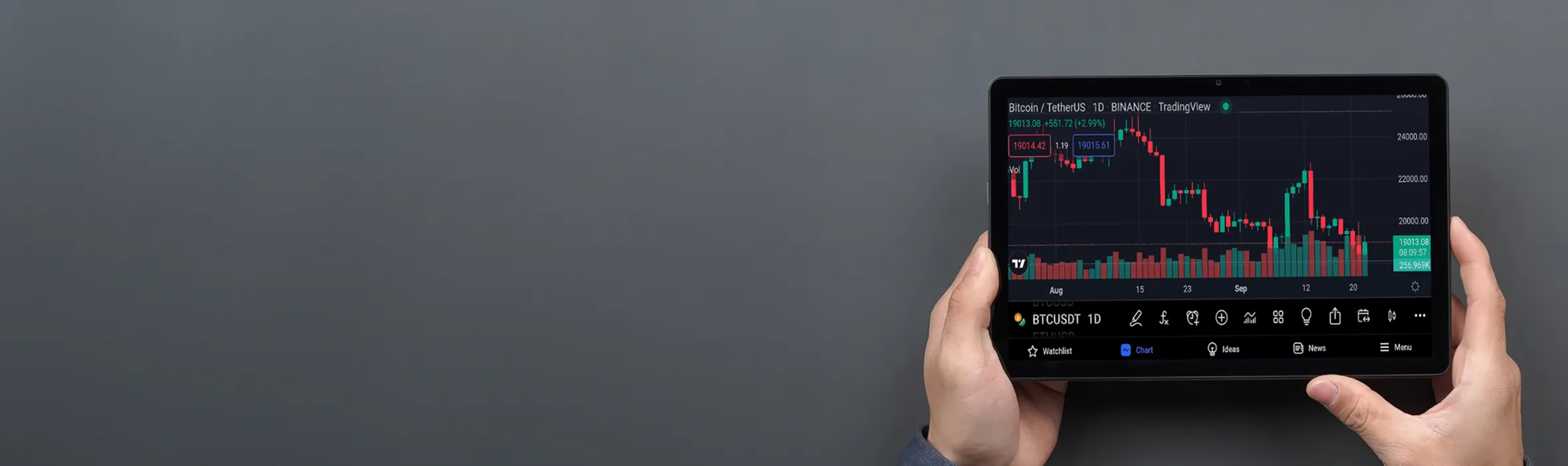
What is cryptocurrency trading?
Cryptocurrency trading is the buying and selling of digital currencies through two primary methods: CFD (contract for difference) trading and direct exchange trading.
Crypto CFD trading allows a trader to speculate on the price movement of a cryptocurrency without owning the underlying asset.
Crypto exchange trading involves purchasing and owning the actual digital currency on an exchange using fiat currency or another cryptocurrency, with the purchased asset held in a digital wallet.
How is cryptocurrency regulated?
Cryptocurrency is regulated differently around the world because there is no single global rulebook for crypto. Oversight may come from securities regulators, derivatives regulators, anti money laundering authorities, central banks, and tax agencies, depending on the jurisdiction.
The 4 main cryptocurrency regulators are Securities and Exchange Commission (SEC), Commodity Futures Trading Commission (CFTC), Financial Crimes Enforcement Network (FinCEN) and Internal Revenue Service (IRS).
1. Securities and Exchange Commission (SEC)
The SEC regulates crypto assets and transactions that fall under federal securities laws and clarified how those laws apply in March 2026.
2. Commodity Futures Trading Commission (CFTC)
The CFTC regulates crypto derivatives such as futures and can act against fraud and manipulation in related markets.
3. Financial Crimes Enforcement Network (FinCEN)
FinCEN applies anti money laundering and money transmission rules to parts of the cryptocurrency industry.
4. Internal Revenue Service (IRS)
The IRS treats cryptocurrency as property for US federal tax purposes, which means tax rules apply to crypto sales, exchanges, and other taxable transactions.
How does cryptocurrency trading work?
Cryptocurrency trading works differently depending on whether the crypto trader uses CFDs or trades directly on an exchange. The core idea is the same, but execution and asset ownership are different.
Cryptocurrency CFD trading works by placing a buy or sell order on a crypto pair, such as BTC/USD, through a CFD broker. Traders open the position using margin, which is the deposit required to access leveraged exposure, and the trade result is based on how many lots are traded, how far the price moves in pips or points, and the spread between the buy and sell price. Traders gain exposure to the cryptocurrency price movement without owning the underlying asset once the order is filled.
Crypto exchange trading works by placing spot buy and sell orders for crypto pairs on a Centralised Exchange (CEX) or a Decentralised Exchange (DEX). Spot trading means the transaction settles immediately at the current market price, and the trader takes direct ownership of the digital asset.
A CEX matches orders using its own order book and available liquidity.
A DEX executes trades through smart contracts and liquidity pools.
Both exchange types require the trader to hold the actual digital asset in a wallet, and profits are realised only when the asset is sold at a higher price than the purchase cost.
Should I trade crypto through a broker or an exchange?
The deciding factor between a broker and an exchange for crypto trading is your trading objective.
Choose a broker if your objective is short-term price speculation with leverage, and choose an exchange if your objective is to own, hold, or use the cryptocurrency directly.
A broker offers more flexibility for active trading because it provides leveraged exposure, the ability to profit from falling prices through short positions, and regulated fund protection that most exchanges do not guarantee.
The following table compares the two options.
What are the cryptocurrency trading hours?
The cryptocurrency market is open 24 hours a day, 7 days a week. Crypto assets trade continuously on exchanges throughout the global week, including weekends and public holidays because there is no central market close, unlike many traditional markets.
The most active window for cryptocurrency trading often falls during the London and New York session overlap, from around 13:00 to 17:00 UTC. This period usually brings higher trading volume and tighter spreads because European and US participants are active at the same time. Major economic data, regulatory headlines, and large institutional flows often have the strongest effect during this window.
What factors move cryptocurrency markets?
Cryptocurrency markets move mainly because of 5 factors, which are Supply and Demand, Sentiment and Headlines, Regulation and Market Access, Network Factors, and Broader Economic Conditions.
1. Supply and demand
Cryptocurrency prices rise when demand grows faster than available supply, and they fall when selling pressure is stronger than buying interest. Bitcoin is the clearest example because its new issuance is cut in half every 210,000 blocks and its total supply is capped at 21 million coins.
2. Sentiment and headlines
Crypto prices react quickly to market perception. Exchange news, product approvals, security incidents, and shifts in investor confidence can all change demand within a short period. Risks such as volatility, fraud, manipulation, hacking, and operational failures in crypto markets are factors that affect sharply as stated by the SEC.
3. Regulation and market access
Regulation moves crypto markets because it changes who can participate and how capital enters the market. The SEC approval of spot bitcoin exchange-traded products in January 2024 expanded regulated access through national securities exchanges. The ECB in Europe stated that regulatory clarity under MiCA has increased investor interest and the number of authorised crypto-asset service providers.
4. Network factors
Blockchain activity such as transaction demand, protocol upgrades, staking, mining economics, and fee changes can all affect the price by influencing how a crypto asset is valued. The base fee changes with network activity and is burned when transactions are processed on the Ethereum blockchain, so heavy usage can affect both transaction costs and circulating Ethereum supply.
5. Economic conditions and adoption
Cryptocurrencies do not trade in isolation from the wider financial system. Risk appetite, liquidity conditions, institutional adoption, and stablecoin flows all influence market direction. USDT and USDC trading volume reached $23 trillion in 2024, which shows how large stablecoin liquidity has become in cryptocurrency markets as stated by the IMF.
What are the benefits of cryptocurrency trading?
The 12 benefits of cryptocurrency trading include:
Cryptocurrency market availability
High profit potential due to volatility
Low barrier of entry
High liquidity
Diverse cryptocurrency assets
Accessibility
Fast transactions and cheap fees
Crypto account and fund security
Crypto trade execution privacy
Transparent price discovery
Leverage opportunities
Trading crypto on inflation momentum
1. Cryptocurrency market availability. The cryptocurrency market is open 24 hours a day, 7 days a week. Traders can open and close positions across weekends and public holidays without interruption.
2. High profit potential due to volatility. Cryptocurrency markets offer higher short-term profit potential than most traditional financial markets because the underlying assets experience larger average price swings.
3. Low barrier of entry. Cryptocurrency trading requires less starting capital than most traditional financial markets. Many brokers allow traders to open positions with deposits as low as $50 to $100.
4. High liquidity. Cryptocurrency markets rank among the most liquid financial markets globally. Bitcoin alone averages over $30 billion in daily spot trading volume, and the combined daily volume across all cryptocurrencies regularly exceeds $100 billion.
5. Diverse cryptocurrency assets. Cryptocurrency brokers offer exposure to a wide range of digital assets beyond Bitcoin and Ethereum, including large-cap, mid-cap, and meme-driven tokens with different market drivers.
6. Accessibility. Cryptocurrency trading is accessible from virtually any device and location with an internet connection.
7. Fast transactions and cheap fees. Cryptocurrency trades execute almost instantly through a broker's platform, and most brokers charge no commission, building their fee into the spread instead.
8. Crypto account and fund security. Cryptocurrency trading through a regulated broker provides multiple layers of account and fund protection, including segregated client funds and platform-level security.
9. Crypto trade execution privacy. Cryptocurrency trading through a broker keeps position data entirely private from other market participants, preventing front-running and public order book exposure.
10. Transparent price discovery. Cryptocurrency prices are formed through publicly visible market activity, and aggregators like CoinMarketCap and CoinGecko compile price data from hundreds of exchanges into a single real-time feed.
11. Leverage opportunities. Leverage allows cryptocurrency traders to control a larger position than their account balance would otherwise permit.
12. Trading crypto on inflation momentum. Cryptocurrency trading allows traders to take directional positions on assets with fixed or limited supply during periods of currency devaluation.
What are the risks of cryptocurrency trading?
The 9 risks of cryptocurrency trading include:
Volatility-amplified losses
Leverage risk
Overnight funding costs
Spread widening
Crypto regulatory uncertainty
Crypto broker platform outages
No ownership of underlying assets
Cryptocurrency scams and fraud
Counterparty risk
1. Volatility-amplified losses. Volatility-amplified losses in cryptocurrency trading are losses magnified by the combination of sharp crypto price swings and leveraged exposure.
2. Leverage risk. Leverage risk in cryptocurrency trading is the risk that borrowed exposure amplifies losses beyond your initial deposit, triggering forced liquidation of your position.
3. Overnight funding costs. Overnight funding costs in cryptocurrency trading are financing charges applied to leveraged positions held open past the end of each trading day.
4. Spread widening. Spread widening in cryptocurrency trading is an increase in the difference between the buy and sell price of a cryptocurrency pair, raising the cost of entering and exiting a trade.
5. Crypto regulatory uncertainty. Crypto regulatory uncertainty is the risk that changes to cryptocurrency laws or regulations alter your trading conditions with limited notice.
6. Crypto broker platform outages. Broker platform outages in cryptocurrency trading are periods when your broker's trading platform becomes unavailable, preventing you from executing, modifying, or closing positions.
7. No ownership of underlying assets. When you trade cryptocurrency through a broker, you do not hold the actual token. Your position is a contract that tracks the price of the cryptocurrency, not a claim on the asset itself.
8. Cryptocurrency scams and fraud. Cryptocurrency scams and fraud are deceptive schemes designed to steal your funds, credentials, or personal data by exploiting the relatively unregulated nature of the crypto market.
9. Counterparty risk. Counterparty risk in cryptocurrency trading is the risk that the broker holding your funds and executing your trades fails to meet its financial obligations.
How do I start cryptocurrency trading?
You start cryptocurrency trading by following these 7 steps:
Understand cryptocurrency trading
Cryptocurrency trading is the act of speculating on the price movements of digital currencies such as Bitcoin (BTC), Ethereum (ETH), and Solana (SOL) without purchasing or owning the underlying asset.
Select a crypto trading broker
A crypto trading broker is the platform that connects you to the cryptocurrency market and executes your buy and sell orders.
Open a crypto trading account
A crypto trading account is a live brokerage account that gives you access to cryptocurrency markets, order execution, and the leverage and margin facilities needed to trade crypto pairs.
Research cryptocurrencies to trade
Researching a cryptocurrency before trading it reduces the risk of entering a position based on hype or incomplete information.
Place your cryptocurrency trade
Placing a cryptocurrency trade means opening a live position on a crypto pair through your broker's trading platform. Every trade requires five decisions: the pair, the direction, the position size, the entry price, and the exit conditions.
Manage your cryptocurrency trade
Managing a cryptocurrency trade is the process of monitoring and adjusting your open position after execution.
Close your cryptocurrency trade
Closing a cryptocurrency trade is the act of exiting your open position, which settles the profit or loss on that trade.
Trade BTC, ETH, SOL and more with TMGM.
Open a crypto trading accountOr try our free demo account (no deposit required).