

Gold reverses gains as US CPI data takes center stage
- Gold reverses from a three-week high as the US Dollar rebound weighs on the metal ahead of US CPI data.
- Rising Oil-driven inflation concerns keep US Treasury yields elevated, reinforcing expectations for higher-for-longer Fed interest rates.
- Technically, XAU/USD remains capped below the 100-day SMA, with RSI and ATR signaling subdued momentum and moderating volatility.
Gold (XAU/USD) reverses earlier gains on Tuesday as fading hopes for a near-term breakthrough in US-Iran negotiations and a modest rebound in the US Dollar (USD) weigh on the precious metal ahead of the US Consumer Price Index (CPI) data release. At the time of writing, XAU/USD is trading around $4,694 after hitting a three-week high of $4,773 during the Asian session.
US-Iran negotiations remain at an impasse over Iran’s nuclear program. US President Donald Trump told reporters in the Oval Office on Monday that the ceasefire is “on massive life support.” The remarks came after Trump rejected Iran’s latest response to the US-backed peace proposal, calling it “totally unacceptable.”
Reports also suggest that the US President is considering a resumption of military operations, alongside a potential restart of “Project Freedom” in the Strait of Hormuz. Meanwhile, Iranian Parliament Speaker Mohammad Bagher Ghalibaf warned that Tehran is prepared to respond to “any aggression,” adding that their move would leave the US “surprised.”
Against this backdrop, Gold’s upside attempts continue to face selling pressure as Oil-driven inflation concerns push US Treasury yields higher amid rising expectations that major central banks, particularly the Federal Reserve (Fed), may keep interest rates higher for longer or even consider rate hikes. The upcoming US inflation report is expected to play a key role in shaping the Fed’s monetary policy outlook and could determine the next directional move for Gold.
Headline CPI is expected to rise 0.6% MoM in April, easing from the 0.9% increase recorded in March. On an annual basis, inflation is projected to accelerate to 3.7% YoY from 3.3% previously. Meanwhile, core CPI, which excludes volatile food and energy prices, is expected to rise 0.3% MoM in April after a 0.2% increase in March, while the annual rate is forecast to edge up to 2.7% YoY from the previous 2.6%.
A hotter-than-expected inflation reading could further reinforce the higher-for-longer interest rate narrative, potentially extending the rise in already elevated US Treasury yields and strengthening the USD, while weighing on non-yielding assets such as Gold. Conversely, softer inflation data may revive expectations for future rate cuts by the central bank and provide fresh support for bullion.
According to the CME FedWatch Tool, traders currently expect the Fed to keep interest rates unchanged for the remainder of the year. However, markets still price in a modest chance of a rate hike at the December meeting, with the probability standing near 30%.
Technical analysis: XAU/USD struggles below 100-day SMA
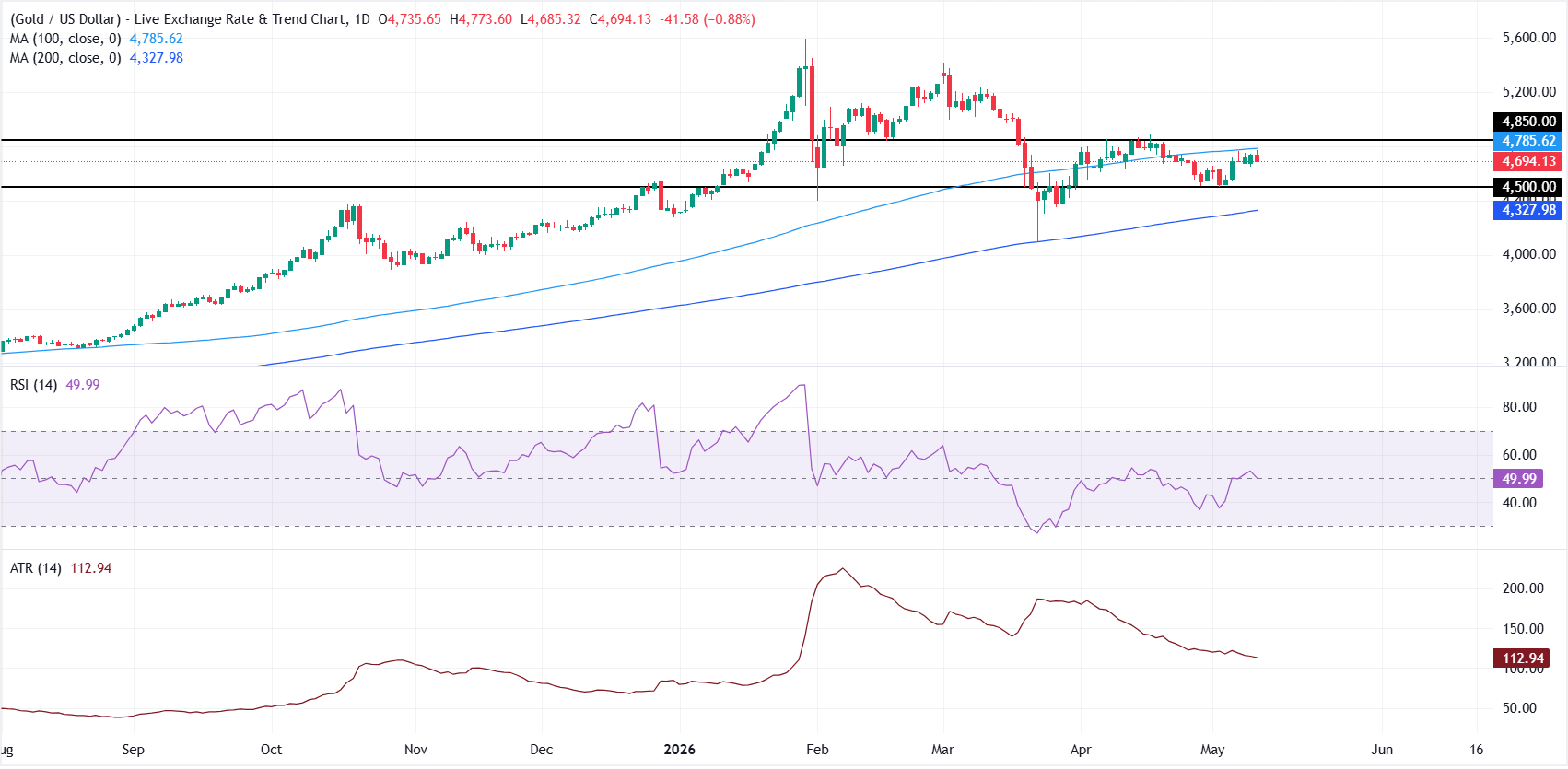
On the daily chart, XAU/USD holds in a neutral near-term stance between its major moving averages. The price remains comfortably above the 200-day Simple Moving Average (SMA) at $4,328, preserving the broader bullish structure, yet it is capped beneath the 100-day SMA around $4,785, which acts as the immediate topside barrier.
The Relative Strength Index (RSI) sits just below the 50 line, hinting at a lack of clear directional momentum, while the Average True Range (ATR) has eased toward $113, suggesting volatility is moderating as Gold consolidates within this mid-range band.
On the downside, initial support is seen at the horizontal floor around $4,500, with the longer-term 200-day SMA near $4,328 reinforcing a deeper demand zone if selling pressure resumes.
On the topside, resistance is first aligned at the 100-day SMA near $4,785, ahead of the more prominent horizontal barrier around $4,850. A sustained break above this cluster would be needed to revive bullish continuation, whereas a failure to clear it would keep XAU/USD confined to its current range.
(The technical analysis of this story was written with the help of an AI tool.)
Inflation FAQs
Inflation measures the rise in the price of a representative basket of goods and services. Headline inflation is usually expressed as a percentage change on a month-on-month (MoM) and year-on-year (YoY) basis. Core inflation excludes more volatile elements such as food and fuel which can fluctuate because of geopolitical and seasonal factors. Core inflation is the figure economists focus on and is the level targeted by central banks, which are mandated to keep inflation at a manageable level, usually around 2%.
The Consumer Price Index (CPI) measures the change in prices of a basket of goods and services over a period of time. It is usually expressed as a percentage change on a month-on-month (MoM) and year-on-year (YoY) basis. Core CPI is the figure targeted by central banks as it excludes volatile food and fuel inputs. When Core CPI rises above 2% it usually results in higher interest rates and vice versa when it falls below 2%. Since higher interest rates are positive for a currency, higher inflation usually results in a stronger currency. The opposite is true when inflation falls.
Although it may seem counter-intuitive, high inflation in a country pushes up the value of its currency and vice versa for lower inflation. This is because the central bank will normally raise interest rates to combat the higher inflation, which attract more global capital inflows from investors looking for a lucrative place to park their money.
Formerly, Gold was the asset investors turned to in times of high inflation because it preserved its value, and whilst investors will often still buy Gold for its safe-haven properties in times of extreme market turmoil, this is not the case most of the time. This is because when inflation is high, central banks will put up interest rates to combat it. Higher interest rates are negative for Gold because they increase the opportunity-cost of holding Gold vis-a-vis an interest-bearing asset or placing the money in a cash deposit account. On the flipside, lower inflation tends to be positive for Gold as it brings interest rates down, making the bright metal a more viable investment alternative.














