

Gold surges as Iran deal hopes crush the US Dollar, yields
- Gold jumps nearly 3% as US-Iran peace hopes grow.
- Oil selloff pressures the US Dollar, lifting bullion despite strong jobs.
- Fed officials warn inflation risks may keep rates elevated.
Gold (XAU/USD) price rallies nearly 3% on Wednesday amid growing speculation of an end to the Iran war, weighing on the Greenback and pushing US Treasury yields lower. At the time of writing, XAU/USD trades at $4,681 after bouncing off daily highs of $4,723.
XAU/USD surges as falling Oil and yields boost demand
Optimism of a possible end of the US-Iran war keeps the yellow metal underpinned. Axios reported that both parties are close to an agreement on a one-page memo with 14 points, while also beginning 30-day negotiations on opening the Strait of Hormuz and limiting Tehran’s nuclear program.
On the news, Oil prices are tumbling, with West Texas Intermediate (WTI) losing more than 7%, a headwind for the Greenback given its close correlation with the US crude Oil benchmark. At the same time, the US Dollar Index (DXY), which tracks the performance of the buck’s value against a basket of currencies, is down 0.46%, at 98.03.
ADP data showed the US labor market remained strong in April, with employment rising by 109,000—the highest gain in 15 months and above forecasts and March's revised figure of 61,000.
Fed hawks ready for Warsh's first meeting
After the news, St. Louis Fed President Alberto Musalem was hawkish, stating that the risks to monetary policy had shifted towards getting inflation under control. He said that “there are plausible scenarios that would require rates to remain stable for some time,” adding that “current policy is either neutral or slightly accommodative in real terms.”
Recently, Chicago Fed President Austan Goolsbee hit the wires, saying that higher productivity could spur spending and boost inflation. Goolsbee added, “It can lead to increased spending and potentially overheat the economy before the productivity boom has actually arrived. In that case, the fundamentals suggest rates would need to rise.”
Given the backdrop, Gold’s advance could be capped if additional policymakers turn dovish ahead of the June meeting, the first for Trump’s nominee to become the new Fed Chair, Kevin Warsh.
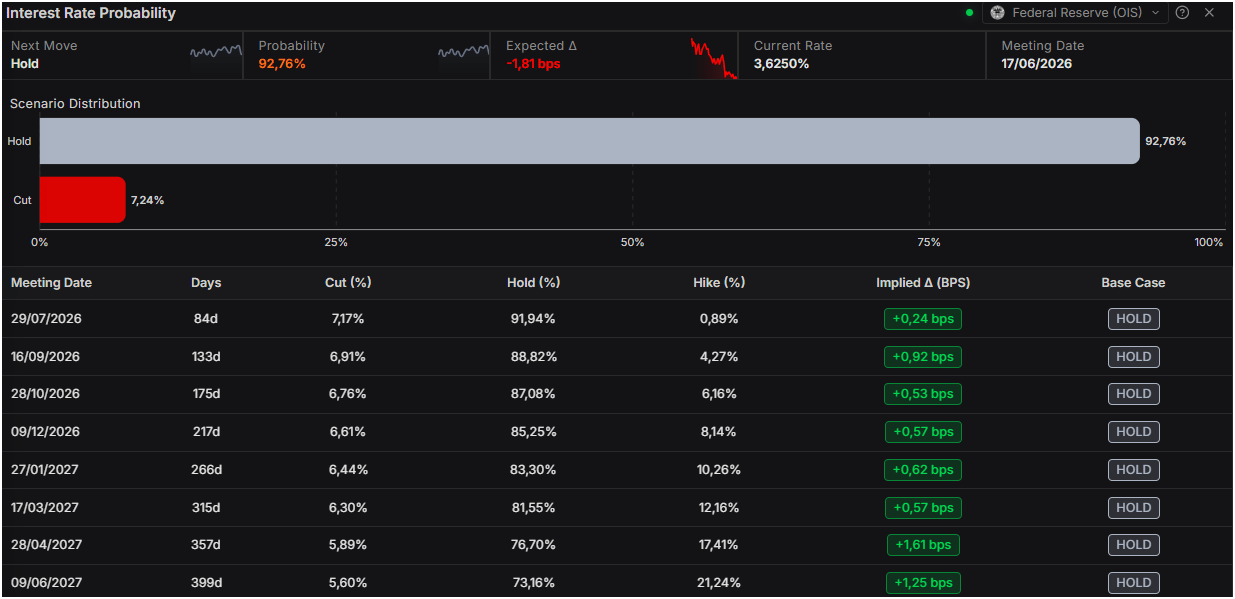
Money markets had priced in a nearly 93% chance that the Fed will hold rates steady in the June 17 meeting, Warsh’s first. For the rest of the year, the Fed funds rate is expected to stay unchanged, according to Prime Terminal data.
Ahead in the US docket, traders' eyes will be on Initial Jobless Claims and speeches by Federal Reserve officials.
XAU/USD technical analysis: Gold buyers challenge $4,700 as sentiment shifts bullish
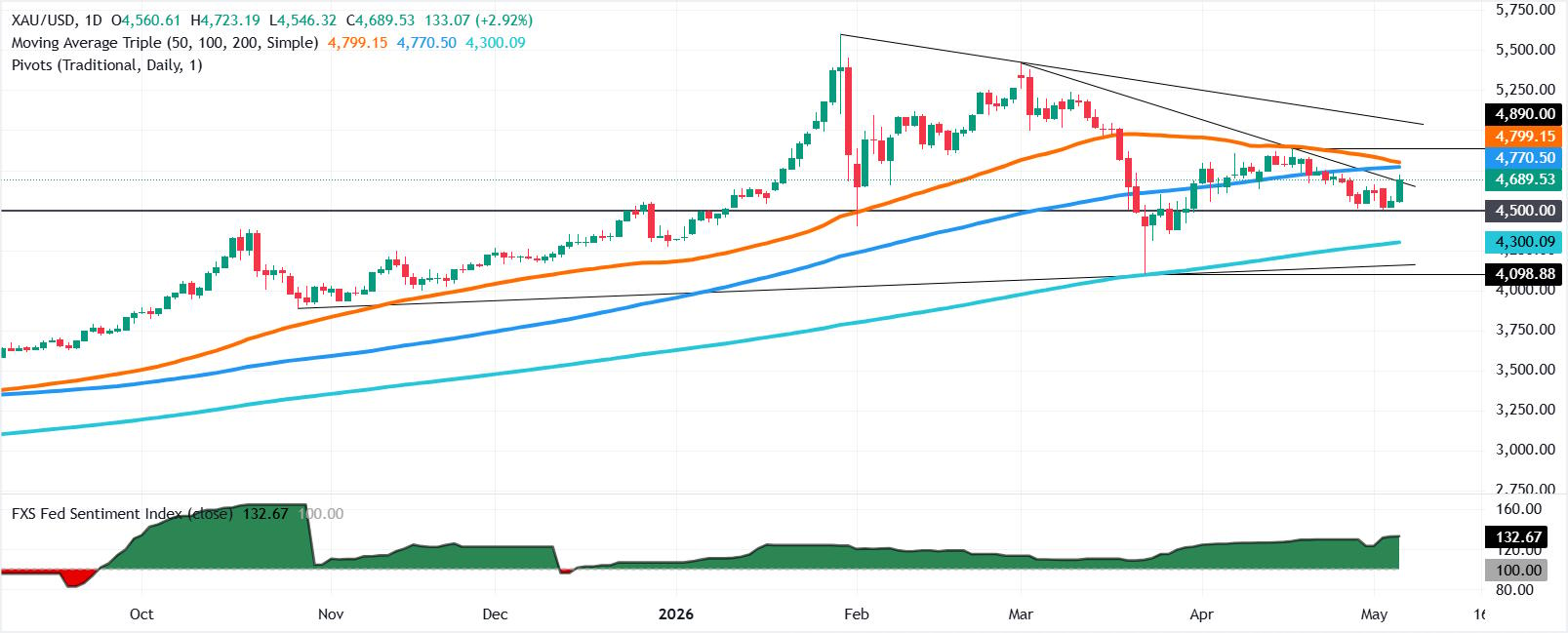
Gold price stages a recovery, rising past the $4,650 psychological level, opening the door for further upside, with buyers targeting the $4,700 milestone. The Relative Strength Index (RSI) suggests momentum is about to shift bullish, indicating further short-term upside.
XAU/USD's first resistance is a downtrend line at around $4,700-$4,715. If breached, the next resistance would be the 100-day Simple Moving Average (SMA) at $4,760. On further strength, the next area of interest would be the $4,800 mark, above the 50-day SMA at $4,799.
Downwards, the first support for XAU/USD is $4,600. If hurdled, the next support would become the May 4 swing low of $4,500, followed by the March 26 daily low of $4,351, before testing the 200-day SMA at $4,276.
Gold FAQs
Gold has played a key role in human’s history as it has been widely used as a store of value and medium of exchange. Currently, apart from its shine and usage for jewelry, the precious metal is widely seen as a safe-haven asset, meaning that it is considered a good investment during turbulent times. Gold is also widely seen as a hedge against inflation and against depreciating currencies as it doesn’t rely on any specific issuer or government.
Central banks are the biggest Gold holders. In their aim to support their currencies in turbulent times, central banks tend to diversify their reserves and buy Gold to improve the perceived strength of the economy and the currency. High Gold reserves can be a source of trust for a country’s solvency. Central banks added 1,136 tonnes of Gold worth around $70 billion to their reserves in 2022, according to data from the World Gold Council. This is the highest yearly purchase since records began. Central banks from emerging economies such as China, India and Turkey are quickly increasing their Gold reserves.
Gold has an inverse correlation with the US Dollar and US Treasuries, which are both major reserve and safe-haven assets. When the Dollar depreciates, Gold tends to rise, enabling investors and central banks to diversify their assets in turbulent times. Gold is also inversely correlated with risk assets. A rally in the stock market tends to weaken Gold price, while sell-offs in riskier markets tend to favor the precious metal.
The price can move due to a wide range of factors. Geopolitical instability or fears of a deep recession can quickly make Gold price escalate due to its safe-haven status. As a yield-less asset, Gold tends to rise with lower interest rates, while higher cost of money usually weighs down on the yellow metal. Still, most moves depend on how the US Dollar (USD) behaves as the asset is priced in dollars (XAU/USD). A strong Dollar tends to keep the price of Gold controlled, whereas a weaker Dollar is likely to push Gold prices up.














