

Indian Rupee trades with caution ahead of Trump-Xi meeting outcome
- The Indian Rupee trades weakly around 95.80 against the US Dollar ahead of the Trump-Xi meeting outcome.
- US Secretary of State Rubio said that Beijing could play a more active role in resolving the Iran crisis.
- Rising US inflationary pressures prompt hawkish Fed bets.
The Indian Rupee (INR) holds onto almost week-long losses against the US Dollar (USD) in the opening session on Thursday. The USD/INR pair appears firm near 95.80, close to its all-time high of 95.88 posted on Wednesday, with oil prices remaining broadly elevated ahead of the outcome of the ongoing meeting between United States (US) President Donald Trump and Chinese leader Xi Jinping. In the Asian trade, the WTI Oil price trades calmly at around $97.15.

Investors await Trump-Xi meeting outcome
The oil prices appear calm amid expectations that US President Trump and Chinese leader Xi are expected to discuss mainly regarding the Iran war, along with other issues such as Taiwan, Artificial Intelligence (AI), sophisticated chips, tariffs, and rare earths.
On Tuesday, US President Trump stated that Washington doesn’t need anyone’s help in resolving conflicts with Iran, when asked if he would discuss the Iran war with Chinese leader Xi Jinping during the May 13-15 visit to Beijing. “I don’t think we need any help with Iran. We’ll win it one way or the other, peacefully or otherwise," Trump said.
However, US Secretary of State Marco Rubio said to Fox News, while boarding Air Force One, that Washington hopes to convince Beijing to play a “more active role” in resolving the Iran crisis, South China Morning Post (SCMP) reported.
Beijing has the potential to pressure Tehran to reach a deal with the US, given that China is the biggest oil buyer of Iran.
FIIs keep paring their stake in Indian stock market
So far in May, Foreign Institutional Investors (FIIs) have remained net sellers in seven of eight trading days and have offloaded their stake worth Rs. 26,172.45 crore. Amid growing concerns regarding India Inc.’s earnings projections due to higher energy prices, foreign investors continue to dump their stake in the Indian stock market.
Currencies from economies, such as India, which rely heavily on oil imports to meet their energy needs, tend to underperform in a high oil price environment.
A firm US Dollar also supports USD/INR
The continued outperformance by the US Dollar due to traders becoming increasingly confident that there will be no interest rate cuts by the Federal Reserve (Fed) this year is also supporting the USD/INR pair.
At the press time, the US Dollar Index (DXY), which tracks the Greenback’s value against six major currencies, is flat around 98.45, but is close to its weekly high of 98.60 posted on Wednesday.
According to the CME FedWatch tool, the odds of the Fed holding interest rates at their current levels or delivering at least one interest rate hike this year are 66.8% and 32.2%, respectively.
Traders pare dovish Fed bets after the US Consumer Price Index (CPI) data release on Tuesday, which showed that the headline inflation accelerated to 3.8% Year-on-Year (YoY) in April, the highest level seen in almost three years. Before the CPI data release, the possibility of the Fed delivering at least one interest rate hike this year was 23.5%, according to the CME FedWatch tool.
Technical Analysis: USD/INR trades firmly near its all-time high of 95.88
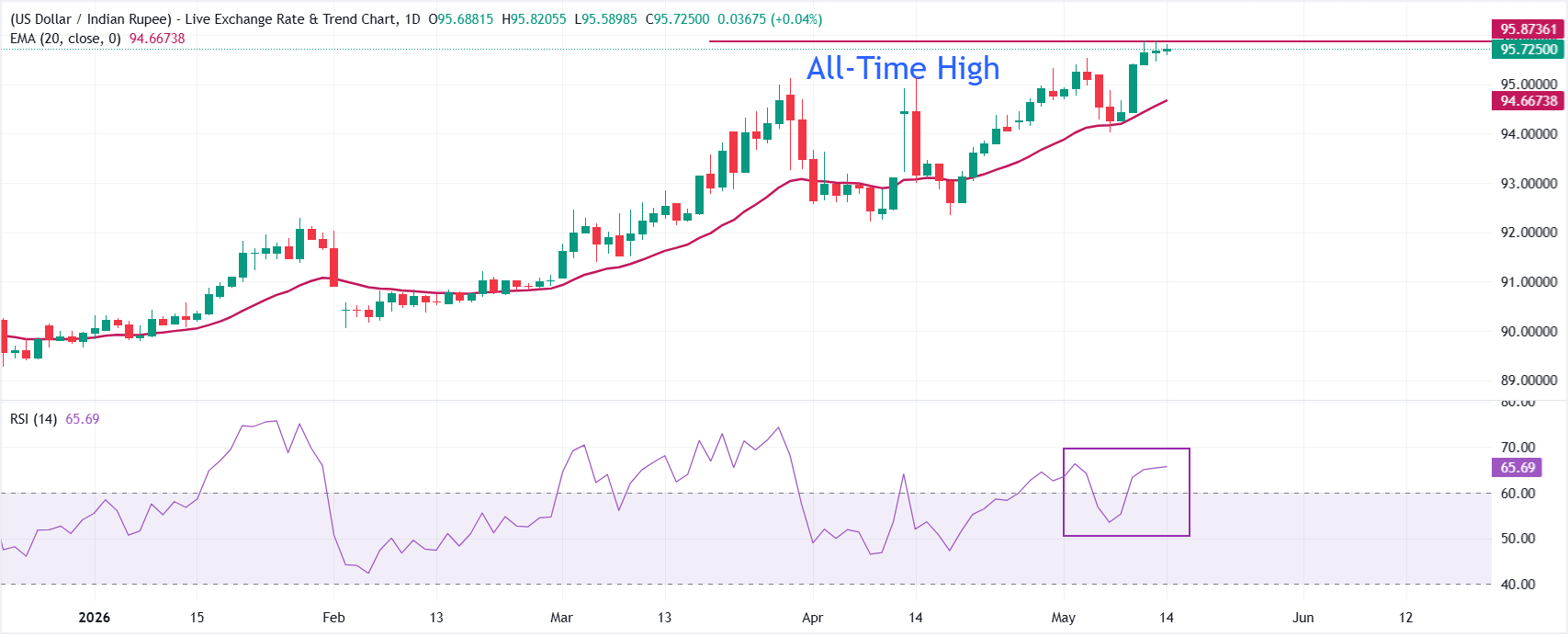
USD/INR trades firmly at around 95.80, extending its advance above the 20-day exponential moving average (EMA) at 94.68 and keeping a clear bullish near-term bias. The pair is supported by this rising EMA, while the Relative Strength Index (RSI) near 66 suggests strong but increasingly overbought momentum, hinting that upside progress could slow even as the broader uptrend remains intact.
On the downside, initial support is now seen at the 20-day EMA around 94.68, which acts as the first line of defense in case of a pullback, with the current price zone at 95.84 acting as a pivotal area for trend continuation. As long as USD/INR holds above this moving average, dips are likely to be viewed as corrective within the prevailing uptrend, while only a sustained break back below the EMA would start to undermine the bullish structure.
(The technical analysis of this story was written with the help of an AI tool.)
Indian Rupee FAQs
The Indian Rupee (INR) is one of the most sensitive currencies to external factors. The price of Crude Oil (the country is highly dependent on imported Oil), the value of the US Dollar – most trade is conducted in USD – and the level of foreign investment, are all influential. Direct intervention by the Reserve Bank of India (RBI) in FX markets to keep the exchange rate stable, as well as the level of interest rates set by the RBI, are further major influencing factors on the Rupee.
The Reserve Bank of India (RBI) actively intervenes in forex markets to maintain a stable exchange rate, to help facilitate trade. In addition, the RBI tries to maintain the inflation rate at its 4% target by adjusting interest rates. Higher interest rates usually strengthen the Rupee. This is due to the role of the ‘carry trade’ in which investors borrow in countries with lower interest rates so as to place their money in countries’ offering relatively higher interest rates and profit from the difference.
Macroeconomic factors that influence the value of the Rupee include inflation, interest rates, the economic growth rate (GDP), the balance of trade, and inflows from foreign investment. A higher growth rate can lead to more overseas investment, pushing up demand for the Rupee. A less negative balance of trade will eventually lead to a stronger Rupee. Higher interest rates, especially real rates (interest rates less inflation) are also positive for the Rupee. A risk-on environment can lead to greater inflows of Foreign Direct and Indirect Investment (FDI and FII), which also benefit the Rupee.
Higher inflation, particularly, if it is comparatively higher than India’s peers, is generally negative for the currency as it reflects devaluation through oversupply. Inflation also increases the cost of exports, leading to more Rupees being sold to purchase foreign imports, which is Rupee-negative. At the same time, higher inflation usually leads to the Reserve Bank of India (RBI) raising interest rates and this can be positive for the Rupee, due to increased demand from international investors. The opposite effect is true of lower inflation.














