

Trading
Explorez une large gamme de marchés avec des prix compétitifs, une liquidité profonde et des outils de trading avancés.
En savoir plus 
Plateforme
Tradez en toute fluidité avec la plateforme puissante de TMGM, conçue pour la vitesse, la précision et une expérience de trading supérieure.
En savoir plus Plateforme de trading
Outils de trading
Académie
Apprenez les fondamentaux du trading avec des ressources adaptées aux débutants, incluant des guides, des webinaires et des analyses de marché.
En savoir plus Actualités et analyses
Obtenez des mises à jour de marché en temps réel et des analyses d'experts pour anticiper les opportunités de trading
En savoir plus Actualités et analyses
À propos
Découvrez ce qui distingue TMGM — notre présence mondiale, notre solidité réglementaire et notre engagement envers l'innovation dans le trading.
En savoir plus Pourquoi choisir TMGM
Silver Price Forecast: XAG/USD jumps to near $61.80 as hawkish Fed bets recede
- Silver price surges to near $61.80 amid receding hawkish Fed expectations.
- Traders pare hawkish Fed bets due to soft US NFP data for September.
- The US Dollar remains firm due to increased French debt concerns.
Silver price (XAG/USD) is up 2.3% to near $61.80 during the European trading session on Monday. The white metal starts the week on a strong note as traders have scaled back Federal Reserve’s (Fed) interest rate expectations after soft United States (US) official labor market data for September.

The data showed on Friday that the economy created 29K fresh jobs in September, fewer than 90K estimates and the previous reading of 133K, revised lower from 162K. The Unemployment Rate increased to 4.2%, while it was expected to remain steady at 4.1%.
According to the CME FedWatch tool, the odds of the Fed hiking interest rates in the policy meeting later this month have diminished to 19.4% from 70.9% seen a week ago.
Theoretically, the scenario of traders trimming hawkish Fed prospects improve the appeal of non-yielding assets, such as Silver.
Contrary to market reaction, analysts at Deutsche Bank see the overall labor market picture remaining steady and expect two further 25 basis points (bps) Fed hikes over the next couple of quarters.
US labour data seen as resilient, keeping Fed hike expectations in place
According to Deutsche Bank, the latest US payrolls disappointment has not fundamentally altered their assessment of the labour backdrop. They note that “our US economists think the details still point to a broadly stable labour market,” with the softer headline figure offset by strength elsewhere. In their view, “although the headline payroll number was disappointing, the wider labour-market picture remains relatively resilient, particularly alongside recent ADP and jobless-claims readings.”
Meanwhile, the US Dollar (USD) remains broadly firm as heightened French fiscal risks have improved its safe-haven demand. The US Dollar Index (DXY), which gauges the Greenback’s value against six major currencies, trades 0.3% higher to near 102.20. The DXY posted a fresh annual high near 102.53 during the day. Technically, a higher US Dollar makes the Silver price an unfavorble risk-reward bet for investors.
Silver Technical Analysis
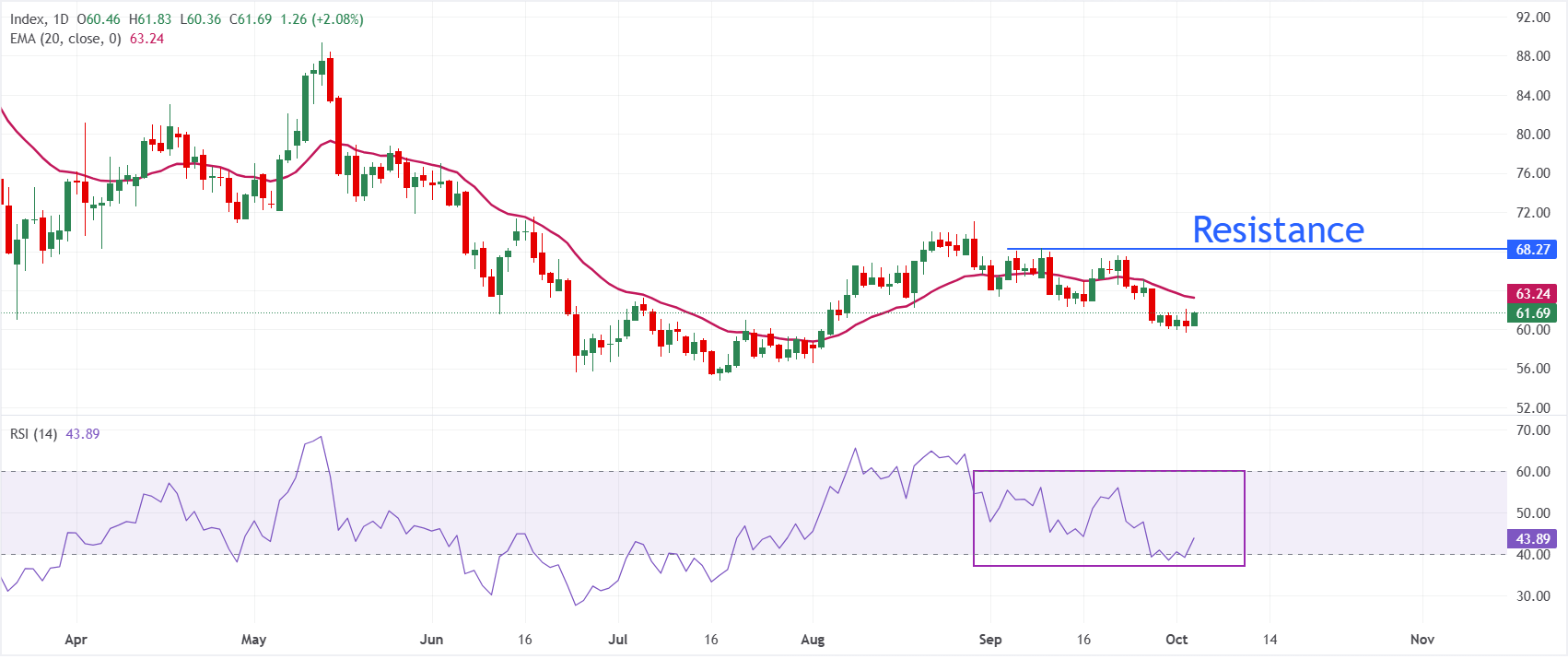
In the daily chart, XAG/USD trades at $61.69, maintaining a bearish near-term bias as it holds beneath the 20-day exponential moving average (EMA) at $63.24. The metal remains pressured by this overhead dynamic resistance, while the Relative Strength Index (RSI) at 43.89 stays below the midline, hinting at subdued bullish momentum rather than an imminent recovery.
On the topside, the 20-day EMA at $63.24 is the first resistance that bulls must reclaim to ease the current downside pressure and open the way for a more sustained rebound towards the September 9 high at $68.33. Looking down, the psychological level of $30 is the immediate support zone. The Silver price could fall further to the August 3 low at $56.57 if it fails to hold $60.00.
(The technical analysis of this story was written with the help of an AI tool. Know more.)
Silver FAQs
Silver is a precious metal highly traded among investors. It has been historically used as a store of value and a medium of exchange. Although less popular than Gold, traders may turn to Silver to diversify their investment portfolio, for its intrinsic value or as a potential hedge during high-inflation periods. Investors can buy physical Silver, in coins or in bars, or trade it through vehicles such as Exchange Traded Funds, which track its price on international markets.
Silver prices can move due to a wide range of factors. Geopolitical instability or fears of a deep recession can make Silver price escalate due to its safe-haven status, although to a lesser extent than Gold's. As a yieldless asset, Silver tends to rise with lower interest rates. Its moves also depend on how the US Dollar (USD) behaves as the asset is priced in dollars (XAG/USD). A strong Dollar tends to keep the price of Silver at bay, whereas a weaker Dollar is likely to propel prices up. Other factors such as investment demand, mining supply – Silver is much more abundant than Gold – and recycling rates can also affect prices.
Silver is widely used in industry, particularly in sectors such as electronics or solar energy, as it has one of the highest electric conductivity of all metals – more than Copper and Gold. A surge in demand can increase prices, while a decline tends to lower them. Dynamics in the US, Chinese and Indian economies can also contribute to price swings: for the US and particularly China, their big industrial sectors use Silver in various processes; in India, consumers’ demand for the precious metal for jewellery also plays a key role in setting prices.
Silver prices tend to follow Gold's moves. When Gold prices rise, Silver typically follows suit, as their status as safe-haven assets is similar. The Gold/Silver ratio, which shows the number of ounces of Silver needed to equal the value of one ounce of Gold, may help to determine the relative valuation between both metals. Some investors may consider a high ratio as an indicator that Silver is undervalued, or Gold is overvalued. On the contrary, a low ratio might suggest that Gold is undervalued relative to Silver.
ARTICLES POPULAIRES
1Australian Dollar: Downside limited against US Dollar – UOB2British Pound recovers some losses against US Dollar, ISM Services PMI eyed3Euro: Pressured yet systemic risk contained – DBS4Silver Price Forecast: XAG/USD jumps to near $61.80 as hawkish Fed bets recede5USD/CHF Price Forecast: Holds below 0.8320 as the Swissie withstands bonds selloff6Gold struggles as dovish Fed repricing meets stronger US Dollar, elevated yields7Why is the US Dollar rising despite October Fed hike odds fading?8Crypto Today: Bitcoin rally slows while Ethereum and XRP extend recovery amid slowing ETF inflows9AI Tokens Price Prediction: Capital rotation fuels FET, VIRTUAL, and NEAR rallies


Commencez !
Inscrivez-vous et accédez aux Marchés Mondiaux en moins de 3 minutes

Connectez-vous avec Nous









Contacts
Téléphone: +61 2 8036 8388
Fax: +61 2 8036 8388
Email: support@tmgm.com
Web: https://www.tmgm.com



Les informations fournies sur ce site web sont de nature générale uniquement et ne constituent pas un conseil financier personnalisé. Avant d’agir sur la base de toute information figurant sur ce site web, vous devez évaluer la pertinence de ces informations au regard de vos objectifs, de votre situation financière et de vos besoins. Investir dans les CFD et les contrats de marge sur le Forex comporte des risques importants et ne convient pas à tous les investisseurs. Vous pouvez perdre plus que votre dépôt initial. Vous ne détenez pas, et n’avez, aucun droit de propriété ou intérêt sur l’actif sous-jacent. Nous vous recommandons de solliciter un avis indépendant et de vous assurer que vous comprenez pleinement les risques encourus avant de trader. Il est important que vous lisiez et preniez en considération le document d’information avant d’acquérir tout produit présenté sur le site web. Les informations et publicités proposées sur ce site web ne sont pas destinées à être utilisées par toute personne dans tout pays ou toute juridiction où une telle utilisation serait contraire aux lois et réglementations locales. Les Produits et Services proposés sur ce site web ne sont pas destinés aux résidents des États-Unis, de la Malaisie et de la Thaïlande.
TMGM est autorisé et réglementé dans diverses juridictions.
Trademax Australia Limited, opérant sous le nom de TMGM, est réglementé par l'Australian Securities and Investments Commission (ASIC), AFSL no. 436416 et est situé au Level 28, One International Tower, 100 Barangaroo Avenue, 2000 Sydney, NSW Australie.
Email: support@tmgm.com.au
Trademax Global Limited, opérant sous le nom de TMGM, est autorisé et réglementé par la Vanuatu Financial Services Commission (VFSC), numéro d'enregistrement 40356 et enregistré au 1276, Kumul Highway, Port Vila, Vanuatu, République de Vanuatu.
Email: support@tmgm.com
Trademax Global Markets (SE) Limited, exerçant sous le nom TMGM, est autorisée et régulée par la Financial Services Authority (FSA) des Seychelles, sous le numéro de licence SD224. La société est enregistrée au bureau n° 13, Providence Estate ABIS Centre, Mahé, Seychelles.
Email: support@tmgm.com
Trademax Global Markets (International) Pty Ltd, opérant sous le nom de TMGM, est autorisé et réglementé par la Financial Services Commission, Maurice (FSC) avec la licence no. GB22201012, et enregistré au 33, Edith Cavell Street C/o IQ EQ Fund Services (Mauritius) Ltd Port Louis, 11324 Maurice.
Email: support@tmgm.com
Copyright © TMGM. Tous droits réservés