[TMGM Financial Breakfast] Gold Gains Geopolitical Tailwinds as Inverse Gold-Oil Trend Signals Major Strategic Opportunities
A weaker U.S. dollar and limited rebound in U.S. Treasury yields have provided supportive conditions for gold prices. Meanwhile, easing inflation concerns—largely driven by the pullback in international crude oil prices—have further stabilized gold. The inverse relationship between gold and oil stems from inflation expectations: rising oil prices push inflation expectations higher, which in turn drives up global bond yields. Higher bond yields increase the opportunity cost of holding non-yielding assets like gold.
On the 9th, former U.S. President Donald Trump publicly stated that military operations would conclude soon and announced the lifting of certain oil-related sanctions. He emphasized that if Iran were to take any action to block oil flows through the Strait of Hormuz, the United States would respond with force “twenty times greater” than current measures.

However, the U.S. Secretary of Defense stated that operations are proceeding according to schedule and that the U.S. will not end its war with Iran unless the enemy is defeated. Over the past 24 hours, the number of missiles launched by Iran hit a historic low. The U.S. military’s objective remains the destruction of Iran’s missile systems and defense industrial base.
Although Trump signaled potential de-escalation, military operations by Israel, the United States, and Iran continue. Nevertheless, there are growing calls to ensure the Strait of Hormuz remains open, easing immediate concerns over crude oil transportation.
Driven by Middle East geopolitical tensions, crude oil prices surged sharply on Monday as tanker traffic through the Strait of Hormuz faced restrictions. Major oil producers including Saudi Arabia, the UAE, Kuwait, and Iraq have been forced to cut production due to rapidly reaching storage capacity limits, intensifying expectations of a tightening global oil supply.
Additionally, facilities in the UAE’s Ruwais Industrial Area were struck by drone attacks, triggering fires and affecting the country’s largest refinery with processing capacity exceeding 900,000 barrels per day. Earlier, Saudi Arabia shut down its largest refinery, and Qatar’s LNG export facilities were also closed following attacks, placing sustained pressure on the Middle East energy supply chain.
Market Analysis:
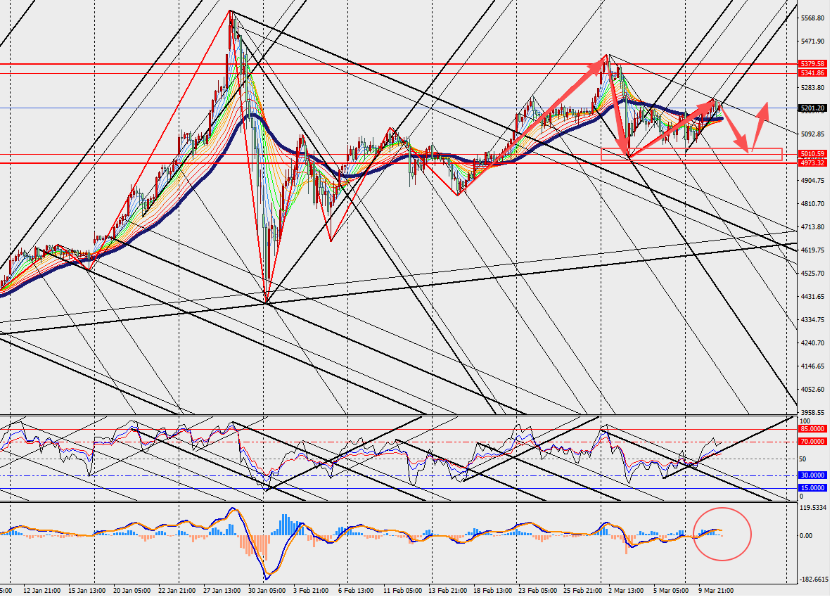
On the four-hour chart, gold remains in a consolidation phase, with the MACD lines and histogram expanding above the zero axis but showing reduced momentum. Escalating oil supply risks could reignite inflation expectations, potentially influencing the Federal Reserve’s rate-cut timeline and directly impacting gold pricing. At the same time, ongoing geopolitical tensions in the Middle East are likely to support safe-haven demand for gold.