

Australian Dollar turns upside down as Trump says MoU with Iran seems over
- The Australian Dollar weakens against the US Dollar as US President Trump said he believes that the MoU with Iran is over.
- Market sentiment turns significantly risk-averse following remarks from US President Trump.
- RBA’s Hauser signals that the central bank is committed to bringing inflation to target.
The Australian Dollar (AUD) gives back its early gains and turns lower to near 0.6915 against the US Dollar (USD) during the European trading session on Wednesday. The Aussie pair faces selling pressure as remarks from United States (US) President Donald Trump that the Memorandum of Understanding (MoU) with Iran, which aimed for a ceasefire between them, seems over, have prompted demand for safe-haven assets.

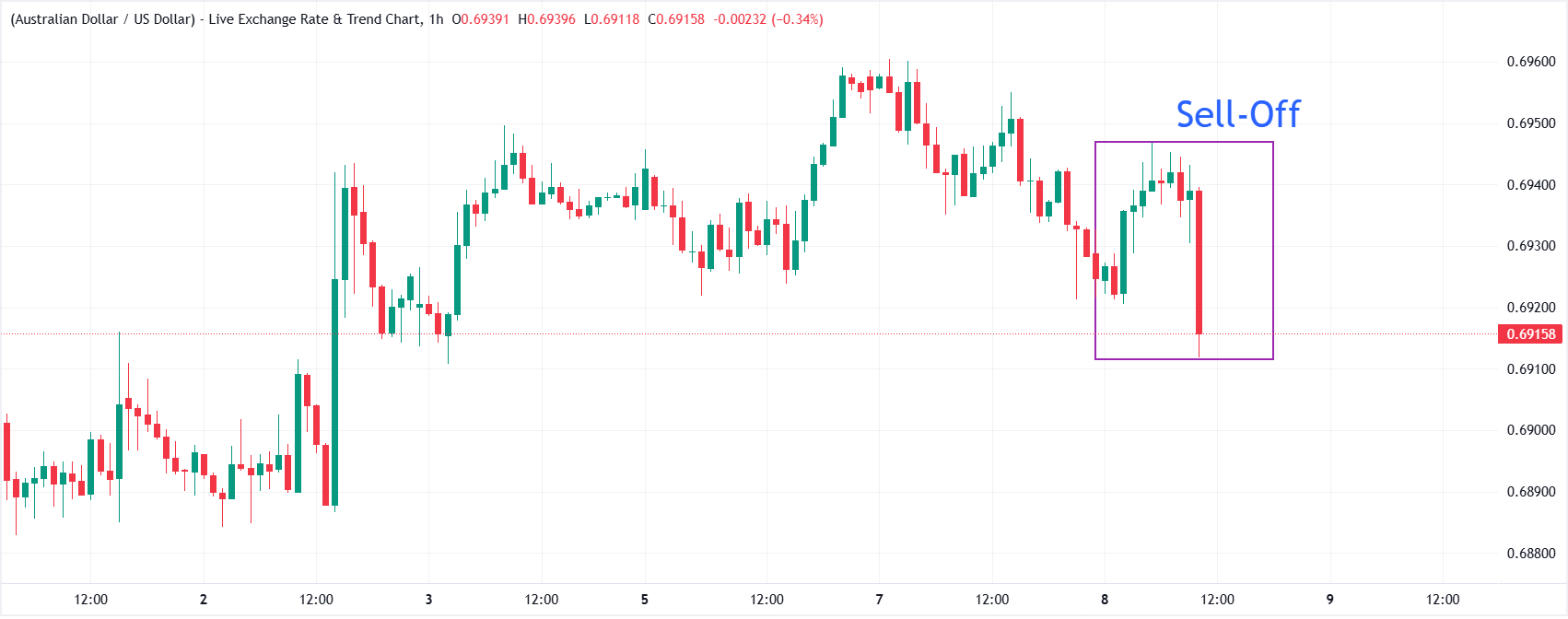
“I think MoU with Iran is over,” US President Trump said. “I don't want to deal with Iran. They are sick people,” he added.
S&P 500 futures tumble over 0.7% to near 7,445, reflecting a weak risk appetite of investors. The US Dollar Index (DXY), which gauges the Greenback’s value against six major currencies, turns almost flat around 101.15 after recovering early losses.
Earlier in the day, the Australian Dollar outperformed as RBA Assistant Governor Sarah Hunter reiterated that the central bank would act, if needed, for inflation to return to target and maintain sustainable full employment.
Meanwhile, investors await the Federal Open Market Committee (FOMC) minutes of the June policy meeting, which will be published at 18:00 GMT.
Investors will pay close attention to FOMC minutes to get cues regarding why policymakers refrained from delivering forward guidance on interest rates. In the monetary policy press conference, Fed Chair Kevin Warsh said, “Policymakers agreed that so-called forward guidance is not well-suited in the current policy juncture.”
Risk sentiment FAQs
In the world of financial jargon the two widely used terms “risk-on” and “risk off'' refer to the level of risk that investors are willing to stomach during the period referenced. In a “risk-on” market, investors are optimistic about the future and more willing to buy risky assets. In a “risk-off” market investors start to ‘play it safe’ because they are worried about the future, and therefore buy less risky assets that are more certain of bringing a return, even if it is relatively modest.
Typically, during periods of “risk-on”, stock markets will rise, most commodities – except Gold – will also gain in value, since they benefit from a positive growth outlook. The currencies of nations that are heavy commodity exporters strengthen because of increased demand, and Cryptocurrencies rise. In a “risk-off” market, Bonds go up – especially major government Bonds – Gold shines, and safe-haven currencies such as the Japanese Yen, Swiss Franc and US Dollar all benefit.
The Australian Dollar (AUD), the Canadian Dollar (CAD), the New Zealand Dollar (NZD) and minor FX like the Ruble (RUB) and the South African Rand (ZAR), all tend to rise in markets that are “risk-on”. This is because the economies of these currencies are heavily reliant on commodity exports for growth, and commodities tend to rise in price during risk-on periods. This is because investors foresee greater demand for raw materials in the future due to heightened economic activity.
The major currencies that tend to rise during periods of “risk-off” are the US Dollar (USD), the Japanese Yen (JPY) and the Swiss Franc (CHF). The US Dollar, because it is the world’s reserve currency, and because in times of crisis investors buy US government debt, which is seen as safe because the largest economy in the world is unlikely to default. The Yen, from increased demand for Japanese government bonds, because a high proportion are held by domestic investors who are unlikely to dump them – even in a crisis. The Swiss Franc, because strict Swiss banking laws offer investors enhanced capital protection.














