

Gold sinks 2% as Iran war fuels fresh inflation shock
- Gold falls by more than 2% as tensions with Iran lift Oil prices.
- Soaring Treasury yields pressure Bullion near the $4,500 area.
- Fed officials keep rate hikes alive if inflation persists.
Gold price retreats by over 2.30% on Friday amid fears that prolonged hostilities between the US and Iran could trigger a second wave of inflation, forcing central banks to hike interest rates. The XAU/USD trades at $4,551 after bottoming at around $4,511.
XAU/USD slides as yields surge and Fed cuts vanish

US Treasury yields are soaring, with the 10-year T-note coupon hitting yearly highs at 4.591%, up 10 basis points and poised to challenge the 2025 high of 4.627%. The Greenback has followed suit, as shown by the US Dollar Index (DXY), which tracks the performance of the American currency against the other six, up 0.33% to 99.19.
Overnight news of US President Donald Trump revealing that he’s losing patience with Iran pushed Oil prices higher, amid speculation of a resumption of hostilities. US inflation data released on Tuesday and Wednesday had erased the chances of the Federal Reserve (Fed) easing, a headwind for Bullion, which fares well in low interest rate environments.
The Fed, under Kevin Warsh’s first meeting as the new Chair, is expected to hold rates unchanged in June and through the end of the year, according to Prime Terminal data.
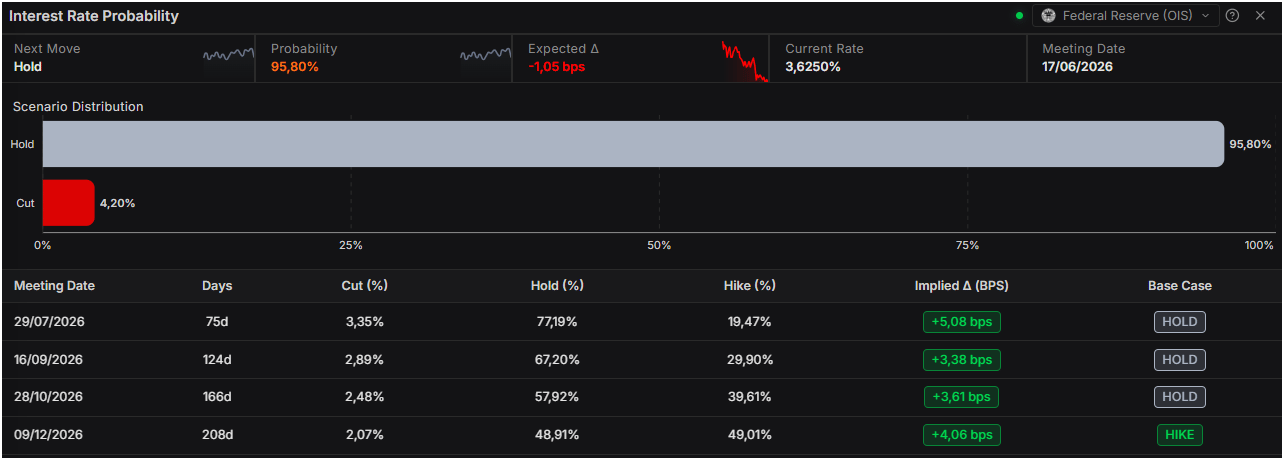
Several Fed policymakers stressed this week that containing inflation remains a priority, with some leaving open the possibility of further rate hikes if price pressures persist.
US data showed Industrial Production rose 0.7% MoM in April, beating forecasts of 0.3% and rebounding from March’s 0.3% decline.
Next week, US traders are now awaiting housing and labor market data, as well as remarks from Fed officials.
XAU/USD technical outlook: Gold set to trade sideways, but bears loom
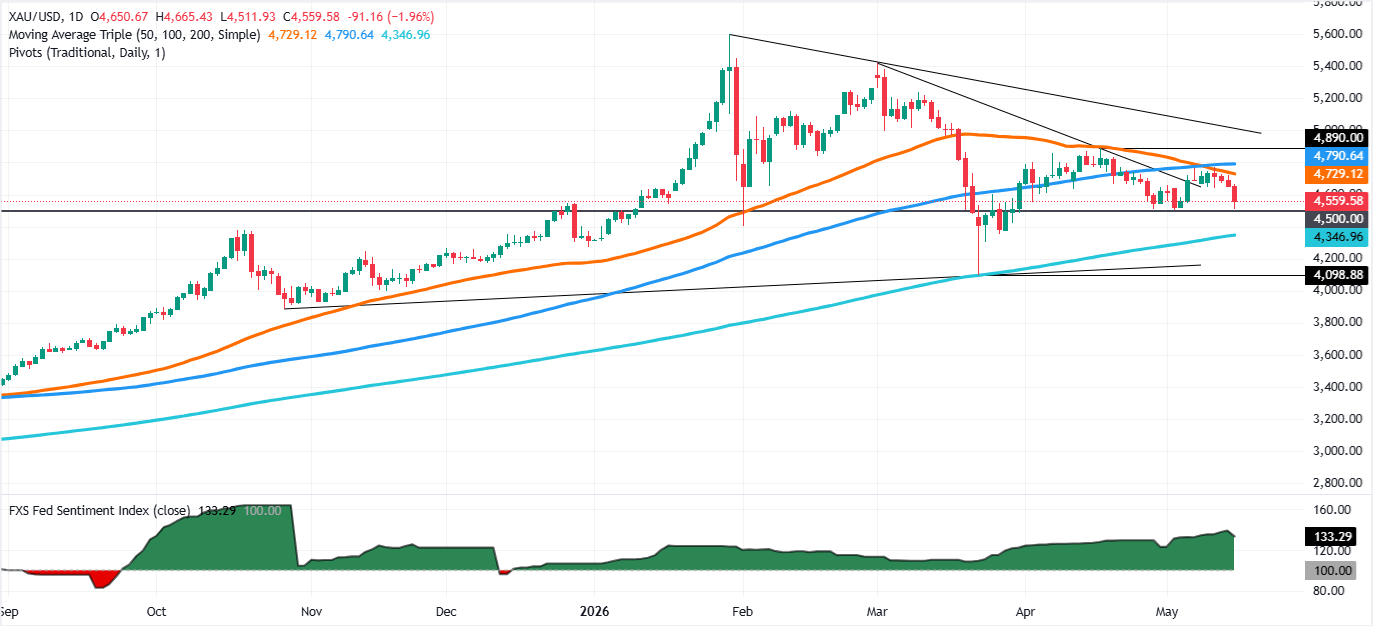
From a technical standpoint, Gold is poised to consolidate around $ 4,500–$4,650 in the short term after clearing key Simple Moving Averages (SMAs) during the week. Momentum is clearly bearish as depicted by the Relative Strength Index (RSI), falling toward oversold territory after diving beneath the 50-neutral level two days ago.
If XAU/USD clears the next area of interest being the May 4 daily low of $4,500, this opens the door for further losses. Downwards, the next support would be the March 26 daily low of $4,351, before challenging the 200-day SMA at $4,322.
On the upside, if Gold regains control above $4,600, the next resistance is the 20-day SMA at $4,662, ahead of the psychological $4,700. The next area of interest is the 50 and 100-day SMAs at $4,729 and $4,785, respectively. Up next is the $4,800 milestone.
Gold FAQs
Gold has played a key role in human’s history as it has been widely used as a store of value and medium of exchange. Currently, apart from its shine and usage for jewelry, the precious metal is widely seen as a safe-haven asset, meaning that it is considered a good investment during turbulent times. Gold is also widely seen as a hedge against inflation and against depreciating currencies as it doesn’t rely on any specific issuer or government.
Central banks are the biggest Gold holders. In their aim to support their currencies in turbulent times, central banks tend to diversify their reserves and buy Gold to improve the perceived strength of the economy and the currency. High Gold reserves can be a source of trust for a country’s solvency. Central banks added 1,136 tonnes of Gold worth around $70 billion to their reserves in 2022, according to data from the World Gold Council. This is the highest yearly purchase since records began. Central banks from emerging economies such as China, India and Turkey are quickly increasing their Gold reserves.
Gold has an inverse correlation with the US Dollar and US Treasuries, which are both major reserve and safe-haven assets. When the Dollar depreciates, Gold tends to rise, enabling investors and central banks to diversify their assets in turbulent times. Gold is also inversely correlated with risk assets. A rally in the stock market tends to weaken Gold price, while sell-offs in riskier markets tend to favor the precious metal.
The price can move due to a wide range of factors. Geopolitical instability or fears of a deep recession can quickly make Gold price escalate due to its safe-haven status. As a yield-less asset, Gold tends to rise with lower interest rates, while higher cost of money usually weighs down on the yellow metal. Still, most moves depend on how the US Dollar (USD) behaves as the asset is priced in dollars (XAU/USD). A strong Dollar tends to keep the price of Gold controlled, whereas a weaker Dollar is likely to push Gold prices up.













