

Gold slides as strong USD, US-China summit dent haven demand
- US Retail Sales confirm consumer resilience despite higher gasoline prices.
- Stronger US Dollar and sticky inflation weigh on Gold’s appeal.
- Trump and Xi meet in China , with Taiwan tensions clouding trade optimism.
Gold (XAU/USD) retreats by some 0.25% during the North American session on Thursday as tensions in the Middle East remain high, while the US-China summit is underway, with President Donald Trump meeting Chinese President Xi Jinping. At the time of writing, the XAU/USD pair trades at $4,678.

XAU/USD falls as resilient US data boosts Dollar demand
Negotiations between the US and Iran have stalled, failing to provide relief for investors, yet US equities have pushed towards new all-time highs, as risk appetite improved. In the meantime, discussions between Presidents Trump and Xi began, with the former saying that Beijing agreed to buy 200 Boeing jets, while clearing sales of NVIDIA H200 chips to 10 Chinese firms.
The Chinese President, warned Trump that disagreements over Taiwan could push relations to “a very dangerous place” as the two began the two-day summit. Xi told Trump that negotiations between the US and Chinese trade teams in South Korea reached “balanced and positive outcomes.”
Economic data in the US showed that Retail Sales rose 0.5% MoM in April, matching forecasts but below March’s 1.6% reading. On an annual basis, sales increased 4.9%, beating expectations for 3.3% growth. At the same time, Initial Jobless Claims for the week ending May 9 came in at 211K, above the 205K forecast.
After the data, bullion extended its losses as the Greenback printed another leg higher, as American consumers remained resilient despite paying high gasoline prices at the pump.
The US Dollar Index (DXY), which tracks the buck’s value against a basket of six currencies, is up 0.38% at 98.82, refreshing two-week highs with investors setting their sights on the 100.00 barrier.
Another factor weighing on Gold is the latest US inflation data, which reflected the energy shock: the Producer Price Index (PPI) rose 6% YoY, and the Consumer Price Index (CPI) reached 3.8%, moving further away from the Federal Reserve’s 2% target.
Investors turned skeptical that the Federal Reserve will cut rates in 2026. Data from Prime Terminal shows that money markets expect the Fed to hold rates unchanged at the next meeting, the first under the new Fed Chair, Kevin Warsh.
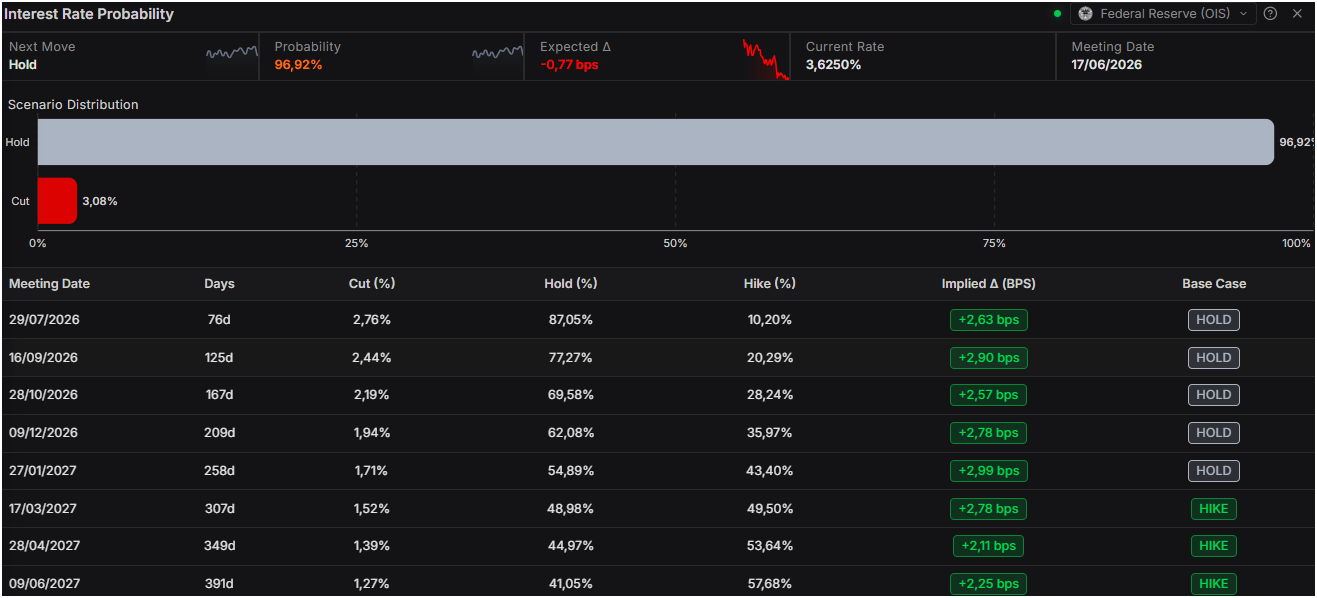
Earlier, Kansas City Fed's Jeffrey Schmid stated that “inflation is the most pressing risk to the US economy.” He added that the economy “has shown remarkable resilience” and that the job market is “functioning effectively.”
Cleveland Fed Beth Hammack commented that central bank independence “is important in achieving our dual mandate goals of maximum employment and price stability.” She added that it allows policymakers to make decisions based “on incoming data and the evolving outlook.”
Ahead in the week, traders will eye the release of the New York Fed Empire State Manufacturing Index and speeches by Federal Reserve officials.
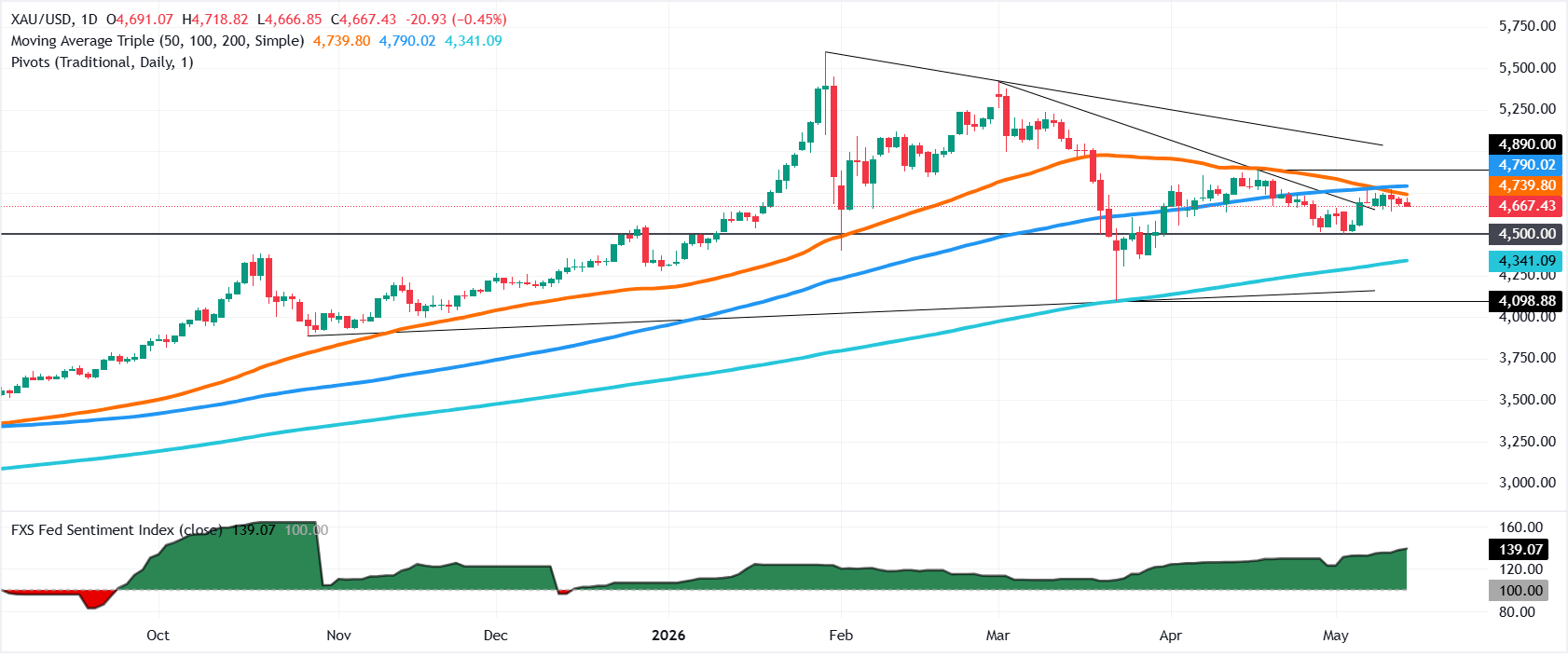
XAU/USD technical outlook: Gold consolidates within $4,650-$4,700
Gold continues to struggle to decisively break the $4,700 milestone, as bullish momentum fades and sellers seem to gain traction. The Relative Strength Index (RSI) shifted bearishly, indicating further downside lies ahead.
For a bearish continuation, sellers must clear $4,650. Once hurdled, the next area of interest would be the $4,600 mark before diving to the May 4 daily low of $4,500.
On the other hand, if bulls reclaim the $4,700, this could pave the way to challenge the 50- and 100-day Simple Moving Averages (SMAs) at $4,740 and $4,783, respectively. Once surpassed, the next stop would be $4,800.
Gold FAQs
Gold has played a key role in human’s history as it has been widely used as a store of value and medium of exchange. Currently, apart from its shine and usage for jewelry, the precious metal is widely seen as a safe-haven asset, meaning that it is considered a good investment during turbulent times. Gold is also widely seen as a hedge against inflation and against depreciating currencies as it doesn’t rely on any specific issuer or government.
Central banks are the biggest Gold holders. In their aim to support their currencies in turbulent times, central banks tend to diversify their reserves and buy Gold to improve the perceived strength of the economy and the currency. High Gold reserves can be a source of trust for a country’s solvency. Central banks added 1,136 tonnes of Gold worth around $70 billion to their reserves in 2022, according to data from the World Gold Council. This is the highest yearly purchase since records began. Central banks from emerging economies such as China, India and Turkey are quickly increasing their Gold reserves.
Gold has an inverse correlation with the US Dollar and US Treasuries, which are both major reserve and safe-haven assets. When the Dollar depreciates, Gold tends to rise, enabling investors and central banks to diversify their assets in turbulent times. Gold is also inversely correlated with risk assets. A rally in the stock market tends to weaken Gold price, while sell-offs in riskier markets tend to favor the precious metal.
The price can move due to a wide range of factors. Geopolitical instability or fears of a deep recession can quickly make Gold price escalate due to its safe-haven status. As a yield-less asset, Gold tends to rise with lower interest rates, while higher cost of money usually weighs down on the yellow metal. Still, most moves depend on how the US Dollar (USD) behaves as the asset is priced in dollars (XAU/USD). A strong Dollar tends to keep the price of Gold controlled, whereas a weaker Dollar is likely to push Gold prices up.













