

Silver Price Forecast: XAG/USD languishes below $74.00 ahead of Fed interest rate decision
- Silver's recovery from Tuesday's lows near $72.00 has been capped below $74.00.
- Precious metals remain on their back foot as the market braces for the Fed's decision.
- XAG/USD maintains its bearish trend from mid-April highs in play.
Silver (XAG/USD) edged up from three-week lows near $72.00 earlier on Wednesday, but it failed to find acceptance above $74.00, and is trading practically flat on the daily chart at $73.10 at the time of writing. The US Dollar (USD) remains moderately bid, with all eyes on the US Federal Reserve’s (Fed) monetary policy meeting, due later on Wednesday.
The Fed is widely expected to keep interest rates unchanged, but Chairman Jerome Powell, who will likely be at its last meeting in front of the central bank, has to decide between remaining on the Board of Governors or leaving the bank as US President Donald Trump requested.
Looking forward, the TD Securities commodity team sees room for further depreciation if the war in the Middle East hampers growth and raises carry costs: "Silver is also likely to drop sharply if inflation causes the economy to slow and increases the cost of carry. A weak economy would reduce industrial demand, while higher rates would erode investor interest."
Technical Analysis: The bearish trend remains intact
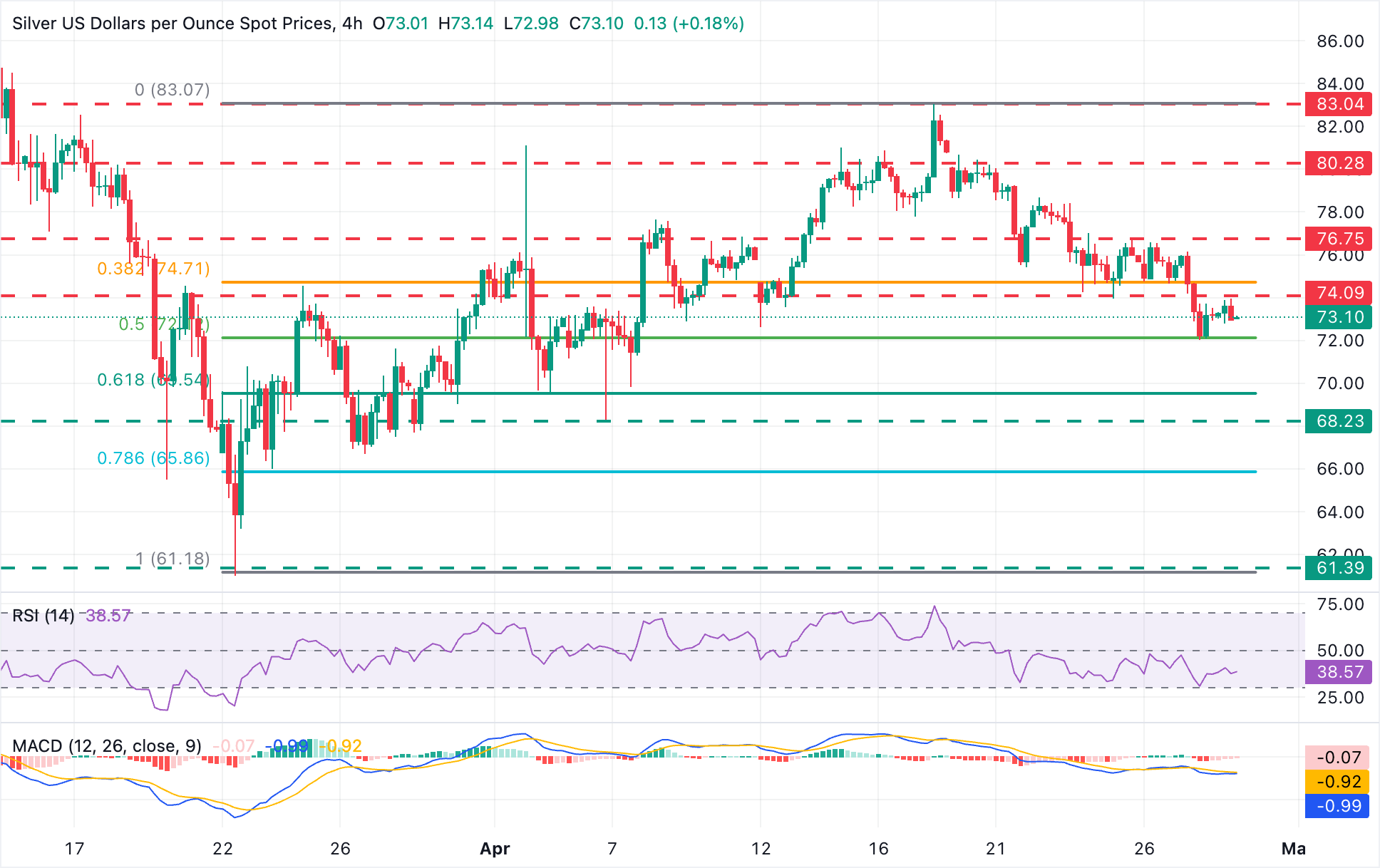
XAG/USD is trading near $73.00 amid a near-term bearish trend from mid-April highs above $83.00. The pair found support at the 50% Fibonacci retracement of the March-April rally, near $72.00, but upside attempts remain limited for now.
The 4-hour Relative Strength Index (RSI) hovers below the 50 line, and the Moving Average Convergence Divergence (MACD) histogram remains below zero, pointing to a neutral-to-negative tone, with the pair lacking momentum to sustain a significant recovery.
Bulls would need to break session highs in the mentioned $74.00 area and last week's highs between $76.70 and $77.00 to negate the bearish structure and attract buyers to retest the $80.00 psychological area.
On the downside, a break below the $72.12 Fibonacci floor would expose deeper supports at the 61.8% Fibonacci retracement near $69.50 ahead of the April 7 low, near $68.30.
(The technical analysis of this story was written with the help of an AI tool.)
Silver FAQs
Silver is a precious metal highly traded among investors. It has been historically used as a store of value and a medium of exchange. Although less popular than Gold, traders may turn to Silver to diversify their investment portfolio, for its intrinsic value or as a potential hedge during high-inflation periods. Investors can buy physical Silver, in coins or in bars, or trade it through vehicles such as Exchange Traded Funds, which track its price on international markets.
Silver prices can move due to a wide range of factors. Geopolitical instability or fears of a deep recession can make Silver price escalate due to its safe-haven status, although to a lesser extent than Gold's. As a yieldless asset, Silver tends to rise with lower interest rates. Its moves also depend on how the US Dollar (USD) behaves as the asset is priced in dollars (XAG/USD). A strong Dollar tends to keep the price of Silver at bay, whereas a weaker Dollar is likely to propel prices up. Other factors such as investment demand, mining supply – Silver is much more abundant than Gold – and recycling rates can also affect prices.
Silver is widely used in industry, particularly in sectors such as electronics or solar energy, as it has one of the highest electric conductivity of all metals – more than Copper and Gold. A surge in demand can increase prices, while a decline tends to lower them. Dynamics in the US, Chinese and Indian economies can also contribute to price swings: for the US and particularly China, their big industrial sectors use Silver in various processes; in India, consumers’ demand for the precious metal for jewellery also plays a key role in setting prices.
Silver prices tend to follow Gold's moves. When Gold prices rise, Silver typically follows suit, as their status as safe-haven assets is similar. The Gold/Silver ratio, which shows the number of ounces of Silver needed to equal the value of one ounce of Gold, may help to determine the relative valuation between both metals. Some investors may consider a high ratio as an indicator that Silver is undervalued, or Gold is overvalued. On the contrary, a low ratio might suggest that Gold is undervalued relative to Silver.














