

AUD/USD Price Forecast: Middle East peace hopes back further recovery towards 20-day EMA
- AUD/USD rises further to near 0.6910 as de-escalation in the Middle East war has boosted investors’ risk appetite.
- Both the US and Iran have signaled readiness to end the Middle East war.
- Investors await the US ADP Employment data for fresh cues on the interest rate outlook.
The AUD/USD pair gives back some of its early gains, but still trades 0.12% higher to near 0.6910 during the late Asian trading session on Wednesday. The Aussie pair extends Tuesday’s recovery move, as hopes of a ceasefire in the Middle East have strengthened after comments from both the United States (US) and Iran signaling willingness to end the war.
The expectation of an end to the month-long Middle East war has improved the demand of riskier assets. As of writing, S&P 500 futures trade 0.33% higher even after surging almost 3% on Tuesday, reflecting a significant improvement in investors; risk appetite.
Meanwhile, the US Dollar (USD) extends its corrective move as its safe-haven demand has diminished amid de-escalating Middle East tensions. During the press time, the US Dollar Index (DXY), which gauges the Greenback’s value against six major currencies, trades 0.1% lower to near 99.75.
Going forward, investors will focus on the US ADP Employment Change and the Manufacturing PMI data for March, which will be published in the North American session. Investors will pay close attention to the private employment data to get fresh cues on the US interest rate outlook.
AUD/USD technical analysis
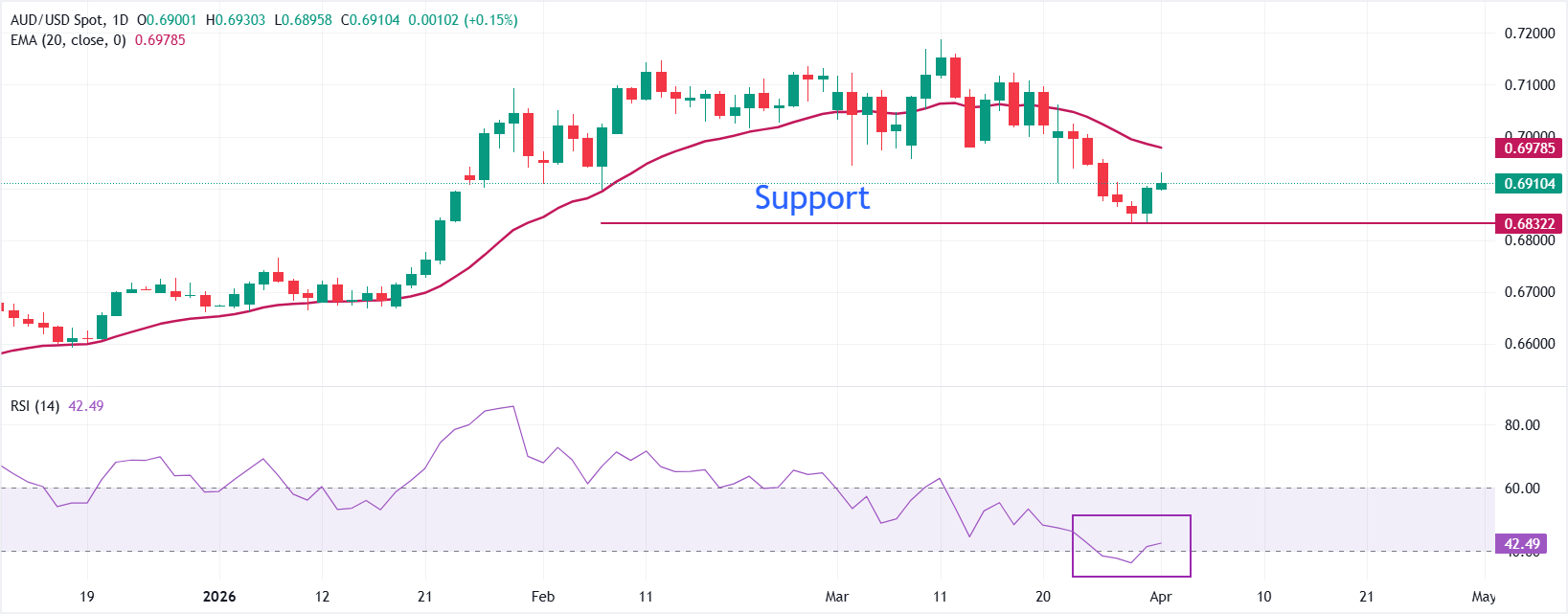
AUD/USD trades higher at around 0.6910 at the press time. However, the near-term bias is mildly bearish as the pair now holds below the 20-day Exponential Moving Average (EMA), which has started to roll over after capping recent rebounds near the 0.70 area. Price has transitioned from trading above this average to respecting it as dynamic resistance, underscoring a loss of upside momentum from the mid-0.71 region.
The recovery move by the 14-day Relative Strength Index (RSI) above 40.00 after sliding below that level signals the presence of buying interest at lower levels, which diminishes the strength of an overall bearish tone.
Initial resistance emerges at 0.6980, where the 20-day EMA clusters with recent minor swing highs, followed by stronger resistance at 0.7050, whose break would be needed to challenge the 0.7120 peak. On the downside, the March 31 low at 0.6834 is the immediate support is at 0.6885, guarding the late pullback lows, with a break exposing the January 7 high of 0.6766 as the next level.
(The technical analysis of this story was written with the help of an AI tool.)
Risk sentiment FAQs
In the world of financial jargon the two widely used terms “risk-on” and “risk off'' refer to the level of risk that investors are willing to stomach during the period referenced. In a “risk-on” market, investors are optimistic about the future and more willing to buy risky assets. In a “risk-off” market investors start to ‘play it safe’ because they are worried about the future, and therefore buy less risky assets that are more certain of bringing a return, even if it is relatively modest.
Typically, during periods of “risk-on”, stock markets will rise, most commodities – except Gold – will also gain in value, since they benefit from a positive growth outlook. The currencies of nations that are heavy commodity exporters strengthen because of increased demand, and Cryptocurrencies rise. In a “risk-off” market, Bonds go up – especially major government Bonds – Gold shines, and safe-haven currencies such as the Japanese Yen, Swiss Franc and US Dollar all benefit.
The Australian Dollar (AUD), the Canadian Dollar (CAD), the New Zealand Dollar (NZD) and minor FX like the Ruble (RUB) and the South African Rand (ZAR), all tend to rise in markets that are “risk-on”. This is because the economies of these currencies are heavily reliant on commodity exports for growth, and commodities tend to rise in price during risk-on periods. This is because investors foresee greater demand for raw materials in the future due to heightened economic activity.
The major currencies that tend to rise during periods of “risk-off” are the US Dollar (USD), the Japanese Yen (JPY) and the Swiss Franc (CHF). The US Dollar, because it is the world’s reserve currency, and because in times of crisis investors buy US government debt, which is seen as safe because the largest economy in the world is unlikely to default. The Yen, from increased demand for Japanese government bonds, because a high proportion are held by domestic investors who are unlikely to dump them – even in a crisis. The Swiss Franc, because strict Swiss banking laws offer investors enhanced capital protection.














