


Gold gains on geopolitics as Fed hike bets shift to December
- Gold recovers to above $4,130 as falling yields offset a hawkish Fed.
- Strait of Hormuz tension keeps WTI elevated despite Trump remarks.
- Markets price in an 81% chance of a 25 bps Fed rate hike in December.
Gold (XAU/USD) price edges higher on Thursday, underpinned by lower US Treasury yields and a weaker US Dollar, even as Federal Reserve (Fed) officials support further tightening by the US central bank. At the time of writing, XAU/USD trades at $4,130, up 0.48%, after bottoming near $4,103.
Bullion rises on falling US yields, despite Fed hawkish rhetoric
The Middle East crisis continues to pressure on inflation as energy prices remain high, pushing global bond yields to multi-year record highs. Explosions around the Strait of Hormuz keep West Texas Intermediate (WTI), the US crude benchmark, at $90.85, up over 2%, which posted earlier gains of more than 4% if not for comments by US President Donald Trump.
Trump said that the US won’t attack Iran before the midterm elections. Nevertheless, an Axios report showed that US and Israeli officials said that Iranian leaders are suspicious of Trump’s comments, adding that Iranian leaders want to avoid a third surprise attack.
Federal Reserve policymakers made some hawkish comments but failed to provide forward guidance on October. St. Louis Fed President Alberto Musalem commented that inflation is high and that the strength of the labor market suggests the Fed must focus on tackling it.
Fed is hawkish but patient at the same time
Earlier, Fed Governor Christopher Waller eyed additional rate hikes but stressed that they do not need to be consecutive, shutting the door on the October meeting.
Money markets show that a rate hike in the October 27-28 meeting is a long shot. But for December, the odds are near 81% that the Fed will raise rates by 25 basis points.
On the data front, Initial Jobless Claims for the week ending October 3 came in at 197K, below forecasts of 200K and the prior week's 199K, suggesting an ongoing low-hire, low-fire jobs market.
Next for Gold traders, they must be attentive to geopolitical developments, the behavior of US Treasury yields and the US Dollar. Regarding US economic data, the University of Michigan Consumer Sentiment survey for October is expected to provide clues about households’ views on the economy and inflation.
XAU/USD technical analysis: Gold bearish bias intact, below $4,200
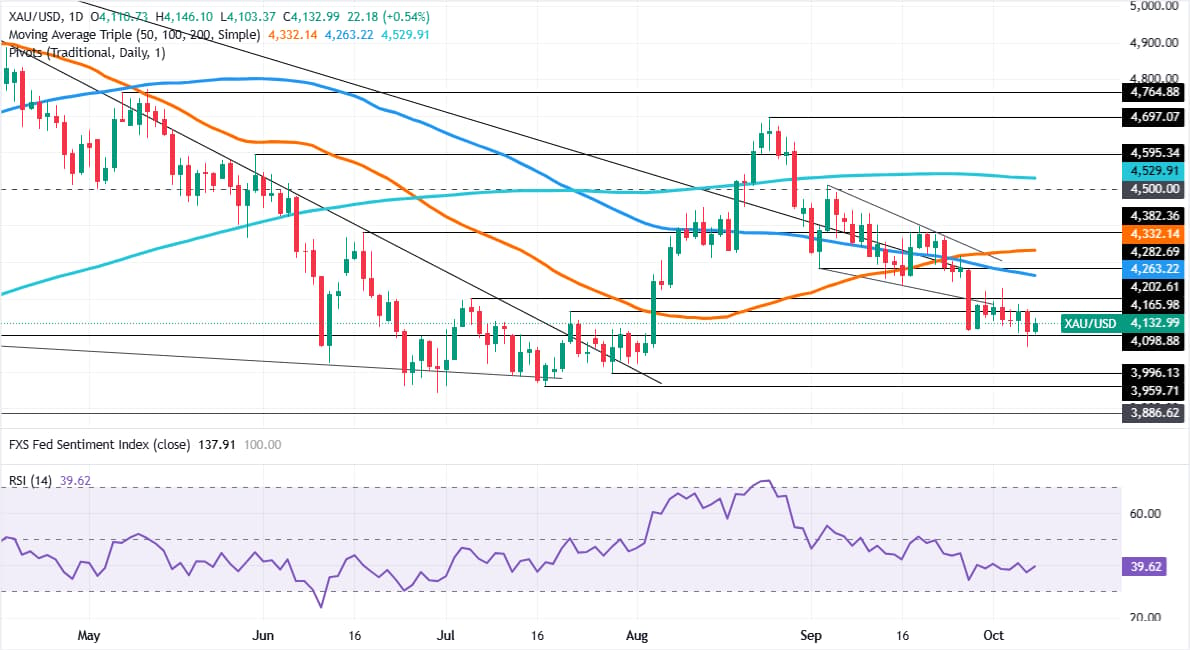
Price action reaffirms that the downtrend remains intact, even though Gold buyers stepped in, pushing spot prices above $4,100. Worth noting that Wednesday's candle engulfs the price action of the day, an indication that a ‘bullish harami’ looms. Nevertheless, further confirmation is needed, like a decisive breakout of key resistance levels, before XAU turns bullish
The Relative Strength Index (RSI) remains bearish, indicating further downside.
Therefore, Gold’s first support is $4,100. Below the next stop is $4,000, ahead of the July 29 swing low of $3,996 and then it challenges the year-to-date (YTD) low of $3,941.
Should XAU/USD reclaim $4,200, this clears the path to test the confluence of the 100- and 50-day Simple Moving Averages (SMAs), each at $ 4,263 and $4,332, respectively. Once those levels are cleared, the next stop is $4,500, ahead of the 200-day SMA at $4,529.
Gold FAQs
Gold has played a key role in human’s history as it has been widely used as a store of value and medium of exchange. Currently, apart from its shine and usage for jewelry, the precious metal is widely seen as a safe-haven asset, meaning that it is considered a good investment during turbulent times. Gold is also widely seen as a hedge against inflation and against depreciating currencies as it doesn’t rely on any specific issuer or government.
Central banks are the biggest Gold holders. In their aim to support their currencies in turbulent times, central banks tend to diversify their reserves and buy Gold to improve the perceived strength of the economy and the currency. High Gold reserves can be a source of trust for a country’s solvency. Central banks added 1,136 tonnes of Gold worth around $70 billion to their reserves in 2022, according to data from the World Gold Council. This is the highest yearly purchase since records began. Central banks from emerging economies such as China, India and Turkey are quickly increasing their Gold reserves.
Gold has an inverse correlation with the US Dollar and US Treasuries, which are both major reserve and safe-haven assets. When the Dollar depreciates, Gold tends to rise, enabling investors and central banks to diversify their assets in turbulent times. Gold is also inversely correlated with risk assets. A rally in the stock market tends to weaken Gold price, while sell-offs in riskier markets tend to favor the precious metal.
The price can move due to a wide range of factors. Geopolitical instability or fears of a deep recession can quickly make Gold price escalate due to its safe-haven status. As a yield-less asset, Gold tends to rise with lower interest rates, while higher cost of money usually weighs down on the yellow metal. Still, most moves depend on how the US Dollar (USD) behaves as the asset is priced in dollars (XAU/USD). A strong Dollar tends to keep the price of Gold controlled, whereas a weaker Dollar is likely to push Gold prices up.
인기 기사
1Pound holds its floor as BoE member Greene presses for a hike2GBP/JPY Price Forecast: Struggles at 209.00 as bearish-engulfing looms3Gold gains on geopolitics as Fed hike bets shift to December4Chinese Yuan: Upside bias within defined band against US Dollar – UOB5Mexican Peso dives on solid US data, despite high inflation6Taiwan Dollar: Trade boom contrasts FX stability – ING7Forex Today: US flash Consumer Sentiment and Canadian jobs in the limelight8Malaysian Ringgit: Fiscal anchor case – MUFG9Fed's Musalem signals more tightening as inflation stays elevated
실시간 시세


GOLD & PRECIOUS METALS에 대한 모든 것

소셜 미디어












이 웹사이트에 제공된 정보는 일반적인 성격의 정보일 뿐이며 개인 맞춤형 금융 자문을 구성하지 않습니다. 이 웹사이트의 정보를 바탕으로 행동하기 전에, 귀하의 목표, 재정 상황 및 필요에 비추어 해당 정보의 적합성을 고려해야 합니다. CFD 및 FX 마진 계약에 대한 투자는 상당한 위험을 수반하며 모든 투자자에게 적합하지 않을 수 있습니다. 귀하는 최초 예치금보다 더 큰 손실을 입을 수 있습니다. 귀하는 기초자산에 대한 소유권이나 어떠한 이해관계도 보유하지 않습니다. 거래를 시작하기 전에 독립적인 자문을 구하고 관련 위험을 충분히 이해하시기를 권장합니다. 웹사이트에 기재된 상품을 취득하기 전에 공시 문서를 읽고 검토하는 것이 중요합니다. 이 웹사이트에서 제공되는 정보 및 광고는 그러한 사용이 현지 법률 및 규정에 위배되는 국가 또는 관할권의 개인이 사용하도록 의도된 것이 아닙니다. 이 웹사이트에서 제공되는 상품 및 서비스는 미국, 말레이시아 및 태국 거주자를 대상으로 하지 않습니다.
TMGM은 다양한 관할권에서 승인 및 규제를 받고 있습니다.
TMGM으로 거래하는 Trademax Australia Limited는 호주 증권투자위원회(ASIC)의 규제를 받으며, AFSL 번호 436416이고 Level 28, One International Tower, 100 Barangaroo Avenue, 2000 Sydney, NSW Australia에 위치하고 있습니다.
이메일: support@tmgm.com.au
TMGM으로 거래하는 Trademax Global Limited는 바누아투 금융서비스위원회(VFSC)의 승인 및 규제를 받으며, 등록 번호 40356이고 1276, Kumul Highway, Port Vila, Vanuatu, Republic of Vanuatu에 등록되어 있습니다.
이메일: support@tmgm.com
Trademax Global Markets (SE) Limited(이하 TMGM)는 세이셸 금융청(FSA)의 인가 및 규제를 받으며, 허가 번호는 SD224입니다. 회사는 세이셸 마헤, 프로비던스 에스테이트 ABIS 센터, 사무실 번호 13에 등록되어 있습니다.
이메일: support@tmgm.com
TMGM으로 거래하는 Trademax Global Markets (International) Pty Ltd는 모리셔스 금융서비스위원회(FSC)의 승인 및 규제를 받으며 라이선스 번호 GB22201012이고, 33, Edith Cavell Street C/o IQ EQ Fund Services (Mauritius) Ltd Port Louis, 11324 Mauritius에 등록되어 있습니다.
이메일: support@tmgm.com
Copyright © TMGM. All rights reserved