


Ripple Price Forecast: XRP risks losing the 50-day EMA support as exchange reserves rise
- XRP decline puts immense pressure on the 50-day EMA support amid a broader crypto market sell-off.
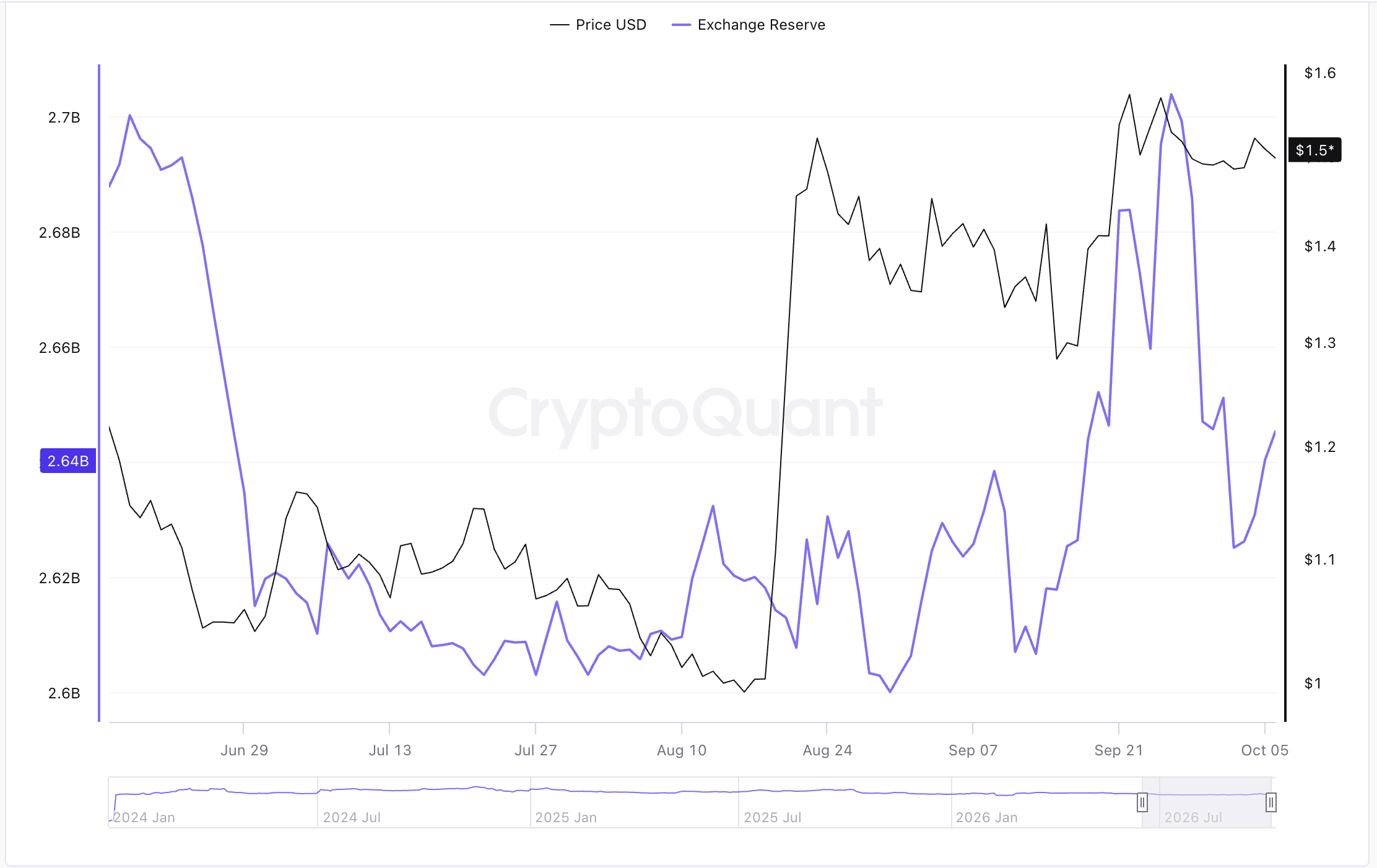
- The balance of XRP on Binance ticks up to 2.64 billion XRP from October lows near 2.60 billion, potentially propping up selling pressure.
- Technically, XRP's path of least resistance remains downward, weighed down by a bearish RSI and a MACD sell signal.
Ripple (XRP) sellers are gaining ground on Thursday, as the token slips below $1.40. Sell-side pressure remains intense in the broader crypto market, as seen with leading digital assets, including Bitcoin (BTC) currently below $83,000 and Ethereum (ETH), sliding below $2,600. Despite the correction, XRP retains a constructive technical outlook, with support provided by a key moving average cluster.

XRP exchange reserves expand amid muted ETF activity
The number of XRP balances on Binance exchange rose in the last few days to 2.64 billion XRP on Thursday, up from the October low of around 2.62 billion XRP. Sustained movement below the current 2.64-2.65 billion range would increase supply available for sale, potentially weighing on price action.
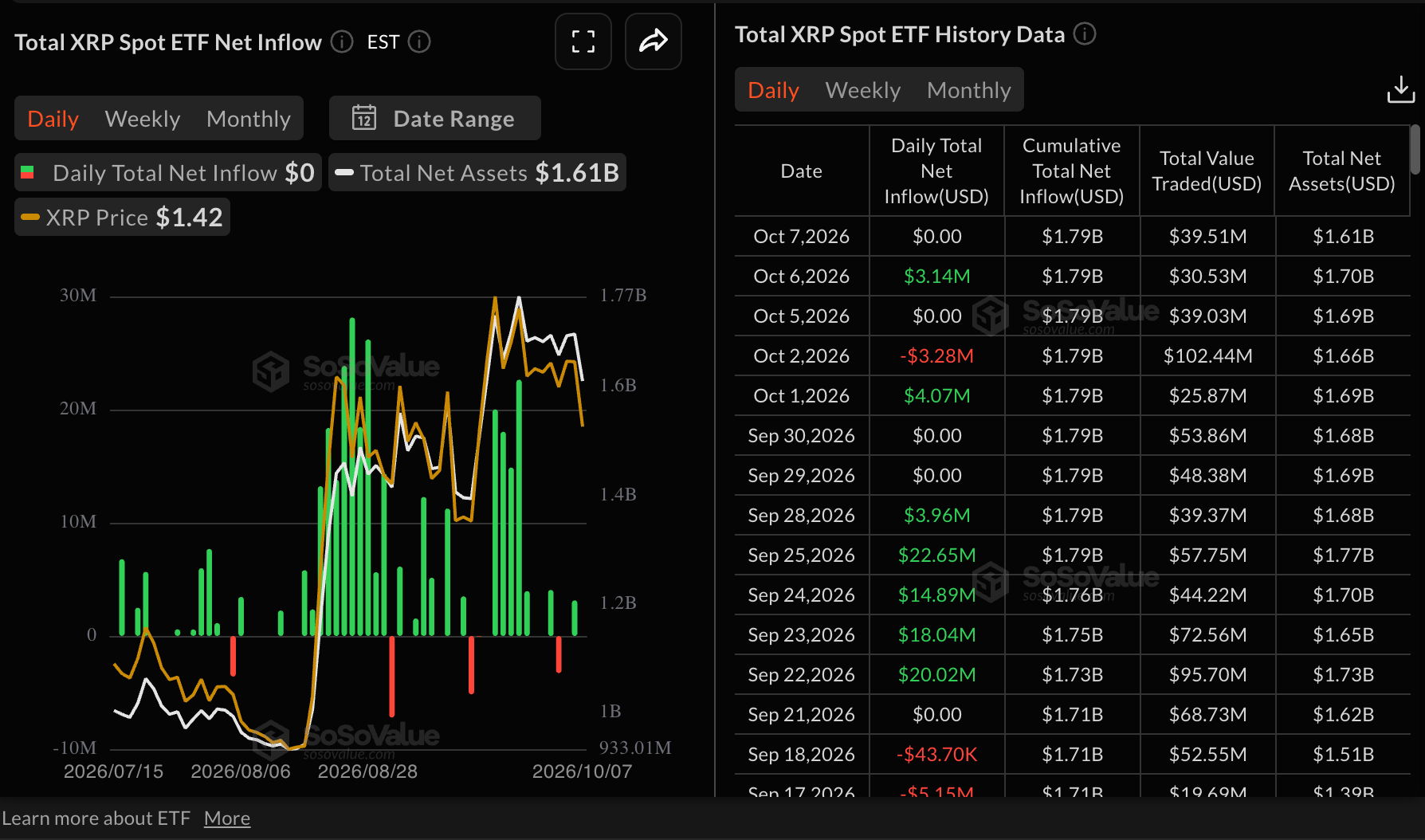
XRP spot ETFs continue to face erratic flows and muted activity. The ETFs remained muted on Wednesday after recording $3 million in outflows the day before. As demand for the remittance token takes a back seat, the path of least resistance will likely stay downward.
Nevertheless, cumulative inflows remain elevated at $1.79 billion, with total assets under management at $1.61 billion, underscoring institutional investors' long-term positive outlook on XRP.
Technical analysis: XRP sellers tighten grip
XRP edges lower below $1.40 as sell-side pressure deepens. Despite this week's correction, the remittance token still maintains a constructive near-term bias, holding above the 50-day Exponential Moving Average (EMA) at 1.39 and the 200-day EMA at $1.38.
The 100-day EMA at $1.34 and the SuperTrend line at $1.30 reinforce a layered demand area beneath spot, suggesting dips could attract buying interest despite the Moving Average Convergence Divergence (MACD) indicator slipping further below zero and the Relative Strength Index (RSI) easing to a neutral-to-soft 43 level.
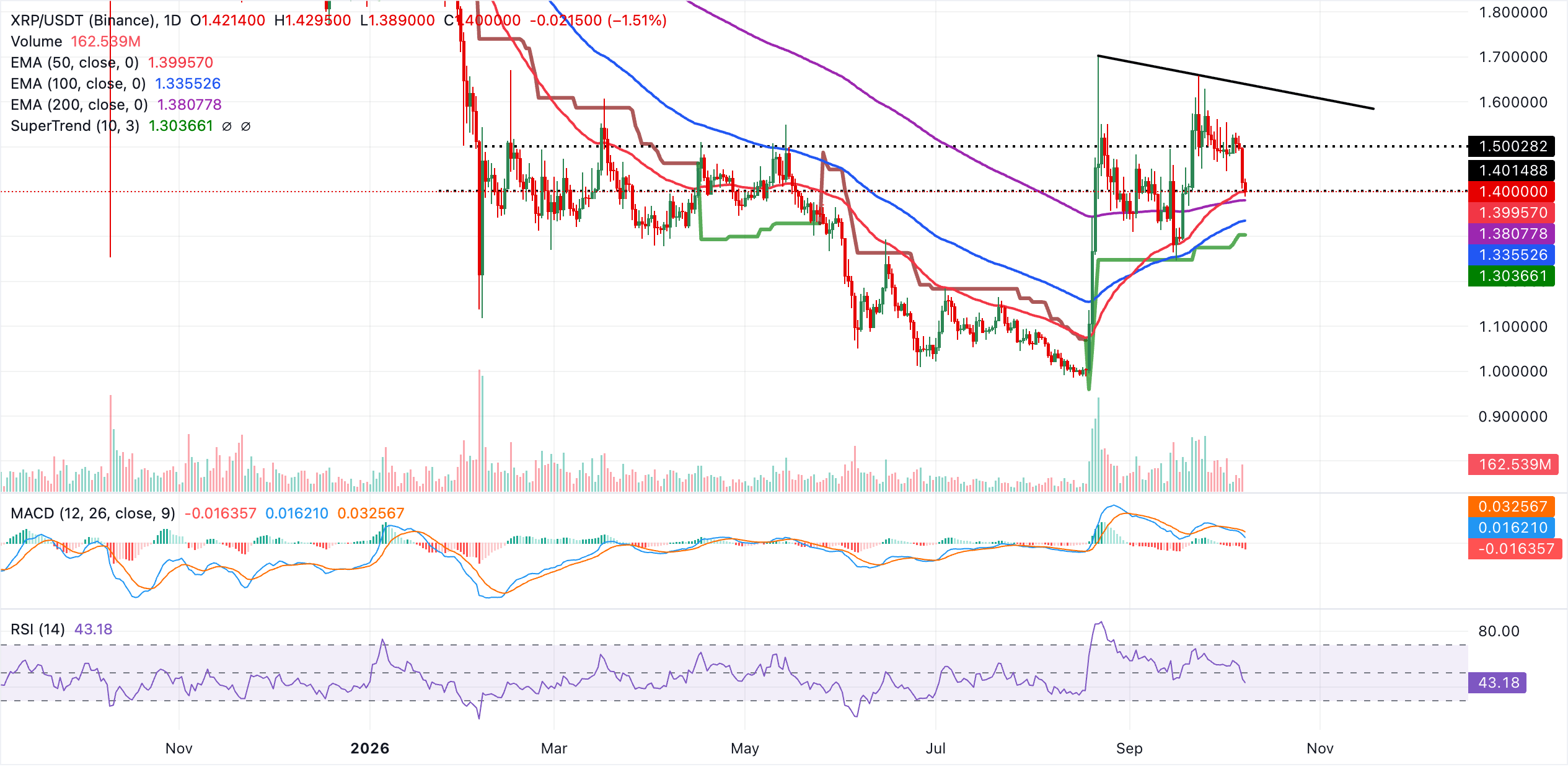
On the downside, initial support lies at the 50-day EMA around $1.39, ahead of deeper structural cushions at the 200-day EMA at $1.38 and the 100-day EMA at $1.34, while the SuperTrend line at $1.30 marks a more distant bullish threshold. On the topside, the focus remains on the descending resistance trendline, with a first barrier near its break region around $1.64 and a stronger cap at the trendline origin near $1.70, where sustained clearance would open the door to a more impulsive bullish phase.
(The technical analysis of this story was written with the help of an AI tool. Know more.)
Crypto ETF FAQs
An Exchange-Traded Fund (ETF) is an investment vehicle or an index that tracks the price of an underlying asset. ETFs can not only track a single asset, but a group of assets and sectors. For example, a Bitcoin ETF tracks Bitcoin’s price. ETF is a tool used by investors to gain exposure to a certain asset.
Yes. The first Bitcoin futures ETF in the US was approved by the US Securities & Exchange Commission in October 2021. A total of seven Bitcoin futures ETFs have been approved, with more than 20 still waiting for the regulator’s permission. The SEC says that the cryptocurrency industry is new and subject to manipulation, which is why it has been delaying crypto-related futures ETFs for the last few years.
Yes. The SEC approved in January 2024 the listing and trading of several Bitcoin spot Exchange-Traded Funds, opening the door to institutional capital and mainstream investors to trade the main crypto currency. The decision was hailed by the industry as a game changer.
The main advantage of crypto ETFs is the possibility of gaining exposure to a cryptocurrency without ownership, reducing the risk and cost of holding the asset. Other pros are a lower learning curve and higher security for investors since ETFs take charge of securing the underlying asset holdings. As for the main drawbacks, the main one is that as an investor you can’t have direct ownership of the asset, or, as they say in crypto, “not your keys, not your coins.” Other disadvantages are higher costs associated with holding crypto since ETFs charge fees for active management. Finally, even though investing in ETFs reduces the risk of holding an asset, price swings in the underlying cryptocurrency are likely to be reflected in the investment vehicle too.
인기 기사
1Silver Price Forecast: XAG/USD slides below $60 as sellers retain control2Mexican Peso: Watching support for reversal signal against US Dollar – Societe Generale3Ripple Price Forecast: XRP risks losing the 50-day EMA support as exchange reserves rise4Euro steadies as US yields retreat, traders assess Fed and ECB signals5Germany: Gradual recovery with energy risks – Deutsche Bank6Canadian Dollar: Consolidation near 1.42s against US Dollar – Scotiabank7European Central Bank: Neutral communication with upside inflation risks – Nordea8Federal Reserve: More hikes ahead after October pause - UOB9BoE’s Bailey calls for stronger financial markets to absorb future shocks
실시간 시세

TECHNICAL에 대한 모든 것
ICT 트레이딩이란 무엇인가요? 이너 서클 트레이더(Inner Circle Trader) 개념 설명
지지선과 저항선: 의미, 유형, 레벨을 그리는 방법 및 트레이딩 전략
유동성이란 무엇인가요? 트레이딩 및 금융시장에서의 의미
유동성 스윕: 의미, 예시 및 트레이딩 전략
트레이딩의 시장 구조: 완벽 가이드 (상승장, 하락장, 횡보장)
캐릭터 변화 (CHoCH): 정의, 예시 및 전략
다크 클라우드 커버 패턴이란 무엇이며, 이를 어떻게 트레이딩하나요?
피어싱 라인 캔들스틱 패턴이란 무엇이며, 이를 어떻게 트레이딩하나요?
트위저 탑 및 바닥 캔들스틱 패턴이란 무엇인가요?

소셜 미디어












이 웹사이트에 제공된 정보는 일반적인 성격의 정보일 뿐이며 개인 맞춤형 금융 자문을 구성하지 않습니다. 이 웹사이트의 정보를 바탕으로 행동하기 전에, 귀하의 목표, 재정 상황 및 필요에 비추어 해당 정보의 적합성을 고려해야 합니다. CFD 및 FX 마진 계약에 대한 투자는 상당한 위험을 수반하며 모든 투자자에게 적합하지 않을 수 있습니다. 귀하는 최초 예치금보다 더 큰 손실을 입을 수 있습니다. 귀하는 기초자산에 대한 소유권이나 어떠한 이해관계도 보유하지 않습니다. 거래를 시작하기 전에 독립적인 자문을 구하고 관련 위험을 충분히 이해하시기를 권장합니다. 웹사이트에 기재된 상품을 취득하기 전에 공시 문서를 읽고 검토하는 것이 중요합니다. 이 웹사이트에서 제공되는 정보 및 광고는 그러한 사용이 현지 법률 및 규정에 위배되는 국가 또는 관할권의 개인이 사용하도록 의도된 것이 아닙니다. 이 웹사이트에서 제공되는 상품 및 서비스는 미국, 말레이시아 및 태국 거주자를 대상으로 하지 않습니다.
TMGM은 다양한 관할권에서 승인 및 규제를 받고 있습니다.
TMGM으로 거래하는 Trademax Australia Limited는 호주 증권투자위원회(ASIC)의 규제를 받으며, AFSL 번호 436416이고 Level 28, One International Tower, 100 Barangaroo Avenue, 2000 Sydney, NSW Australia에 위치하고 있습니다.
이메일: support@tmgm.com.au
TMGM으로 거래하는 Trademax Global Limited는 바누아투 금융서비스위원회(VFSC)의 승인 및 규제를 받으며, 등록 번호 40356이고 1276, Kumul Highway, Port Vila, Vanuatu, Republic of Vanuatu에 등록되어 있습니다.
이메일: support@tmgm.com
Trademax Global Markets (SE) Limited(이하 TMGM)는 세이셸 금융청(FSA)의 인가 및 규제를 받으며, 허가 번호는 SD224입니다. 회사는 세이셸 마헤, 프로비던스 에스테이트 ABIS 센터, 사무실 번호 13에 등록되어 있습니다.
이메일: support@tmgm.com
TMGM으로 거래하는 Trademax Global Markets (International) Pty Ltd는 모리셔스 금융서비스위원회(FSC)의 승인 및 규제를 받으며 라이선스 번호 GB22201012이고, 33, Edith Cavell Street C/o IQ EQ Fund Services (Mauritius) Ltd Port Louis, 11324 Mauritius에 등록되어 있습니다.
이메일: support@tmgm.com
Copyright © TMGM. All rights reserved