

Silver slips as hawkish Fed outlook persists despite soft US inflation data
- Silver weakens despite a softer US Dollar as hawkish Fed expectations weigh on sentiment.
- Renewed Middle East tensions keep Oil prices elevated and inflation risks in focus.
- Technically, XAG/USD remains below key moving averages, with the $55.50-$56.00 support zone under pressure.
Silver (XAG/USD) trades on the back foot on Wednesday, struggling to capitalize on a weaker US Dollar (USD) as hawkish Federal Reserve (Fed) expectations keep bears in control. At the time of writing, XAG/USD trades around $57.55, down 1.90% on the day.

Both the US Consumer Price Index (CPI) and Producer Price Index (PPI) reports for June broadly missed market expectations. The softer inflation readings have reduced expectations of an imminent Fed interest rate hike, putting some pressure on the US Dollar.
The US Dollar Index (DXY), which tracks the Greenback’s value against six major currencies, trades around 100.46, easing from an intraday high of 101.03.
However, the data did not materially change the Fed’s hawkish outlook. Inflation risks persist as Oil prices climb following renewed fighting in the Middle East, keeping the possibility of an interest rate hike later this year on the table.
Fed Governor Lisa Cook said on Wednesday that inflation expectations remain anchored, although this depends on maintaining an appropriate monetary policy stance. She warned that the Fed “can’t take its eye off the ball.”
Cook said there are reasons to believe disinflation will occur but noted that price pressures could persist due to tariffs, the Middle East conflict and strong investment in artificial intelligence.
Expectations that the Fed will keep interest rates elevated or even raise them remain a major headwind for Silver, as higher borrowing costs increase the opportunity cost of holding the non-yielding metal.
Technical Analysis
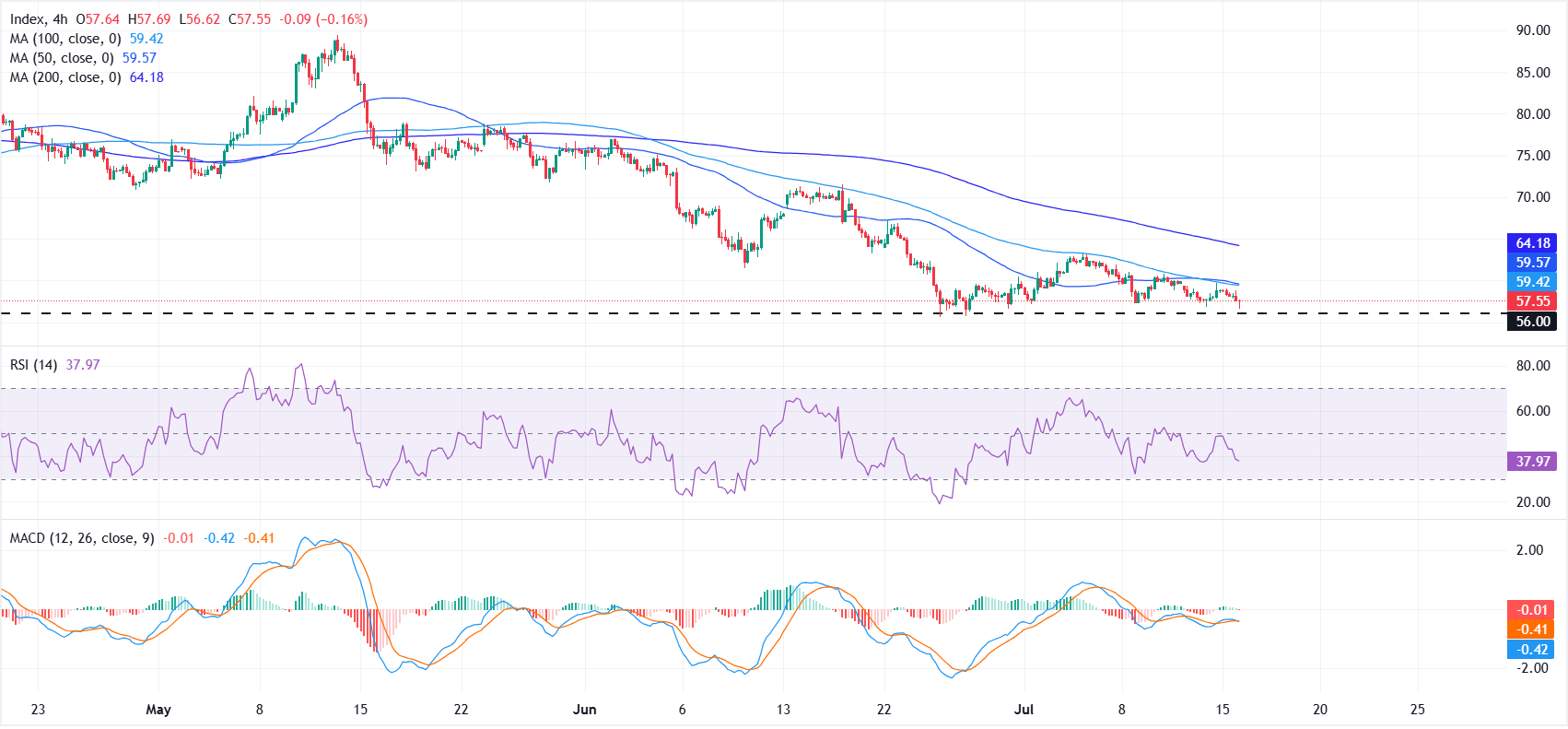
On the 4-hour chart, XAG/USD retains a bearish bias as the price remains below the 50-, 100-, and 200-period Simple Moving Averages (SMAs).
The Relative Strength Index (RSI) at 37 sits just above oversold territory, hinting at persistent downside pressure, while the Moving Average Convergence Divergence (MACD) indicator remains marginally negative, reinforcing a capped tone despite some recent stabilization.
On the topside, initial resistance appears at the 100-period SMA near $59.42, followed closely by the 50-period SMA at $59.57, which together form a nearby supply zone ahead of the more distant 200-period SMA at $64.18.
On the downside, buyers are attempting to build a base in the $55.50-$56.00 region. A break below this area could trigger a deeper corrective decline.
(The technical analysis of this story was written with the help of an AI tool. Know more.)
Silver FAQs
Silver is a precious metal highly traded among investors. It has been historically used as a store of value and a medium of exchange. Although less popular than Gold, traders may turn to Silver to diversify their investment portfolio, for its intrinsic value or as a potential hedge during high-inflation periods. Investors can buy physical Silver, in coins or in bars, or trade it through vehicles such as Exchange Traded Funds, which track its price on international markets.
Silver prices can move due to a wide range of factors. Geopolitical instability or fears of a deep recession can make Silver price escalate due to its safe-haven status, although to a lesser extent than Gold's. As a yieldless asset, Silver tends to rise with lower interest rates. Its moves also depend on how the US Dollar (USD) behaves as the asset is priced in dollars (XAG/USD). A strong Dollar tends to keep the price of Silver at bay, whereas a weaker Dollar is likely to propel prices up. Other factors such as investment demand, mining supply – Silver is much more abundant than Gold – and recycling rates can also affect prices.
Silver is widely used in industry, particularly in sectors such as electronics or solar energy, as it has one of the highest electric conductivity of all metals – more than Copper and Gold. A surge in demand can increase prices, while a decline tends to lower them. Dynamics in the US, Chinese and Indian economies can also contribute to price swings: for the US and particularly China, their big industrial sectors use Silver in various processes; in India, consumers’ demand for the precious metal for jewellery also plays a key role in setting prices.
Silver prices tend to follow Gold's moves. When Gold prices rise, Silver typically follows suit, as their status as safe-haven assets is similar. The Gold/Silver ratio, which shows the number of ounces of Silver needed to equal the value of one ounce of Gold, may help to determine the relative valuation between both metals. Some investors may consider a high ratio as an indicator that Silver is undervalued, or Gold is overvalued. On the contrary, a low ratio might suggest that Gold is undervalued relative to Silver.













