

USD/CAD Price Forecast: Needs to sustain above 50% Fibo retracement to extend rally
- USD/CAD rises to near 1.3772 as the Canadian Dollar underperforms across the board.
- The odds of the BoC raising interest rates in the July meeting have diminished.
- Investors await the FOMC minutes of the April policy meeting, which will be released at 18:00 GMT.
The USD/CAD pair is up 0.2% to near 1.3772 during the European trading session on Wednesday. The Loonie pair reflects strength as the Canadian Dollar (CAD) underperforms its peers due to easing expectations that the Bank of Canada (BoC) will raise interest rates in the July policy meeting.

Canadian Dollar Price Today
The table below shows the percentage change of Canadian Dollar (CAD) against listed major currencies today. Canadian Dollar was the weakest against the Australian Dollar.
| USD | EUR | GBP | JPY | CAD | AUD | NZD | CHF | |
|---|---|---|---|---|---|---|---|---|
| USD | 0.04% | -0.01% | -0.05% | 0.18% | -0.23% | -0.17% | 0.09% | |
| EUR | -0.04% | -0.06% | -0.07% | 0.14% | -0.28% | -0.20% | 0.05% | |
| GBP | 0.01% | 0.06% | -0.02% | 0.20% | -0.24% | -0.16% | 0.10% | |
| JPY | 0.05% | 0.07% | 0.02% | 0.24% | -0.17% | -0.11% | 0.15% | |
| CAD | -0.18% | -0.14% | -0.20% | -0.24% | -0.41% | -0.30% | -0.09% | |
| AUD | 0.23% | 0.28% | 0.24% | 0.17% | 0.41% | 0.08% | 0.32% | |
| NZD | 0.17% | 0.20% | 0.16% | 0.11% | 0.30% | -0.08% | 0.24% | |
| CHF | -0.09% | -0.05% | -0.10% | -0.15% | 0.09% | -0.32% | -0.24% |
The heat map shows percentage changes of major currencies against each other. The base currency is picked from the left column, while the quote currency is picked from the top row. For example, if you pick the Canadian Dollar from the left column and move along the horizontal line to the US Dollar, the percentage change displayed in the box will represent CAD (base)/USD (quote).
According to a report from Deutsche Bank, the implied probability of a July rate hike has fallen to 24%, following the release of the Canadian Consumer Price Index (CPI) data for April. The data on Tuesday showed that the headline inflation accelerated at a slower-than-expected pace to 2.8% Year-on-Year (YoY), while it was expected to arrive at 3.1%.
Meanwhile, the continued outperformance by the US Dollar amid expectations that the Federal Reserve (Fed) will hike interest rates this year has also strengthened the Loonie pair. As of writing, the US Dollar Index (DXY), which gauges the Greenback’s value against six major currencies, trades marginally higher to near 99.35. The USD Index gives back a majority of its early gains.
Later in the day, investors will focus on the release of the Federal Open Market Committee (FOMC) minutes of the April policy meeting at 18:00 GMT.
USD/CAD technical analysis
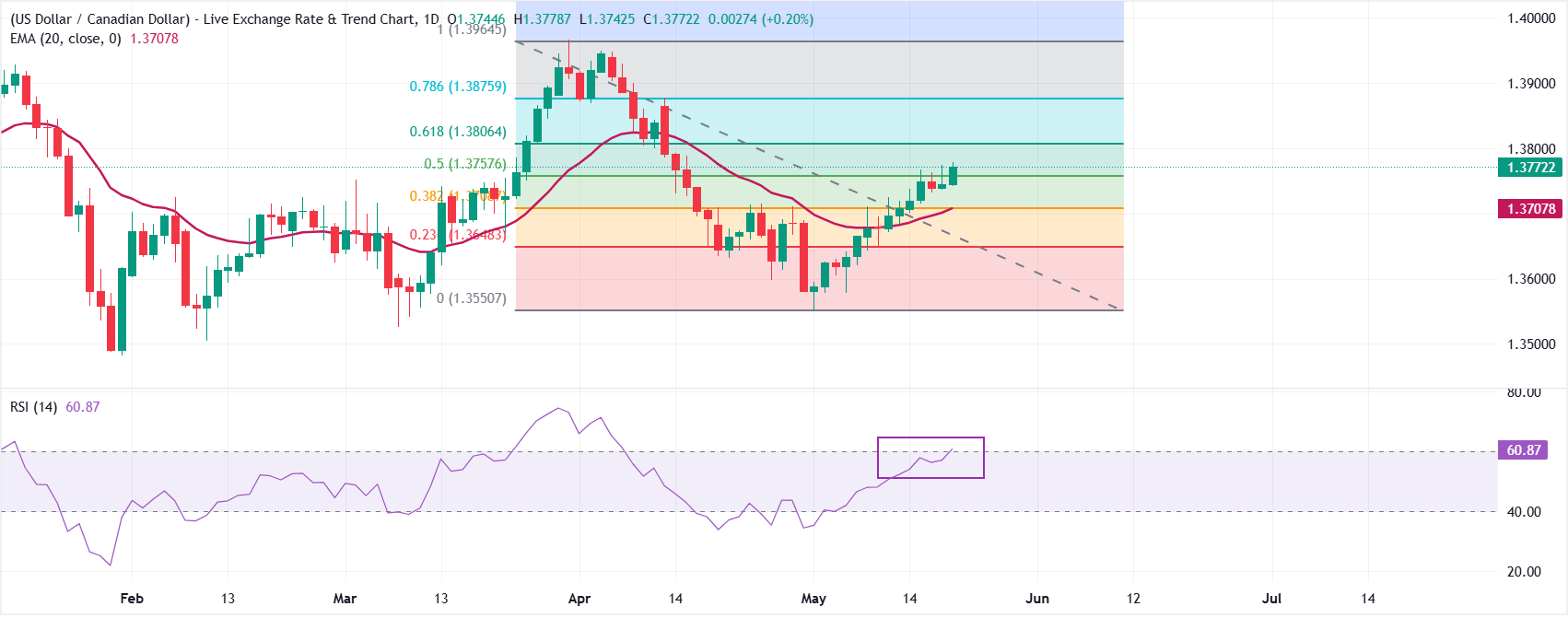
USD/CAD trades higher at around 1.3772 at the press time. The pair holds above the 20-period exponential moving average (EMA) at 1.3708, suggesting a mildly bullish near-term bias while it grinds higher within the recent range.
The Relative Strength Index (RSI) at around 61 tilts to the upside, hinting that buyers retain the upper hand, though price still faces nearby Fibonacci-derived hurdles.
On the topside, immediate resistance emerges at the 61.8% Fibonacci retracement at 1.3806, followed by the 78.6% level near 1.3876 and the recent swing high area around the 100% retracement at 1.3964. On the downside, major cushions will be the 38.2% level and the 20-period EMA clustered around 1.3710, ahead of deeper Fibonacci support at 1.3648 and the 1.3551 anchor.
(The technical analysis of this story was written with the help of an AI tool.)
Bank of Canada FAQs
The Bank of Canada (BoC), based in Ottawa, is the institution that sets interest rates and manages monetary policy for Canada. It does so at eight scheduled meetings a year and ad hoc emergency meetings that are held as required. The BoC primary mandate is to maintain price stability, which means keeping inflation at between 1-3%. Its main tool for achieving this is by raising or lowering interest rates. Relatively high interest rates will usually result in a stronger Canadian Dollar (CAD) and vice versa. Other tools used include quantitative easing and tightening.
In extreme situations, the Bank of Canada can enact a policy tool called Quantitative Easing. QE is the process by which the BoC prints Canadian Dollars for the purpose of buying assets – usually government or corporate bonds – from financial institutions. QE usually results in a weaker CAD. QE is a last resort when simply lowering interest rates is unlikely to achieve the objective of price stability. The Bank of Canada used the measure during the Great Financial Crisis of 2009-11 when credit froze after banks lost faith in each other’s ability to repay debts.
Quantitative tightening (QT) is the reverse of QE. It is undertaken after QE when an economic recovery is underway and inflation starts rising. Whilst in QE the Bank of Canada purchases government and corporate bonds from financial institutions to provide them with liquidity, in QT the BoC stops buying more assets, and stops reinvesting the principal maturing on the bonds it already holds. It is usually positive (or bullish) for the Canadian Dollar.














