

USD/JPY Price Forecast: 20-day EMA acts as key support zone around 157.50
- USD/JPY jumps to near 158.33 as the US Dollar regains ground after a sharp decline on Thursday.
- BoJ’s Ueda is confident of an interest rate hike if the potential economic downturn proves to be temporary.
- The Fed is expected to hold interest rates steady at their current levels by the year-end.
The USD/JPY pair is up 0.4% to near 158.33 during the Asian trading session on Friday. The pair recovers after a sharp sell-off on Thursday, as the Japanese Yen (JPY) underperforms despite the Bank of Japan (BoJ) retaining its hawkish stance on the monetary policy outlook.

Japanese Yen Price Today
The table below shows the percentage change of Japanese Yen (JPY) against listed major currencies today. Japanese Yen was the strongest against the Euro.
| USD | EUR | GBP | JPY | CAD | AUD | NZD | CHF | |
|---|---|---|---|---|---|---|---|---|
| USD | 0.27% | 0.19% | 0.40% | -0.06% | 0.07% | -0.16% | 0.14% | |
| EUR | -0.27% | -0.08% | 0.13% | -0.32% | -0.19% | -0.42% | -0.12% | |
| GBP | -0.19% | 0.08% | 0.21% | -0.25% | -0.11% | -0.34% | -0.05% | |
| JPY | -0.40% | -0.13% | -0.21% | -0.43% | -0.32% | -0.55% | -0.23% | |
| CAD | 0.06% | 0.32% | 0.25% | 0.43% | 0.12% | -0.11% | 0.20% | |
| AUD | -0.07% | 0.19% | 0.11% | 0.32% | -0.12% | -0.23% | 0.07% | |
| NZD | 0.16% | 0.42% | 0.34% | 0.55% | 0.11% | 0.23% | 0.30% | |
| CHF | -0.14% | 0.12% | 0.05% | 0.23% | -0.20% | -0.07% | -0.30% |
The heat map shows percentage changes of major currencies against each other. The base currency is picked from the left column, while the quote currency is picked from the top row. For example, if you pick the Japanese Yen from the left column and move along the horizontal line to the US Dollar, the percentage change displayed in the box will represent JPY (base)/USD (quote).
BoJ Governor Kazuo Ueda said after the interest rate decision on Thursday, where they left interest rates unchanged at 0.75%, that a hike is possible if the Middle East conflicts-linked economic downturn proved to be short-lived.
In the monetary policy, BoJ officials warned of uncertainty surrounding the economic growth amid surging energy prices due to a joint assault by the United States (US) and Israel against Iran.
Meanwhile, the US Dollar (USD) gains ground after Thursday’s mayhem as the Federal Reserve (Fed) is expected to adopt an extended pause amid high inflation across the world. During the press time, the US Dollar Index (DXY), which gauges the Greenback’s value against six major currencies, trades 0.2% higher to near 99.35.
According to the CME FedWatch tool, the Fed is unlikely to cut interest rates during the year.
USD/JPY technical analysis
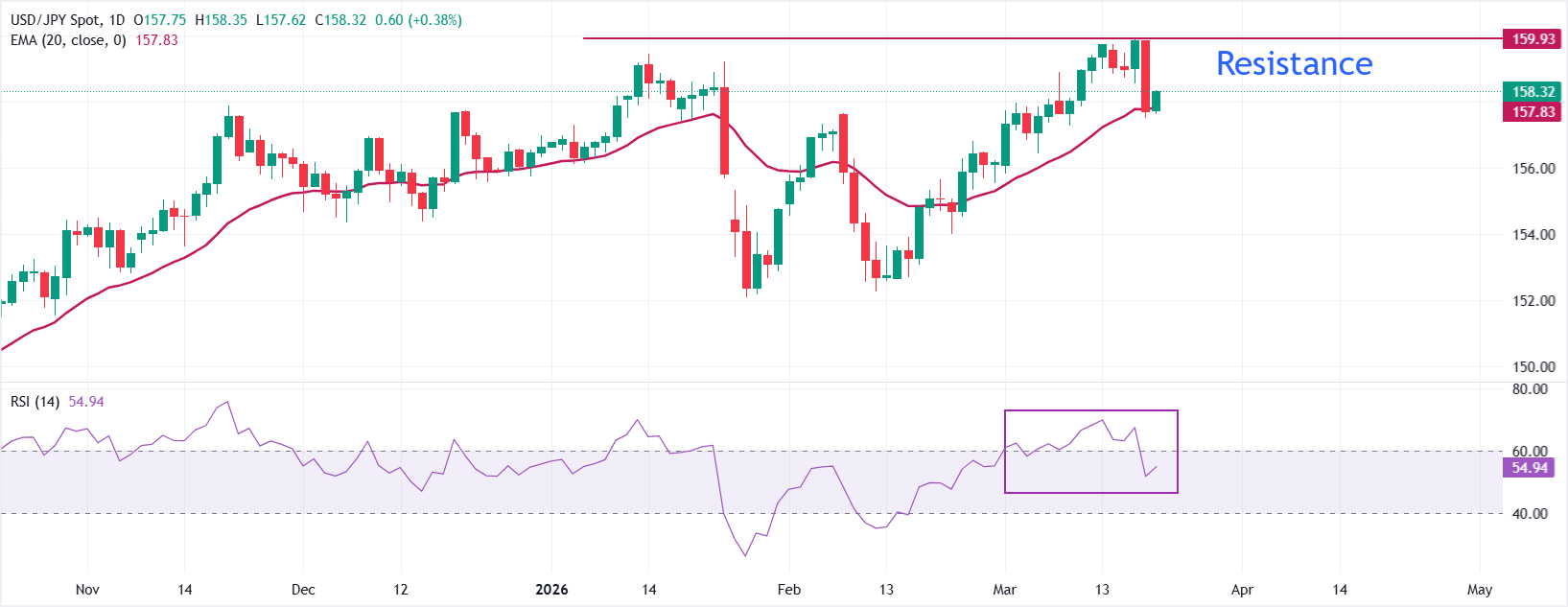
USD/JPY trades higher to near 158.33 during the press time. The near-term bias stays mildly bullish as price recovers after correcting to near the rising 20-day Exponential Moving Average near 157.50, keeping the broader uptrend structure intact after last week’s brief pullback toward 157.70. Momentum turns balanced with the 14-day Relative Strength Index (RSI) sliding into the 40.00-60.00 zone from the 60.00-80.00 range; however, the trend remains bullish.
Initial support emerges at the 20-day EMA around 157.50, followed by the March 5 low of 156.46, where a daily close below would open a deeper retracement toward the February 25 low of 155.35. On the topside, immediate resistance is seen at 159.00, ahead of the late-June high near 159.90, where rejection would reinforce range conditions, but a daily close above would confirm a renewed push toward the 160.50 area.
(The technical analysis of this story was written with the help of an AI tool.)
Bank of Japan FAQs
The Bank of Japan (BoJ) is the Japanese central bank, which sets monetary policy in the country. Its mandate is to issue banknotes and carry out currency and monetary control to ensure price stability, which means an inflation target of around 2%.
The Bank of Japan embarked in an ultra-loose monetary policy in 2013 in order to stimulate the economy and fuel inflation amid a low-inflationary environment. The bank’s policy is based on Quantitative and Qualitative Easing (QQE), or printing notes to buy assets such as government or corporate bonds to provide liquidity. In 2016, the bank doubled down on its strategy and further loosened policy by first introducing negative interest rates and then directly controlling the yield of its 10-year government bonds. In March 2024, the BoJ lifted interest rates, effectively retreating from the ultra-loose monetary policy stance.
The Bank’s massive stimulus caused the Yen to depreciate against its main currency peers. This process exacerbated in 2022 and 2023 due to an increasing policy divergence between the Bank of Japan and other main central banks, which opted to increase interest rates sharply to fight decades-high levels of inflation. The BoJ’s policy led to a widening differential with other currencies, dragging down the value of the Yen. This trend partly reversed in 2024, when the BoJ decided to abandon its ultra-loose policy stance.
A weaker Yen and the spike in global energy prices led to an increase in Japanese inflation, which exceeded the BoJ’s 2% target. The prospect of rising salaries in the country – a key element fuelling inflation – also contributed to the move.














