

Warsh's Fed begins with a hawkish message and a promise of reform
The Federal Reserve (Fed) left interest rates unchanged at 3.50%-3.75% on Wednesday, but the bigger surprise came from the updated economic projections and Kevin Warsh's first press conference as Fed Chair.
The policy statement itself struck a relatively familiar tone after officials acknowledged that economic activity continues to expand at a solid pace despite heightened uncertainty linked partly to the conflict in the Middle East. The Fed also pointed out strong productivity growth and capital investment but said inflation remains elevated relative to its 2% goal, with recent supply shocks and higher energy prices helping to push prices higher.
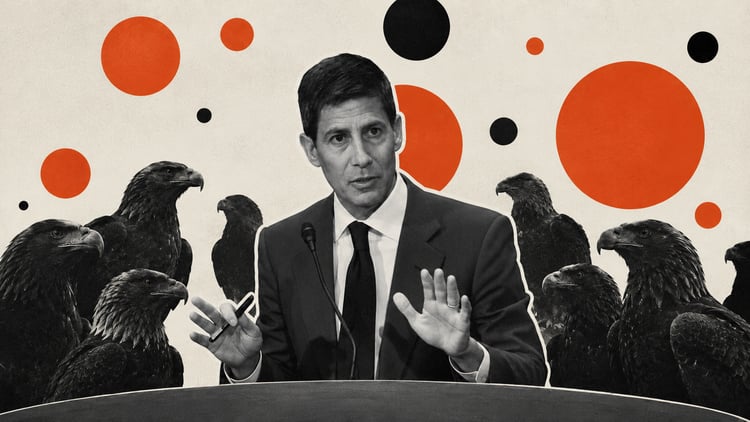
The updated Summary of Economic Projections (SEP), however, delivered a distinctly more hawkish message.
Policymakers sharply raised their inflation forecasts, with PCE inflation now expected to end 2026 at 3.6%, up from 2.7% projected in March. Core inflation forecasts were also revised higher, while the Fed continues to see inflation returning to its 2% objective only in 2028.
The rate outlook shifted higher as well. Indeed, the median projection for the Federal Funds rate at the end of 2026 rose to 3.8% from 3.4%, with policymakers also lifting their projected rate paths for 2027 and 2028. At the same time, growth forecasts were trimmed only modestly and unemployment projections improved slightly, reinforcing the view that the Committee sees inflation as a more pressing concern than economic weakness.
Warsh used his first appearance as Chair to reinforce that message.
He repeatedly stressed that inflation remains well above target and said the Committee's commitment to restoring price stability was unanimous and unambiguous. He argued that persistently high prices continue to burden households and maintained that inflation is ultimately determined by monetary policy.
At the same time, Warsh made it clear that he intends to change how the Fed communicates with markets.
He described the new policy statement as shorter, simpler and more focused on facts, while defending the decision to remove forward guidance. According to Warsh, forward guidance is not well suited to the current environment, and policymakers should not attempt to signal future decisions when economic conditions remain uncertain.
The most notable development from the press conference was Warsh's announcement of a broad review of the Fed's policymaking framework.
He unveiled five task forces that will examine communications, the balance sheet, data sources, productivity and employment, and the Fed's inflation framework. The groups will include experts from inside and outside the economics profession and are expected to propose recommendations for future changes.
Among the areas under review is the SEP itself. Warsh revealed that he expects changes to the SEP and suggested a new communications framework could be introduced before the end of the year. He also declined to submit his own rate projection, arguing that doing so would not be helpful to the conduct of policy.
On the economy, Warsh painted a relatively constructive picture. He said labour market conditions remain stable, noted that recent jobs data have been moving in a favourable direction and argued that trends matter more than individual data releases. He also suggested that monetary policy appears restrictive primarily in the housing sector, while financial conditions elsewhere in the economy appear less constrained.
Artificial intelligence featured prominently in the discussion. Warsh said policymakers spent time discussing AI and productivity developments, describing the technology as offering significant opportunities as well as risks.
To sum up
The meeting delivered a clear message: the Fed remains committed to returning inflation to 2%, policymakers now expect inflation to stay elevated for longer than previously anticipated, and the new Chair appears determined to reshape how the central bank communicates and evaluates policy in the years ahead.
Interest rates FAQs
Interest rates are charged by financial institutions on loans to borrowers and are paid as interest to savers and depositors. They are influenced by base lending rates, which are set by central banks in response to changes in the economy. Central banks normally have a mandate to ensure price stability, which in most cases means targeting a core inflation rate of around 2%. If inflation falls below target the central bank may cut base lending rates, with a view to stimulating lending and boosting the economy. If inflation rises substantially above 2% it normally results in the central bank raising base lending rates in an attempt to lower inflation.
Higher interest rates generally help strengthen a country’s currency as they make it a more attractive place for global investors to park their money.
Higher interest rates overall weigh on the price of Gold because they increase the opportunity cost of holding Gold instead of investing in an interest-bearing asset or placing cash in the bank. If interest rates are high that usually pushes up the price of the US Dollar (USD), and since Gold is priced in Dollars, this has the effect of lowering the price of Gold.
The Fed funds rate is the overnight rate at which US banks lend to each other. It is the oft-quoted headline rate set by the Federal Reserve at its FOMC meetings. It is set as a range, for example 4.75%-5.00%, though the upper limit (in that case 5.00%) is the quoted figure. Market expectations for future Fed funds rate are tracked by the CME FedWatch tool, which shapes how many financial markets behave in anticipation of future Federal Reserve monetary policy decisions.














