

AUD/USD tumbles toward 0.7100 as Powell lifts Dollar demand again
- AUD/USD slid as Fed held rates and Powell backed staying on board.
- Fed statement flagged resilient growth and elevated Iran-linked energy inflation.
- Split vote underscored policy divisions over easing bias and rate cuts.
The AUD/USD drops towards 0.7100, down some 1%, as the Federal Reserve holds rates unchanged and Fed Chair Jerome Powell hints that, once his term as chief ends, he will remain on the Fed’s board.
Aussie slides as Fed split and Powell remarks lift USD demand now

At his press conference, Jay Powell congratulated Kevin Warsh as he hurdled the first stage on his path to becoming his successor as Fed Chair and clarified that he will remain as Governor until the criminal investigation against him concludes. He added that, as Governor, he “will keep a low profile” and that he will stay at the Fed after May 15, when his eight-year term as the chief of the US central bank ends.
Regarding the monetary policy statement, the Fed revealed that the US economy remains resilient, that the unemployment rate “has been little changed in recent months,” and that inflation is elevated, driven by higher energy prices linked to the Iran conflict.
The Fed noted that recent events in the Middle East are adding to economic uncertainty and stressed that policymakers will continue to weigh both parts of their dual mandate.
The vote on the decision was split 8–4. Governor Stephen Miran dissented in favor of lowering rates, while Beth Hammack, Neel Kashkari, and Lorie Logan opposed including an easing bias in the statement.
AUD/USD reaction to Jerome Powell’s statement to stay at the Fed
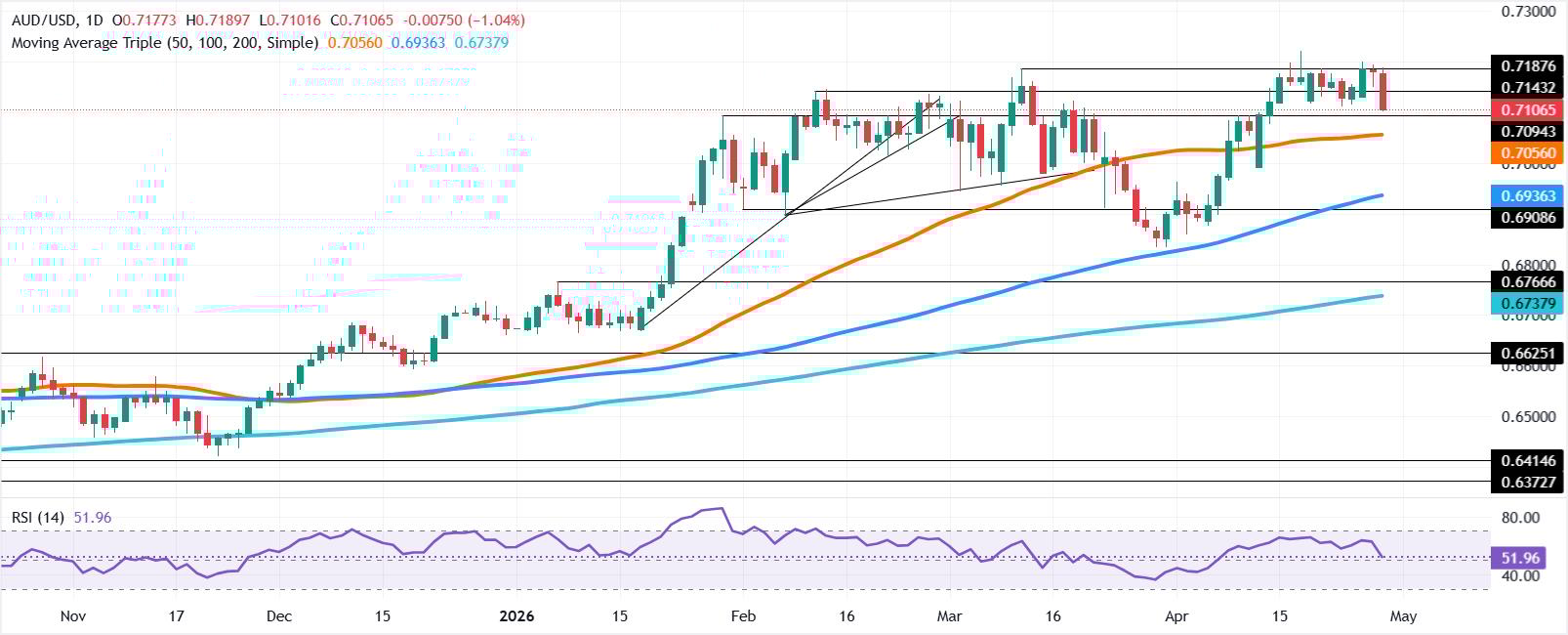
The AUD/USD extended its losses from around 0.7120, breaking below 0.7110, with eyes on the psychological 0.7100 figure. A breach of the latter will expose the 50-day SMA at 0.7056. If cleared, the next stop would be 0.7000.
Australian Dollar FAQs
One of the most significant factors for the Australian Dollar (AUD) is the level of interest rates set by the Reserve Bank of Australia (RBA). Because Australia is a resource-rich country another key driver is the price of its biggest export, Iron Ore. The health of the Chinese economy, its largest trading partner, is a factor, as well as inflation in Australia, its growth rate and Trade Balance. Market sentiment – whether investors are taking on more risky assets (risk-on) or seeking safe-havens (risk-off) – is also a factor, with risk-on positive for AUD.
The Reserve Bank of Australia (RBA) influences the Australian Dollar (AUD) by setting the level of interest rates that Australian banks can lend to each other. This influences the level of interest rates in the economy as a whole. The main goal of the RBA is to maintain a stable inflation rate of 2-3% by adjusting interest rates up or down. Relatively high interest rates compared to other major central banks support the AUD, and the opposite for relatively low. The RBA can also use quantitative easing and tightening to influence credit conditions, with the former AUD-negative and the latter AUD-positive.
China is Australia’s largest trading partner so the health of the Chinese economy is a major influence on the value of the Australian Dollar (AUD). When the Chinese economy is doing well it purchases more raw materials, goods and services from Australia, lifting demand for the AUD, and pushing up its value. The opposite is the case when the Chinese economy is not growing as fast as expected. Positive or negative surprises in Chinese growth data, therefore, often have a direct impact on the Australian Dollar and its pairs.
Iron Ore is Australia’s largest export, accounting for $118 billion a year according to data from 2021, with China as its primary destination. The price of Iron Ore, therefore, can be a driver of the Australian Dollar. Generally, if the price of Iron Ore rises, AUD also goes up, as aggregate demand for the currency increases. The opposite is the case if the price of Iron Ore falls. Higher Iron Ore prices also tend to result in a greater likelihood of a positive Trade Balance for Australia, which is also positive of the AUD.
The Trade Balance, which is the difference between what a country earns from its exports versus what it pays for its imports, is another factor that can influence the value of the Australian Dollar. If Australia produces highly sought after exports, then its currency will gain in value purely from the surplus demand created from foreign buyers seeking to purchase its exports versus what it spends to purchase imports. Therefore, a positive net Trade Balance strengthens the AUD, with the opposite effect if the Trade Balance is negative.














