

USD/CHF Price Forecast: Consolidates around 0.7900; near-term outlook remains bullish
- USD/CHF trades sideways around 0.7900 as investors await Iran’s revert to Trump’s 15-point proposal.
- Trump’s 15-point plan restricts Iran from pursuing nuclear ambitions.
- The SNB could intervene against significant appreciation in the Swiss Franc.
The USD/CHF pair trades in a tight range around 0.7900 during the European trading session on Wednesday. The Swiss Franc pair trades calmly as the US Dollar (USD) turns sideways, with investors awaiting the response from Iran over United States (US) President Donald Trump’s 15-point settlement plan.

As of writing, the US Dollar Index (DXY), which tracks the Greenback’s value against six major currencies, trades flat around 99.20.
On late Tuesday, US President Trump proposed a month-long ceasefire plan with Iran, along with a 15-point proposal, which restricts the nation from pursuing nuclear ambitions and nuclear weapons, and disallows uranium enrichment on Iranian territory.
Meanwhile, Iran has been dismissing announcements from US President Trump claiming Tehran’s direct involvement in ceasefire talks with Washington.
In the Swiss region, the Swiss National Bank (SNB) has expressed readiness to intervene to counter significant appreciation in the domestic currency.
USD/CHF technical analysis
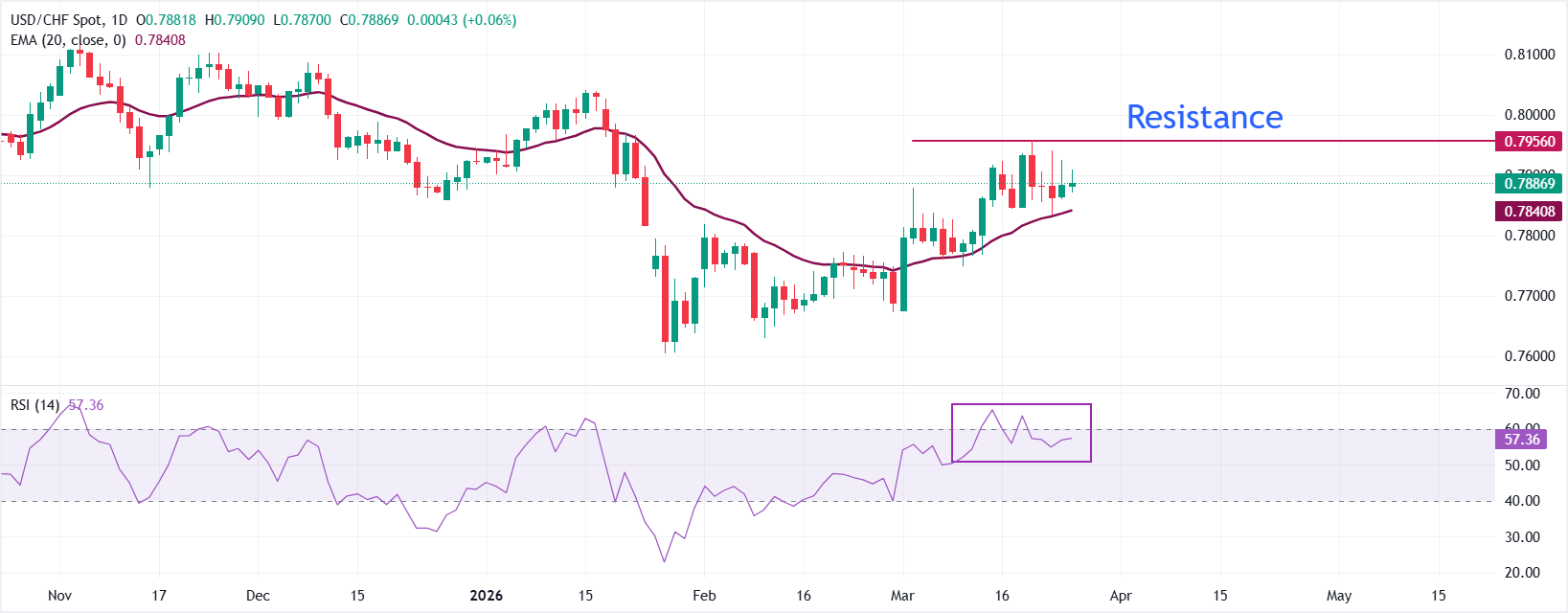
USD/CHF trades almost flat at around 0.7890 at the press time. The near-term bias is bullish as price holds above the rising 20-day Exponential Moving Average (EMA), which has tracked the recovery from the mid-0.76 area and now underpins the advance around 0.78. Recent higher closes from the 0.77 handle reinforce a gradual basing structure after the earlier decline, while the RSI near 57 stays above its midline and signals persistent upside momentum rather than exhaustion.
Initial support emerges at 0.7830, aligning with the 20-day EMA zone, and a break below would expose deeper support toward 0.7770 and then the 0.7700 area. On the topside, immediate resistance sits near 0.7930, where recent advances stalled, followed by 0.8000 as the next psychological barrier that would need to yield to confirm a stronger bullish extension.
(The technical analysis of this story was written with the help of an AI tool.)
SNB FAQs
The Swiss National Bank (SNB) is the country’s central bank. As an independent central bank, its mandate is to ensure price stability in the medium and long term. To ensure price stability, the SNB aims to maintain appropriate monetary conditions, which are determined by the interest rate level and exchange rates. For the SNB, price stability means a rise in the Swiss Consumer Price Index (CPI) of less than 2% per year.
The Swiss National Bank (SNB) Governing Board decides the appropriate level of its policy rate according to its price stability objective. When inflation is above target or forecasted to be above target in the foreseeable future, the bank will attempt to tame excessive price growth by raising its policy rate. Higher interest rates are generally positive for the Swiss Franc (CHF) as they lead to higher yields, making the country a more attractive place for investors. On the contrary, lower interest rates tend to weaken CHF.
Yes. The Swiss National Bank (SNB) has regularly intervened in the foreign exchange market in order to avoid the Swiss Franc (CHF) appreciating too much against other currencies. A strong CHF hurts the competitiveness of the country’s powerful export sector. Between 2011 and 2015, the SNB implemented a peg to the Euro to limit the CHF advance against it. The bank intervenes in the market using its hefty foreign exchange reserves, usually by buying foreign currencies such as the US Dollar or the Euro. During episodes of high inflation, particularly due to energy, the SNB refrains from intervening markets as a strong CHF makes energy imports cheaper, cushioning the price shock for Swiss households and businesses.
The SNB meets once a quarter – in March, June, September and December – to conduct its monetary policy assessment. Each of these assessments results in a monetary policy decision and the publication of a medium-term inflation forecast.














