

Trading
Explore uma ampla variedade de mercados com preços competitivos, alta liquidez e ferramentas de trading avançadas.
Saiba Mais 
Plataforma
Negocie sem interrupções com a poderosa plataforma da TMGM, desenvolvida para proporcionar velocidade, precisão e uma experiência de trading superior.
Saiba Mais Plataforma de Trading
Ferramentas de Negociação
Academia
Aprenda os fundamentos do trading com recursos para iniciantes, incluindo guias, webinars e insights de mercado.
Saiba Mais Academia TMGM
Notícias e Análises
Receba atualizações de mercado em tempo real e análises de especialistas para se antecipar às oportunidades de trading
Saiba Mais Notícias e Análises
Sobre
Descubra o que torna a TMGM única: presença global, solidez regulatória e compromisso com a inovação em trading.
Saiba Mais Por Que Escolher a TMGM
Patrocínios
Bitcoin vs Gold Forecast: BTC, XAU extend gains despite escalating Middle East tensions
- Bitcoin edges higher above the 50-day EMA, increasing the odds of recovery above $65,000.
- Gold approaches $4,500 resistance, supported by key moving averages.
- Geopolitical tensions escalate in the Middle East as UAE halts trade with Iran over missile attacks.
Bitcoin (BTC) and Gold (XAU/USD) are broadly rising on Wednesday, with BTC hovering near $65,000 and XAU gaining momentum near its immediate $4,500 hurdle.
The neutral-to-bullish outlook comes ahead of the United States (US) Federal Reserve’s (Fed) release of the Minutes of the July Federal Open Market Committee (FOMC) later on Wednesday. This document will give investors a clearer gauge of the central bank's hawkish stance, following an FOMC meeting marked by three dissenting votes for a rate hike.
The Fed left interest rates unchanged in the 3.5%-3.75% range in July, which matched market expectations. However, Fed Chair Kevin Warsh insists the central bank remains focused on its 2% inflation target. This, along with the dissenting votes, could keep monetary policy tightening on the table at the September review.
UAE halts trading with Iran as Middle East tensions intensify
The United Arab Emirates (UAE) has reportedly halted all trade with Iran “until further notice.” According to a CNN report, the trade suspension has been confirmed by an official from the country’s Foreign Ministry, which cited two ballistic missiles that targeted “maritime navigation” but fell into the sea.
Meanwhile, United States President Donald Trump said on Tuesday that there are no ongoing or scheduled talks with Iran. The Memorandum of Understanding (MoU) signed by the US and Iran in June expired on Monday.
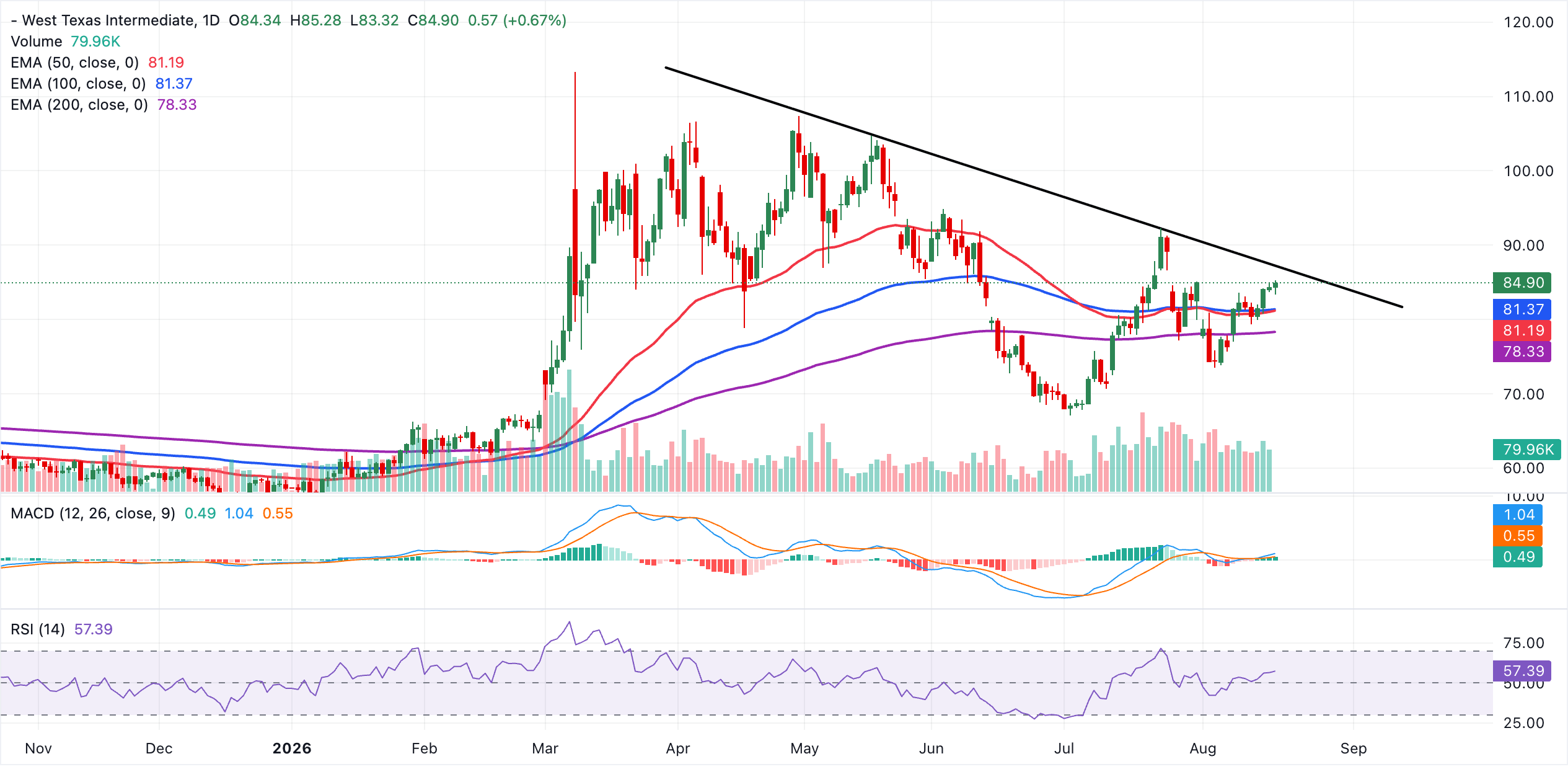
Global Oil prices remain high, with the West Texas Intermediate (WTI) trading above $84 amid the continued blockage of the Strait of Hormuz.
Technical analysis: Bitcoin momentum remains constructive
Bitcoin holds above the 50-day Exponential Moving Average (EMA) at $64,402 and an upward-sloping trendline support near $63,002, but remains capped beneath the 100-day EMA at $66,353 and the 200-day EMA at $71,521, which keeps the broader bias neutral-to-capped for now.
Momentum is constructive, as the Relative Strength Index (RSI) at 57 stays in positive territory and the Moving Average Convergence Divergence (MACD) histogram moves higher in positive territory, suggesting buyers retain control while still needing to clear layered overhead averages to unlock a stronger bullish phase.
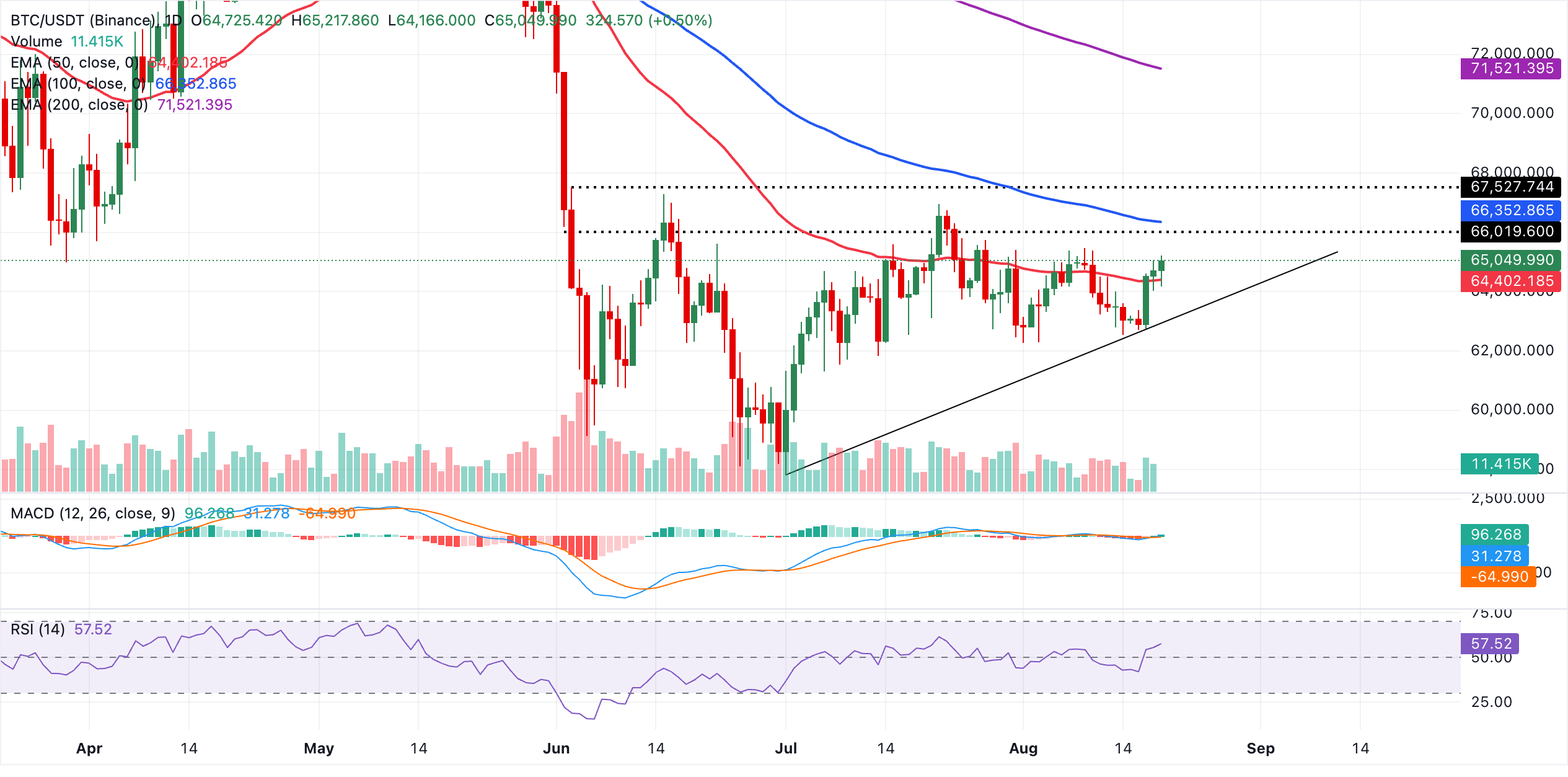
Initial resistance lies at the 100-day EMA at $66,353, with a more significant barrier at the 200-day EMA at $71,521, where a daily close above would soften the prevailing cap and open the way toward higher levels. On the downside, immediate support aligns with the 50-day EMA at $64,402, followed by the ascending trendline support around $63,002, and a decisive break below this area would neutralize the current constructive momentum backdrop and expose deeper retracements.
Gold extends recovery
Gold holds a clear bullish near-term bias, as the spot price sits well above the 50-day, 100-day, and 200-day EMAs, forming a firm underlying demand zone. The break above the downward resistance trendline, now offering support around $4,255, reinforces the constructive structure, while a positive MACD reading and an RSI near 65 hint that bullish momentum remains strong, though edging toward overbought conditions.
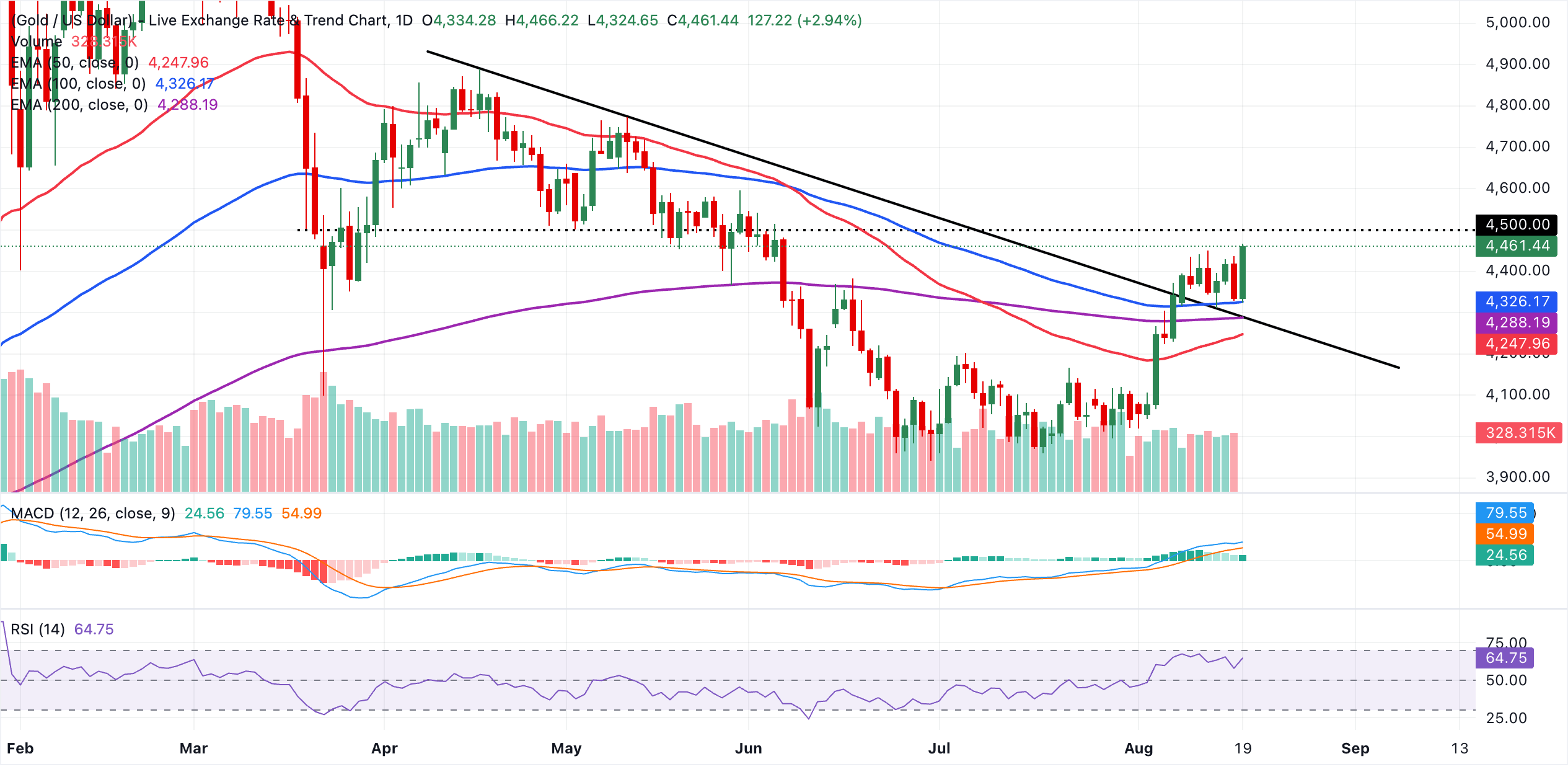
Initial support lies at the former trendline break area near $4,255, reinforced by the 50-day EMA at $4,248. Below this, the 200-day EMA at $4,288 and the 100-day EMA at $4,326 form a broader support cluster that is poised to attract buyers on corrective dips. With no significant technical resistance indicators on the daily chart, the bias stays upward as long as XAU/USD holds above this stacked moving-average floor. Still, stretched momentum suggests further gains could come with intermittent consolidation.
(The technical analysis of this story was written with the help of an AI tool. Know more.)
Bitcoin, altcoins, stablecoins FAQs
Bitcoin is the largest cryptocurrency by market capitalization, a virtual currency designed to serve as money. This form of payment cannot be controlled by any one person, group, or entity, which eliminates the need for third-party participation during financial transactions.
Altcoins are any cryptocurrency apart from Bitcoin, but some also regard Ethereum as a non-altcoin because it is from these two cryptocurrencies that forking happens. If this is true, then Litecoin is the first altcoin, forked from the Bitcoin protocol and, therefore, an “improved” version of it.
Stablecoins are cryptocurrencies designed to have a stable price, with their value backed by a reserve of the asset it represents. To achieve this, the value of any one stablecoin is pegged to a commodity or financial instrument, such as the US Dollar (USD), with its supply regulated by an algorithm or demand. The main goal of stablecoins is to provide an on/off-ramp for investors willing to trade and invest in cryptocurrencies. Stablecoins also allow investors to store value since cryptocurrencies, in general, are subject to volatility.
Bitcoin dominance is the ratio of Bitcoin's market capitalization to the total market capitalization of all cryptocurrencies combined. It provides a clear picture of Bitcoin’s interest among investors. A high BTC dominance typically happens before and during a bull run, in which investors resort to investing in relatively stable and high market capitalization cryptocurrency like Bitcoin. A drop in BTC dominance usually means that investors are moving their capital and/or profits to altcoins in a quest for higher returns, which usually triggers an explosion of altcoin rallies.
ARTIGOS POPULARES
1The Kiwi defies hot US inflation as Fed pause bets weaken the USD2Ethereum slips below $2,400 as Oil surges, ETF outflows mount3Canada: Energy-driven resilience with limited core pass-through – RBC4Taiwan Dollar: Foreign outflows pressure currency – OCBC5Silver Price Forecast: Bears target $55 as RSI nears oversold6Gold stumbles as US yields eclipse fading October Fed hike bets7Circle says USDC settled $36T in H1 2026, revenue hits $1.4B8Bank of Korea: Policy patience case – Standard Chartered9EUR/USD Price Forecast: Recovery remains fragile below key moving averages
COTAÇÕES AO VIVO


Comece Agora!
Cadastre-se e acesse os Mercados Globais em menos de 3 minutos

Entre em Contato Conosco









Contatos
Telefone: +61 2 8036 8388
Fax: +61 2 8036 8388
E-mail: support@tmgm.com
Site: https://www.tmgm.com



As informações fornecidas neste website são apenas de natureza geral e não constituem aconselhamento financeiro pessoal. Antes de agir com base em qualquer informação neste website, deve considerar a adequação da informação em relação aos seus objetivos, situação financeira e necessidades. Investir em CFDs e contratos de margem de FX envolve riscos significativos e não é adequado para todos os investidores. Poderá perder mais do que o seu depósito inicial. Não possui, nem detém, qualquer interesse no ativo subjacente. Recomendamos que procure aconselhamento independente e que se certifique de que compreende plenamente os riscos envolvidos antes de negociar. É importante que leia e considere o documento de divulgação antes de adquirir qualquer produto listado no website. As informações e os anúncios oferecidos neste website não se destinam a ser utilizados por qualquer pessoa em qualquer país ou jurisdição onde tal utilização seja contrária às leis e regulamentos locais. Os Produtos e Serviços oferecidos neste website não se destinam a residentes dos Estados Unidos, da Malásia e da Tailândia.
A TMGM é autorizada e regulada em diversas jurisdições.
A Trademax Australia Limited, que opera sob o nome comercial TMGM, é regulamentada pela Comissão Australiana de Valores Mobiliários e Investimentos (ASIC), com o número de licença AFSL 436416, e está localizada no 28º andar da One International Tower, na Barangaroo Avenue, 100, 2000 Sydney, NSW, Austrália.
E-mail: support@tmgm.com.au
A Trademax Global Limited, que opera sob o nome comercial TMGM, é autorizada e regulamentada pela Comissão de Serviços Financeiros de Vanuatu (VFSC), com o número de registro 40356, e está registrada no endereço 1276, Kumul Highway, Port Vila, Vanuatu, República de Vanuatu.
Email: support@tmgm.com
A Trademax Global Markets (SE) Limited, que opera sob o nome comercial TMGM, é autorizada e regulamentada pela Autoridade de Serviços Financeiros (FSA) das Seychelles, com o número de licença SD224. A empresa está registrada no endereço: Escritório nº 13, Providence Estate ABIS Centre, Mahé, Seychelles.
E-mail: support@tmgm.com
A Trademax Global Markets (International) Pty Ltd, que opera sob o nome comercial TMGM, é autorizada e regulamentada pela Comissão de Serviços Financeiros das Ilhas Maurício (FSC), com o número de licença GB22201012, e está registrada no endereço: 33, Edith Cavell Street, C/o IQ EQ Fund Services (Mauritius) Ltd, Port Louis, 11324, Ilhas Maurício.
E-mail: support@tmgm.com
Copyright © TMGM. Todos os direitos reservados