

British Pound slides as Gulf War risk fuels US Dollar rally
- Trump attack threat boosts safe-haven demand for the Dollar.
- Strong jobless claims reinforce resilient US labor-market narrative.
- UK Retail Sales, GfK confidence and PMIs drive next move.
The Pound Sterling drops by over 0.40% against the Greenback as risk aversion weighs on most G8 currencies amid the escalation of the Middle East conflict and growing speculation of an extended US campaign against Iran. The GBP/USD trades at 1.3313 after reaching a daily high at 1.3393.
GBP/USD falls as Middle East escalation revives Fed hike bets

The Gulf War continues to drive price action, bolstering the American currency. The US Dollar Index (DXY), which tracks the buck against its peers, edges up 0.32% to 101.46.
Tensions in the Middle East are rising sharply as N12 reports that US President Donald Trump said that he is “considering a massive attack greater than anything before, I'm close to making a decision.” This exerts additional pressure on the GBP/USD, which approaches the 1,3300 figure. In the meantime, Houthi sources said that Atamco Oil facilities would be a target if the blockade of Yemen is not lifted, reported Al Jazeera.
Aside from this, US economic data revealed that the labour market remains solid, as the US Department of Labour revealed that Initial Jobless Claims for the week ending July 18 came at 187K, stronger than the expected 212K by analysts.
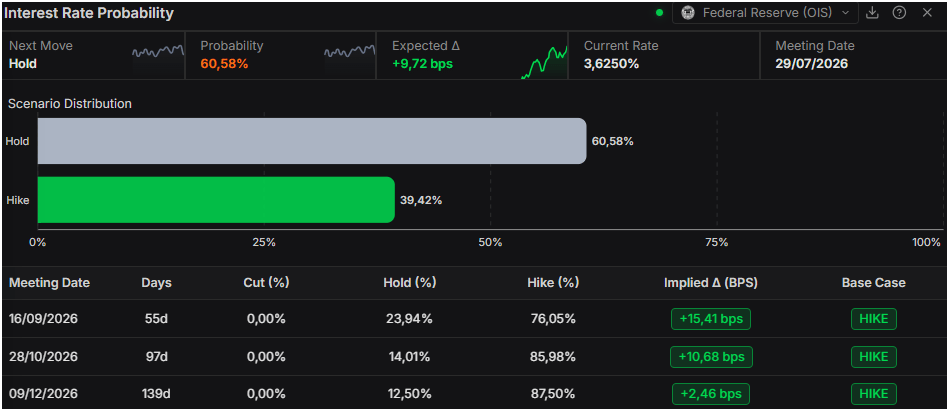
Money markets increased the chances of a Federal Reserve rate hike at the July 20 meeting. A day ago, the chances were near 33%; as of writing, they are closing in on 40%. Meanwhile, the odds for a hold are 60%, according to Prime Terminal data.
In the UK, the economic docket this week features the release of inflation figures, which eased somewhat. Nevertheless, the recent rise of energy prices spurred by an escalation of the US-Iran conflict could trigger another jump in inflation next month.
The UK economic docket will feature Retail Sales data on Friday, and the GfK Consumer Confidence for July. In the US, traders are waiting for S&P Global Flash PMIs, ahead of the next week’s monetary policy decision by the Federal Reserve.
GBP/USD Price Forecast: Technical outlook
In the daily chart, GBP/USD trades at 1.3308, retaining a bearish near-term bias as spot holds beneath the latest reading of the 50/100/200-day Simple Moving Averages (SMA) cluster at 1.3369. The pair also trades below the downward resistance trend-line break level at 1.3474 and the former upward support trend-line break around 1.3517, suggesting rallies remain capped, while the Relative Strength Index (14) at 43.8 leans toward weak downside momentum rather than an oversold condition.
On the topside, initial resistance aligns with the daily SMA cluster at 1.3369, ahead of the descending trend-line break around 1.3474, with a stronger barrier seen near 1.3517 where the prior rising support line was broken. As long as GBP/USD holds below these overhead levels, the technical structure favors further consolidation or fresh downside attempts rather than a sustained recovery.
(The technical analysis of this story was written with the help of an AI tool. Know more.)
Pound Sterling Price This week
The table below shows the percentage change of British Pound (GBP) against listed major currencies this week. British Pound was the strongest against the Swiss Franc.
| USD | EUR | GBP | JPY | CAD | AUD | NZD | CHF | |
|---|---|---|---|---|---|---|---|---|
| USD | 0.50% | 1.10% | 0.92% | 0.54% | -0.09% | 1.12% | 1.11% | |
| EUR | -0.50% | 0.60% | 0.37% | 0.03% | -0.57% | 0.61% | 0.60% | |
| GBP | -1.10% | -0.60% | -0.22% | -0.57% | -1.17% | 0.01% | 0.05% | |
| JPY | -0.92% | -0.37% | 0.22% | -0.31% | -0.96% | 0.14% | 0.28% | |
| CAD | -0.54% | -0.03% | 0.57% | 0.31% | -0.57% | 0.45% | 0.62% | |
| AUD | 0.09% | 0.57% | 1.17% | 0.96% | 0.57% | 1.19% | 1.22% | |
| NZD | -1.12% | -0.61% | -0.01% | -0.14% | -0.45% | -1.19% | 0.04% | |
| CHF | -1.11% | -0.60% | -0.05% | -0.28% | -0.62% | -1.22% | -0.04% |
The heat map shows percentage changes of major currencies against each other. The base currency is picked from the left column, while the quote currency is picked from the top row. For example, if you pick the British Pound from the left column and move along the horizontal line to the US Dollar, the percentage change displayed in the box will represent GBP (base)/USD (quote).














