




Gold rises above $4,300 as traders brace for US Nonfarm Payrolls
- Gold climbs to a fresh seven-week high above $4,300 as traders await the US Nonfarm Payrolls report.
- Lower Oil prices have prompted traders to trim Fed rate-hike bets, while Middle East developments remain in focus.
- XAU/USD maintains a bullish technical bias with buyers eyeing the 100-day SMA near $4,390.
Gold (XAU/USD) extends its recovery on Friday as technical buying accelerates, even as market sentiment remains cautious due to developments in the Middle East and uncertainty over the Federal Reserve’s (Fed) interest-rate outlook. Traders now await the US Nonfarm Payrolls (NFP) report, due at 12:30 GMT.

At the time of writing, XAU/USD trades around $4,322, climbing to a fresh seven-week high.
Economists expect the US economy to add 80K jobs in July, following a 57K increase in June, while the Unemployment Rate is forecast to remain unchanged at 4.2%.
The precious metal is heading for its strongest weekly rise since January, gaining more than 6% so far after breaking above the month-old $4,000-$4,200 range on Wednesday. The advance was initially fuelled by optimism that the Strait of Hormuz could reopen soon as Iran and Oman reportedly moved closer to an agreement on a proposed shipping route through the waterway.
The development pushed Oil prices sharply lower earlier in the week, easing concerns over energy-driven inflation and weighing on the US Dollar (USD) and US Treasury yields as traders scaled back bets on Fed interest rate hikes. Gold tends to perform well in a low-interest-rate environment, as it offers no yield.
According to the CME FedWatch Tool, markets currently see around a 55% probability of a rate hike at the September meeting, down from roughly 67% a week ago. The upcoming employment data could shift those expectations and determine whether Gold extends its advance or begins to lose momentum.
Nevertheless, energy-related inflation risks have diminished rather than disappeared, as Oil prices still carry a substantial geopolitical risk premium. Fars News reported on Friday that Iran had struck what it described as “hostile targets” in the Strait of Hormuz.
Meanwhile, the proposed Iran-Oman arrangement would not result in a complete reopening of the Strait. Tehran could collect transit fees under the framework and is also reviewing a bill that would bar US, Israeli and other hostile vessels from using the waterway.
Technical analysis: Daily chart
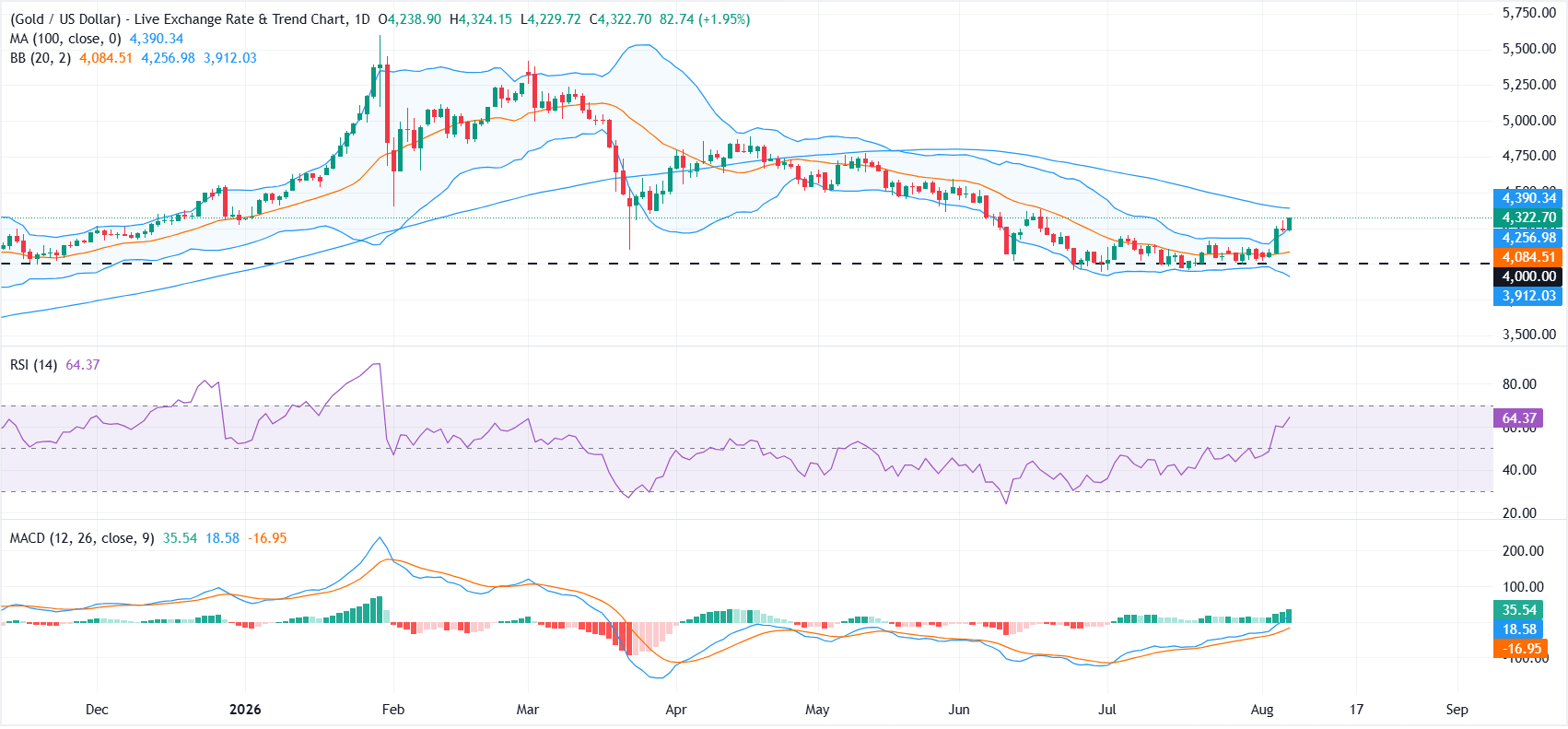
XAU/USD bounced back above the Bollinger Bands’ 20-period Simple Moving Average (SMA) at $4,084 and is now holding over the upper band at $4,256, hinting at firm underlying demand after the recent range-bound trade.
The Relative Strength Index (RSI) at 64 approaches overbought territory on the daily chart, and the Moving Average Convergence Divergence (MACD) histogram stays firmly positive, reinforcing bullish momentum.
On the topside, initial resistance is defined by the 100-day SMA at $4,390, and a sustained break above this barrier would open the way for a more decisive bullish continuation.
On the downside, immediate support is seen at the Bollinger upper band near $4,256, followed by the mid-line at $4,084, with a more solid floor at the horizontal level of $4,000.
(The technical analysis of this story was written with the help of an AI tool. Know more.)
Nonfarm Payrolls FAQs
Nonfarm Payrolls (NFP) are part of the US Bureau of Labor Statistics monthly jobs report. The Nonfarm Payrolls component specifically measures the change in the number of people employed in the US during the previous month, excluding the farming industry.
The Nonfarm Payrolls figure can influence the decisions of the Federal Reserve by providing a measure of how successfully the Fed is meeting its mandate of fostering full employment and 2% inflation. A relatively high NFP figure means more people are in employment, earning more money and therefore probably spending more. A relatively low Nonfarm Payrolls’ result, on the either hand, could mean people are struggling to find work. The Fed will typically raise interest rates to combat high inflation triggered by low unemployment, and lower them to stimulate a stagnant labor market.
Nonfarm Payrolls generally have a positive correlation with the US Dollar. This means when payrolls’ figures come out higher-than-expected the USD tends to rally and vice versa when they are lower. NFPs influence the US Dollar by virtue of their impact on inflation, monetary policy expectations and interest rates. A higher NFP usually means the Federal Reserve will be more tight in its monetary policy, supporting the USD.
Nonfarm Payrolls are generally negatively-correlated with the price of Gold. This means a higher-than-expected payrolls’ figure will have a depressing effect on the Gold price and vice versa. Higher NFP generally has a positive effect on the value of the USD, and like most major commodities Gold is priced in US Dollars. If the USD gains in value, therefore, it requires less Dollars to buy an ounce of Gold. Also, higher interest rates (typically helped higher NFPs) also lessen the attractiveness of Gold as an investment compared to staying in cash, where the money will at least earn interest.
Nonfarm Payrolls is only one component within a bigger jobs report and it can be overshadowed by the other components. At times, when NFP come out higher-than-forecast, but the Average Weekly Earnings is lower than expected, the market has ignored the potentially inflationary effect of the headline result and interpreted the fall in earnings as deflationary. The Participation Rate and the Average Weekly Hours components can also influence the market reaction, but only in seldom events like the “Great Resignation” or the Global Financial Crisis.













