

The Australian Dollar goes nowhere with conviction
- AUD/USD trades flat around the 0.7000 handle after another failed run at the declining 50-day EMA.
- Hike risk in Australia and hike risk in America are cancelling each other out, leaving the currency with no rate edge in either direction.
- Thursday's employment report at 01:30 GMT opens a six-session stretch that ends with next Wednesday's inflation print and Federal Reserve decision landing the same day.
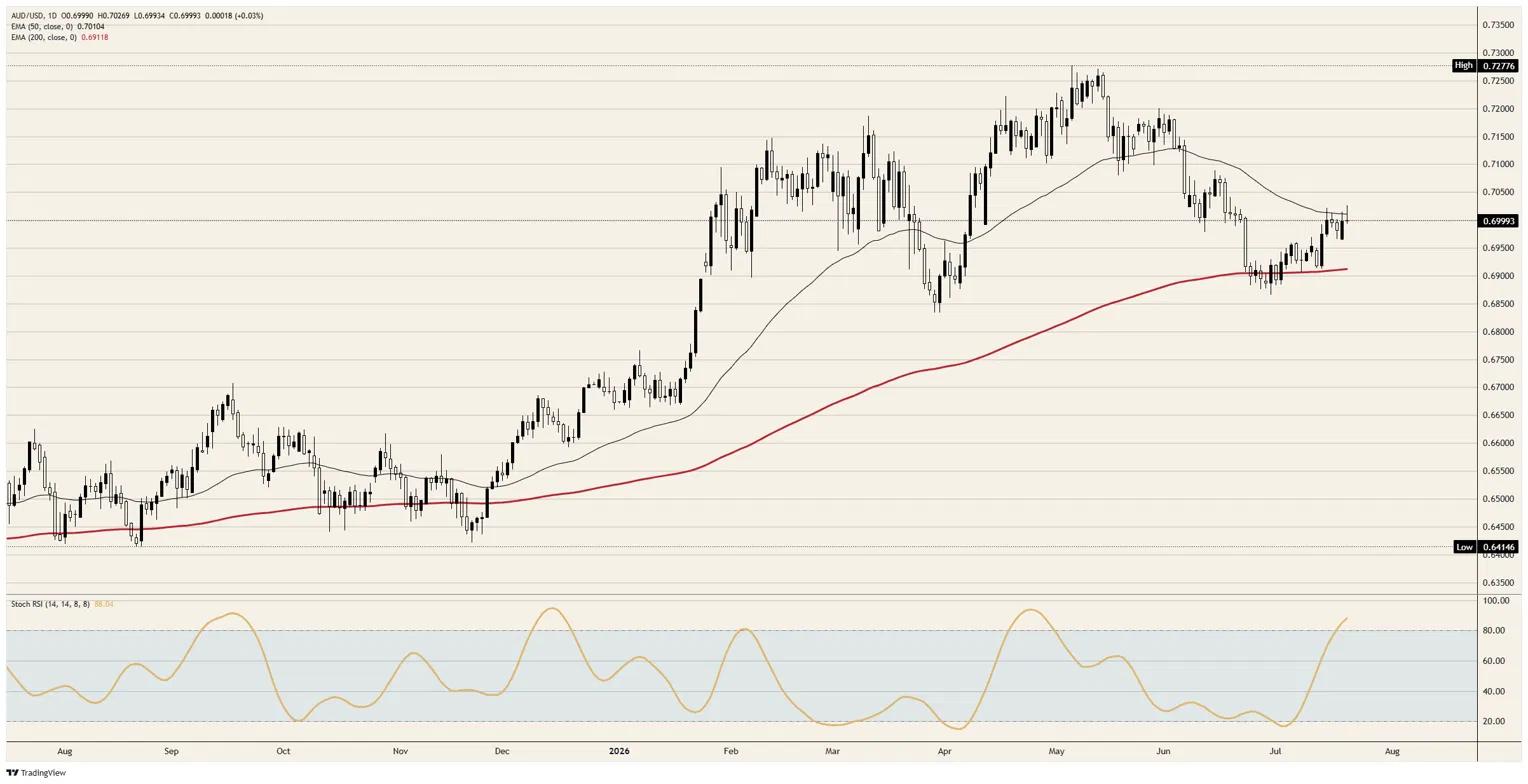
The Australian Dollar spent Tuesday doing a convincing impression of movement, climbing from just below the 0.7000 handle to a session high short of 0.7050 before handing the entire advance back through the North American afternoon. The rally stalled where every rally this month has stalled, at the declining 50-day Exponential Moving Average sitting just above 0.7000, and AUD/USD trades back near 0.7000 late in the session, flat on the day and flat on the story. For a currency wired into a war, a tariff cycle, and two hawkish central banks, going nowhere this precisely takes real effort.

A war that pulls the currency in both directions
Tuesday's backdrop should, in theory, have picked a direction for the Aussie. The strike campaign against Iran runs into a tenth consecutive night, Houthi allies have declared a maritime embargo against Saudi Arabia, and Crude Oil trades firmly higher again, exactly the kind of energy tape that feeds Australian inflation and keeps the Reserve Bank of Australia's tightening bias alive. The cash rate already sits at 4.35% after three hikes this year, the June hold kept further increases explicitly on the table, and a majority of surveyed economists still pencil one more move for the 11 August meeting.
The same war works just as hard for the other side of the pair. Safe-haven demand and energy-fed inflation risk have markets carrying a Federal Reserve hike as fully priced by December, roughly two-thirds odds of one by mid-September, and a stubborn tail betting on two, a mix that shoved USD/JPY through 163.00 on Tuesday for the first time since 1986. Tuesday's lone US data point, a weekly hiring gauge slowing for a fourth consecutive week, counted as the Dollar's only soft spot and moved precisely nothing. When both central banks lean hawkish for the same reason, the rate differential goes nowhere, which doubles as a fair description of the chart.
Iron Ore is not breaking the tie
The commodity channel that usually referees these standoffs is offering nothing. Iron Ore has spent the summer stuck below $100 a tonne, capped by rising seaborne supply, compressed Chinese steel-mill margins, and port inventories that refuse to draw down, while Beijing's recurring stimulus pledges keep getting filed under talk until construction demand proves otherwise. Australia's terms of trade are treading water at precisely the moment the currency needs a push, and the pull from sticky domestic inflation only cancels against it rather than compounding.
The tariff wave adds a quieter drag on the same side of the ledger. Washington opened the week with a fresh 50% round against Canadian goods and signalled that action against dozens of trading partners is coming soon, and a small open economy wired into Chinese industrial demand does not need to appear on any list to feel the chill. Every risk-sensitive currency carries that overhang into month-end, and the Australian Dollar, a proxy for global trade whenever traders need one, carries more of it than most.
A jobs test before next Wednesday's double bill
Thursday's labour force report at 01:30 GMT is the one scheduled chance this week to break the deadlock. Consensus looks for employment growth to slow to 15K in June from 40.3K in May, with the unemployment rate holding at 4.4% and participation steady at 66.7%. A print near consensus keeps the August question open and the range intact, while a genuine miss in either direction finally hands the currency the domestic story it has lacked all month.
Late Thursday adds the preliminary July Purchasing Managers Indexes at 23:00 GMT, with manufacturing, services, and the composite all hovering barely above the 50.0 line, close enough to contraction that one bad month would matter. The heavier ordnance waits for next Wednesday, when the June Consumer Price Index, the release that decides the August rate call, lands the same day the Federal Reserve announces its own decision at 18:00 GMT. Both halves of this pair's rate math get marked to market inside a single session, and a tape this flat at 0.7000 reads like a market fully aware of it.
Technical levels to watch
Resistance: The declining 50-day EMA just above the 0.7000 handle caps the tape, with Tuesday's supply short of 0.7050 stacked behind it and the June breakdown zone near 0.7100 beyond that.
Support: First support sits at 0.6950, the launch area of the latest leg higher, backed by the rising 200-day EMA near 0.6900, the floor that started July's entire recovery.
Bias: Bearish. Repeated rejections at a declining 50-day EMA with the daily Stochastic Relative Strength Index deep in overbought territory argue the path of least resistance runs back toward 0.6950, and only a daily close above 0.7050 invalidates the call.
AUD/USD daily chart
Australian Dollar FAQs
One of the most significant factors for the Australian Dollar (AUD) is the level of interest rates set by the Reserve Bank of Australia (RBA). Because Australia is a resource-rich country another key driver is the price of its biggest export, Iron Ore. The health of the Chinese economy, its largest trading partner, is a factor, as well as inflation in Australia, its growth rate and Trade Balance. Market sentiment – whether investors are taking on more risky assets (risk-on) or seeking safe-havens (risk-off) – is also a factor, with risk-on positive for AUD.
The Reserve Bank of Australia (RBA) influences the Australian Dollar (AUD) by setting the level of interest rates that Australian banks can lend to each other. This influences the level of interest rates in the economy as a whole. The main goal of the RBA is to maintain a stable inflation rate of 2-3% by adjusting interest rates up or down. Relatively high interest rates compared to other major central banks support the AUD, and the opposite for relatively low. The RBA can also use quantitative easing and tightening to influence credit conditions, with the former AUD-negative and the latter AUD-positive.
China is Australia’s largest trading partner so the health of the Chinese economy is a major influence on the value of the Australian Dollar (AUD). When the Chinese economy is doing well it purchases more raw materials, goods and services from Australia, lifting demand for the AUD, and pushing up its value. The opposite is the case when the Chinese economy is not growing as fast as expected. Positive or negative surprises in Chinese growth data, therefore, often have a direct impact on the Australian Dollar and its pairs.
Iron Ore is Australia’s largest export, accounting for $118 billion a year according to data from 2021, with China as its primary destination. The price of Iron Ore, therefore, can be a driver of the Australian Dollar. Generally, if the price of Iron Ore rises, AUD also goes up, as aggregate demand for the currency increases. The opposite is the case if the price of Iron Ore falls. Higher Iron Ore prices also tend to result in a greater likelihood of a positive Trade Balance for Australia, which is also positive of the AUD.
The Trade Balance, which is the difference between what a country earns from its exports versus what it pays for its imports, is another factor that can influence the value of the Australian Dollar. If Australia produces highly sought after exports, then its currency will gain in value purely from the surplus demand created from foreign buyers seeking to purchase its exports versus what it spends to purchase imports. Therefore, a positive net Trade Balance strengthens the AUD, with the opposite effect if the Trade Balance is negative.














