

Gold Holds, Bitcoin Crashes! “Big Short” Burry Warns: Another 10% Drop Could Trigger Disaster
Bitcoin, once laden with the dual dreams of a “monetary revolution” and “ultimate safe-haven asset”, is now being repeatedly exposed by reality as a liquidity-driven speculative vehicle that rises and falls in tandem with risk assets. Gold, by contrast, has been setting one record high after another. At the same time, Burry argues that if Bitcoin’s slump continues, the risk could spread from within the crypto ecosystem into the broader financial system.
Bitcoin’s Steep Sell-Off
This Bitcoin downturn is not a routine correction. Both its depth and momentum point to a fundamental loss of market confidence.

Since hitting an all-time high in October 2025, Bitcoin has now fallen more than 40%, completely erasing all gains made since Trump’s victory in the November 2024 election.
On 3 February, Bitcoin decisively broke through the key psychological and technical support level at USD 73,000, with an intraday low of USD 72,949.94, stunning the market.
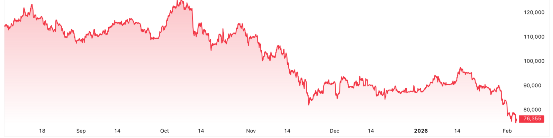
Selling pressure quickly spread across the entire crypto market. Ethereum (ETH) and Solana (SOL) plunged 9.6% and 7.1% respectively over the past 24 hours, with prices now below their April 2025 market lows and more than 57% off their respective 2025 peaks.
The violent price swings triggered a wave of forced liquidations. According to Coinglass data, total liquidations in the crypto market reached USD 659 million over the past 24 hours, including USD 234 million of long Bitcoin positions wiped out.
Why the “Digital Gold” Narrative Has Broken Down
The most damaging aspect of this downturn is that it has effectively shattered Bitcoin’s core narrative: that it is a gold-like safe-haven asset that hedges inflation and geopolitical risk.
Safe-haven function thoroughly disproven:
Recently, despite rising geopolitical tensions and a weaker US dollar, capital has not flowed into crypto in the way Bitcoin advocates had hoped. Instead, gold and silver prices have both hit new record highs.
This stark divergence makes one thing very clear: in moments of genuine fear, mainstream institutional capital in traditional finance still overwhelmingly chooses gold—not Bitcoin. Michael Burry bluntly calls Bitcoin a “purely speculative asset”, noting that the oft-repeated logic that its “fixed supply makes it comparable to gold” has proven deeply flawed in practice.
Rising correlation with risk assets:
Burry further warns that while the launch of spot Bitcoin ETFs has brought in additional liquidity, it has also reinforced Bitcoin’s speculative nature and increased its linkage with traditional equity markets. Data show that Bitcoin’s correlation with the S&P 500 index has recently approached 0.5 (where 1 indicates a perfectly positive correlation). This means Bitcoin is looking more and more like a highly volatile tech stock, rather than a safe-haven asset independent of the traditional financial system. When global risk appetite declines, it fails to act as a refuge for capital and is instead sold off alongside equities.
Internal engines stalling:
The disappearance of capital inflows has been the direct driver of the decline. At the end of January, spot Bitcoin ETFs saw their largest single-day outflows since November 2025, with three separate episodes of major redemptions occurring within just ten days. At the same time, some native crypto traders have begun shifting into other areas—such as prediction markets—further tightening overall liquidity in the Bitcoin market.
What Happens If Bitcoin Falls Another 10%?
Michael Burry warns that if Bitcoin falls another 10%, it could trigger the following “disastrous consequences”:
If it drops another ~10%, corporate “treasuries” face an existential squeeze.
For example, listed company MicroStrategy (MSTR), famous for its heavy Bitcoin holdings, would see tens of billions of dollars in unrealised losses and effectively lose access to capital markets. Other institutions holding Bitcoin would face mark-to-market losses of 15%–20% and be forced into aggressive selling.
If it falls to around USD 60,000, a wave of miner bankruptcies and a breakdown in market structure could follow.
Crypto miners would find their operations uneconomical and go bust on a large scale, forcing them to dump their Bitcoin reserves and creating a “death spiral”. MicroStrategy could face an existential crisis under such conditions.
If it falls to USD 50,000, a black hole in the derivatives market and “contamination” of precious metals could emerge.
Derivative products such as “tokenised metal futures” that lack physical backing would collapse as their collateral (Bitcoin) plunges in value, “falling into a black hole with no natural buyers”. A sharp Bitcoin sell-off could also force speculative capital to deleverage positions in gold and silver, leading to collateral damage from forced selling in the precious metals market.
Burry’s core argument is that today’s crypto market has been tightly bound to the traditional financial system through complex financial engineering—such as ETFs, collateralised lending and tokenised derivatives. Bitcoin is no longer an isolated speculative asset. Its collapse could transmit through corporate balance sheets, the mining ecosystem and derivative chains, creating unexpected and potentially systemic spillover effects.
Market Sentiment
Market sentiment has now reversed 180 degrees. Just a week ago, traders were still broadly betting that Bitcoin would challenge the USD 100,000 mark. Now, the probability being priced in for Bitcoin first falling to USD 69,000 has surged to around 75%. Analysts, including the head of research at Galaxy Digital, believe that Bitcoin lacks near-term catalysts, and that structural weakness could push it further down towards its long-term moving average around USD 58,000.
That said, there are also more measured views. Some argue that, given Bitcoin’s total market capitalisation is still below USD 1.5 trillion and that households and corporates have relatively limited direct exposure, the resulting wealth effect and systemic risk may remain within controllable bounds. However, this does not change one fundamental conclusion: the narrative of Bitcoin as a “safe-haven asset” has collapsed. Going forward, its price will be driven far more by global liquidity conditions, US equity market sentiment and internal leverage unwinds within crypto than by any “digital gold” thesis—an aura that is unlikely to return in the foreseeable future.
For investors, the current plunge is a vivid lesson in risk. It once again proves that treating Bitcoin as equivalent to gold in a long-term portfolio is a dangerous misconception. On the asset allocation scale, Bitcoin should be categorised much more clearly as a high-risk, high-volatility speculative asset class.













