

British Pound rebounds as US Dollar rally fades, UK politics stabilize
- US Dollar slips from YTD highs as Fed repricing cools.
- Burnham fiscal-rule pledge helps calm UK political nerves.
- NFP, UK GDP and Warsh testimony anchor next week.
The Pound Sterling gains 0.20% against the Greenback as the latter recoils after hitting year-to-date (YTD) highs, with money markets pricing in a less hawkish Federal Reserve, despite policymakers stating they will focus on inflation. The GBP/USD trades at 1.3217 after reaching a daily low of 1.3180.
GBP/USD rebounds as Fed bets cool and UK politics stabilize
Cable is set to end the week with modest losses of 0.15%, despite the ongoing political turmoil, which was tempered by UK Prime Minister Keir Starmer's resignation. Signs of an orderly transmission to a new PM – the seventh in 10 years, with the race led by Andy Burnham, who is the only declared candidate to succeed Starmer.
On May 14, Burnham announced his intention to contest a parliamentary seat to challenge Starmer, sparking broad GBP weakness and sending GILTS yields higher. This amid growing speculation that his “business-friendly socialism” will increase spending and borrowing, at a time when the budget is walking a tightrope.
Lately, his team said he would adhere to the current Chancellor, Rachel Reeves, fiscal rules, which calmed markets.
Traders eye one rate hike by the BoE
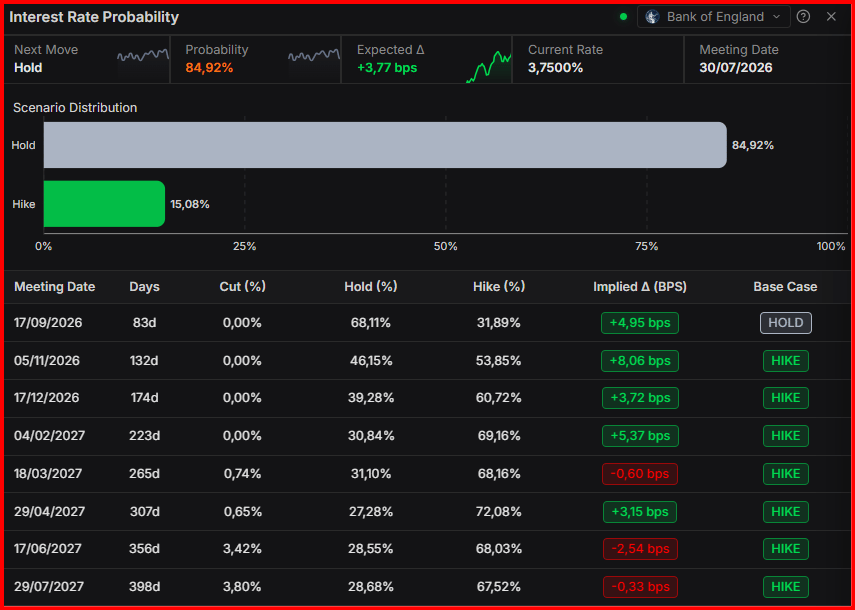
Aside from this, expectations that the Bank of England (BoE) will increase rates in 2026 have trimmed sharply. A week ago, investors expected 33 basis points (bps) of tightening, but as of writing, they had priced in 21 bps, according to Prime Terminal data.
Across the pond, the US economic docket was packed during the week, ending with the release of the US Consumer Sentiment by the University of Michigan, which improved in June. The index rose from 48.9 preliminary reading for June to 49.5, also exceeding May’s print of 44.8.
Further insights on consumers revealed that higher costs of living are projected as inflation expectations for one year were unchanged at 4.6% and for five years at 3.3%, down from 3.4% in the previous reading.
In the meantime, the US Dollar Index (DXY), which measures the performance of the American currency against the other six currencies, is down 0.18% to 101.25.
Minneapolis Fed President Neel Kashkari said the Fed may need to raise rates due to broad inflation in a Bloomberg interview.
What’s in the economic calendar for the UK and US, next week?
In the UK, the docket will feature GDP figures and speeches by BoE officials. In the US, Nonfarm Payrolls are eyed, followed by Fed Chair Kevin Warsh's speech at the US Congress and the ISM Manufacturing PMI.
GBP/USD Price Forecast: Technical Outlook
In the daily chart, GBP/USD trades at 1.3218, holding a bearish near-term bias as spot remains below the simple moving average triple cluster (50, 100 and 200) around 1.3431. The pair has slipped away from the former rising support line that began near 1.3159, while the break levels at 1.3454 and 1.3535 on the respective uptrend and downtrend lines sit well overhead, hinting that the recent push lower is still unfolding. The Relative Strength Index (14) at around 38 stays below the midline, suggesting subdued bullish momentum rather than a clear oversold condition.
On the topside, initial resistance emerges at the 1.3431 area defined by the clustered simple moving averages, with further barriers at the former uptrend break near 1.3454 and the downward resistance trend-line break level around 1.3535. On the downside, immediate focus sits on the current trading band near 1.3218, with the prior trend-line origin at 1.3159 offering the next notable support zone should selling pressure extend.
(The technical analysis of this story was written with the help of an AI tool.)
Pound Sterling FAQs
The Pound Sterling (GBP) is the oldest currency in the world (886 AD) and the official currency of the United Kingdom. It is the fourth most traded unit for foreign exchange (FX) in the world, accounting for 12% of all transactions, averaging $630 billion a day, according to 2022 data. Its key trading pairs are GBP/USD, also known as ‘Cable’, which accounts for 11% of FX, GBP/JPY, or the ‘Dragon’ as it is known by traders (3%), and EUR/GBP (2%). The Pound Sterling is issued by the Bank of England (BoE).
The single most important factor influencing the value of the Pound Sterling is monetary policy decided by the Bank of England. The BoE bases its decisions on whether it has achieved its primary goal of “price stability” – a steady inflation rate of around 2%. Its primary tool for achieving this is the adjustment of interest rates. When inflation is too high, the BoE will try to rein it in by raising interest rates, making it more expensive for people and businesses to access credit. This is generally positive for GBP, as higher interest rates make the UK a more attractive place for global investors to park their money. When inflation falls too low it is a sign economic growth is slowing. In this scenario, the BoE will consider lowering interest rates to cheapen credit so businesses will borrow more to invest in growth-generating projects.
Data releases gauge the health of the economy and can impact the value of the Pound Sterling. Indicators such as GDP, Manufacturing and Services PMIs, and employment can all influence the direction of the GBP. A strong economy is good for Sterling. Not only does it attract more foreign investment but it may encourage the BoE to put up interest rates, which will directly strengthen GBP. Otherwise, if economic data is weak, the Pound Sterling is likely to fall.
Another significant data release for the Pound Sterling is the Trade Balance. This indicator measures the difference between what a country earns from its exports and what it spends on imports over a given period. If a country produces highly sought-after exports, its currency will benefit purely from the extra demand created from foreign buyers seeking to purchase these goods. Therefore, a positive net Trade Balance strengthens a currency and vice versa for a negative balance.














