

GBP/JPY consolidates near highs as momentum shows signs of exhaustion
- GBP/JPY edges lower on Tuesday as the Japanese Yen firms after a hawkish hold from the Bank of Japan.
- Traders await the Bank of England interest rate decision on Thursday.
- Technically, GBP/JPY holds a bullish bias above key moving averages, though momentum shows signs of fading.
The British Pound (GBP) weakens against the Japanese Yen (JPY) on Tuesday as the Yen gains traction following the latest monetary policy decision from the Bank of Japan. At the time of writing, GBP/JPY is trading around 215.18, down nearly 0.27% on the day, while remaining confined within a two-week range.

The BoJ kept the benchmark interest rate unchanged at 0.75%, in line with expectations, with a 6-3 vote split as three policymakers backed a hike to 1.0%. The central bank delivered a hawkish hold, raising its inflation outlook while trimming growth projections, reflecting risks linked to the US-Iran war and elevated Oil prices.
Governor Kazuo Ueda reinforced the tightening bias, stating the BoJ will continue to raise the policy rate and adjust the degree of monetary accommodation in line with economic activity, prices, and financial conditions. He also warned that Japan’s economic growth could slow in fiscal year 2026 due to ongoing geopolitical tensions.
The Japanese Yen strengthened after the decision, but gains remain limited as high energy prices continue to weigh, with Japan’s reliance on imported oil keeping the currency sensitive to ongoing supply risks.
Meanwhile, the wide interest rate differential between the Bank of England (BoE)and the BoJ keeps the broader GBP/JPY bias tilted to the upside. Attention now turns to the BoE policy decision due on Thursday, where rates are widely expected to be held, although markets continue to price in at least two hikes ahead amid mounting inflation risks driven by higher Oil prices.
Technical Analysis:
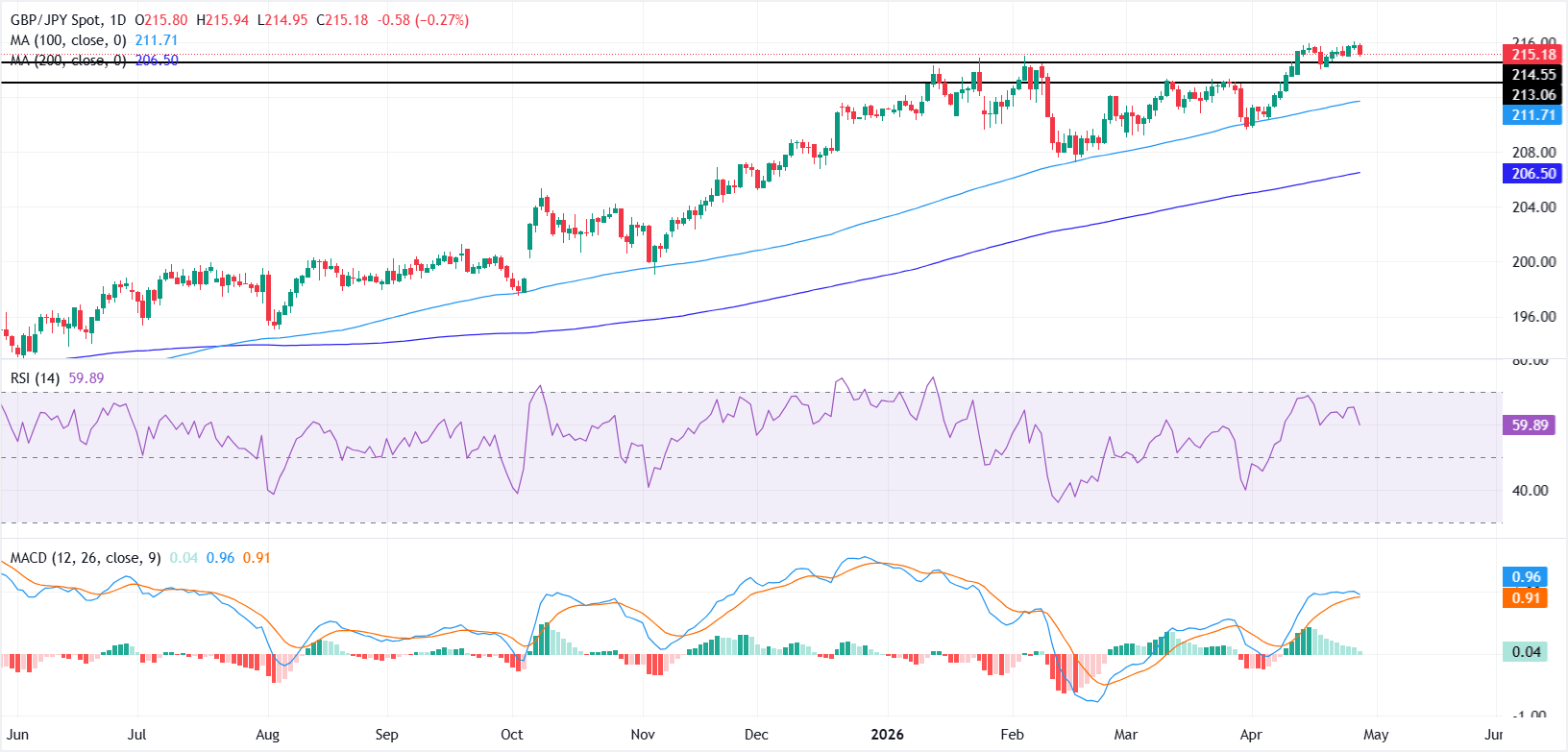
On the daily chart, GBP/JPY maintains a bullish near-term bias as it holds above the 100-day Simple Moving Average (SMA) and the 200-day SMA.
However, momentum indicators suggest a loss of strength, with a mild bearish divergence emerging as prices consolidate near recent highs, while the Relative Strength Index (RSI) trends slightly lower around 60. The Moving Average Convergence Divergence (MACD) shows a fading green histogram, indicating that upside momentum is weakening.
On the downside, immediate support emerges at 214.50, reinforced by a lower horizontal level at 213.00, which together frame the first demand zone before the 100-day SMA at 211.71. A deeper decline would expose the broader bullish floor near the 200-day SMA at 206.50.
On the upside, the 216.00 handle acts as immediate resistance. A daily close above this level could open the door for a continuation of the prevailing uptrend, with upside targets at 217.00 and 218.00.
Economic Indicator
BoE Interest Rate Decision
The Bank of England (BoE) announces its interest rate decision at the end of its eight scheduled meetings per year. If the BoE is hawkish about the inflationary outlook of the economy and raises interest rates it is usually bullish for the Pound Sterling (GBP). Likewise, if the BoE adopts a dovish view on the UK economy and keeps interest rates unchanged, or cuts them, it is seen as bearish for GBP.
Read more.Next release: Thu Apr 30, 2026 11:00
Frequency: Irregular
Consensus: 3.75%
Previous: 3.75%
Source: Bank of England














