

Gold lacks upside momentum as Fed hike bets grow amid US-Iran tensions
- Gold steadies on Tuesday but lacks upside momentum as higher-for-longer interest rate expectations weigh.
- Markets dial up Fed rate hike bets as tensions around the Strait of Hormuz intensify.
- XAU/USD trades below the 50- and 100-day SMAs with mild bearish momentum on the daily chart.
Gold (XAU/USD) steadies on Tuesday but lacks upside momentum as higher-for-longer interest rate expectations rise following renewed escalation in the Middle East, which continues to fuel energy-driven inflation concerns. At the time of writing, XAU/USD is trading around $4,550 after hitting a five-week low near $4,500 on Monday.

Reports of fresh attacks in the Gulf region on Monday have pushed the fragile truce between the United States (US) and Iran to the brink, as both sides intensify efforts to assert control over the Strait of Hormuz. Iran reportedly targeted Oil infrastructure in the United Arab Emirates (UAE), while US President Donald Trump said US forces shot down seven small Iranian boats near the Strait.
Trump warned that Iran would be “blown off the face of the Earth” if it attacks American ships, as the US military moves ahead with his “Project Freedom” plan aimed at guiding stranded vessels out of the waterway.
Iran’s Foreign Minister Abbas Araghchi said that developments in the Strait of Hormuz “make clear there’s no military solution to a political crisis,” while adding that “talks are making progress” with Pakistan acting as a mediator.
As tensions around the Strait of Hormuz intensify and direct negotiations remain limited, the conflict shows little sign of easing in the near term. Renewed attacks have heightened fears of global inflation, as supply disruptions keep a geopolitical risk premium firmly embedded in energy markets.
Against this backdrop, central banks, particularly the Federal Reserve (Fed), are expected to maintain a hawkish stance to contain inflation, which remains above the Fed’s 2% target. While Gold is traditionally seen as an inflation hedge, higher interest rates reduce its appeal by making yield-bearing assets more attractive.
Traders now expect the Fed to delay rate cuts, while pricing in a higher likelihood of interest rate hikes, with the CME FedWatch Tool showing the probability of a rate hike at the December meeting rising to around 27% from near zero a week ago.
In the near term, Gold is expected to trade with a downside bias as elevated US Treasury yields and a firm US Dollar (USD) continue to weigh on the non-yielding metal.
Looking ahead, traders will closely track developments in the US-Iran conflict, while also focusing on upcoming US economic data, including the Nonfarm Payrolls (NFP) report due on Friday, which could influence interest rate expectations.
Technical Analysis: Bearish bias persists below 50- and 100-day SMAs
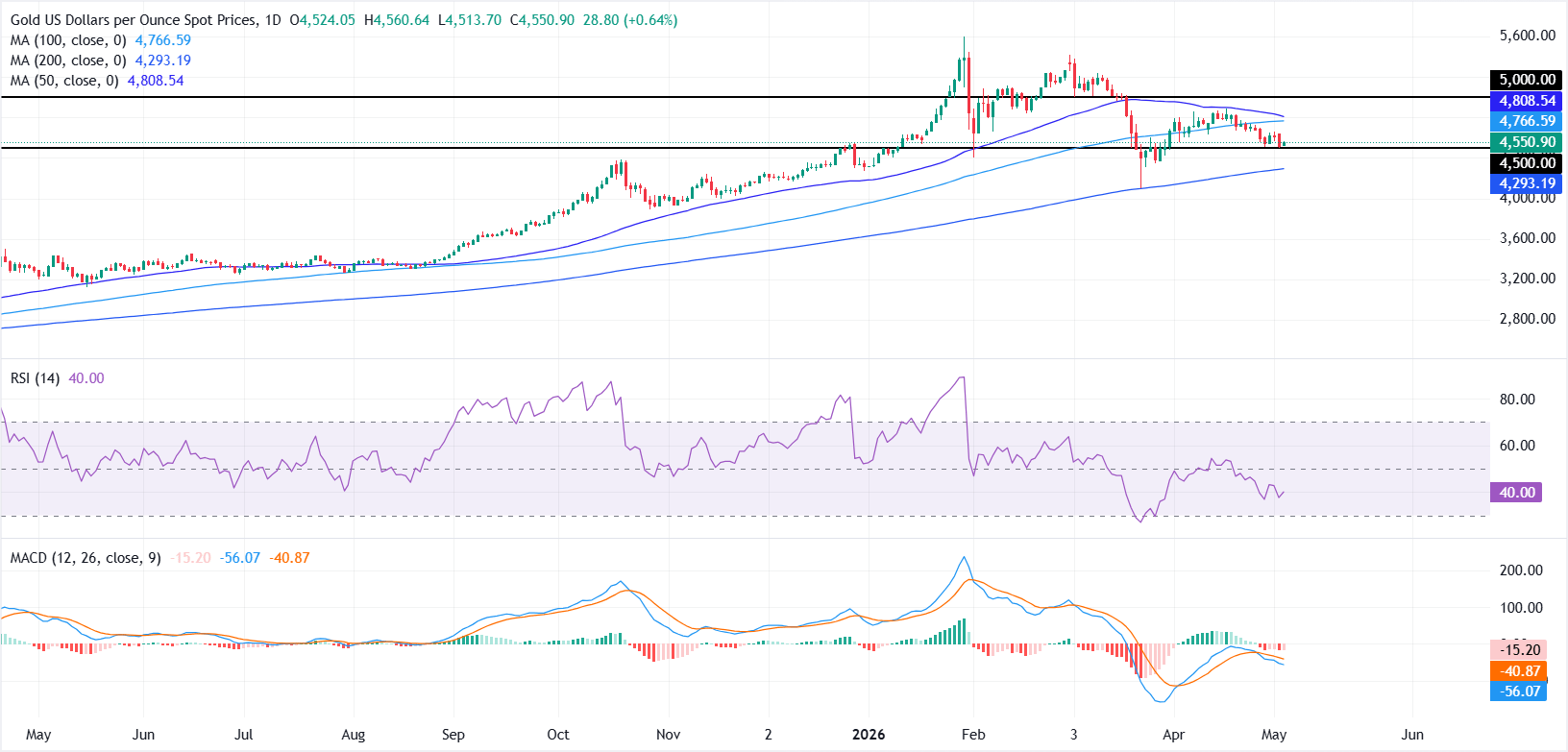
In the daily chart, XAU/USD maintains a bearish near-term bias, as it remains capped below the 100-day Simple Moving Average (SMA) and the 50-day SMA. The pair still trades above the 200-day SMA, which hints that the broader uptrend is intact, but the negative Moving Average Convergence Divergence (MACD) and a subdued Relative Strength Index (RSI) around 40 suggest mild bearish momentum and leave risks tilted to the downside while these overhead averages limit advances.
On the downside, immediate support is seen around Monday's lows and the horizontal floor at $4,500, ahead of the more meaningful demand zone provided by the 200-day SMA near $4,293. On the topside, a sustained recovery would need to overcome first the 100-day SMA at $4,766 and then the 50-day SMA at $4,808, with a further break exposing the psychological resistance barrier at $5,000.
(The technical analysis of this story was written with the help of an AI tool.)
Gold FAQs
Gold has played a key role in human’s history as it has been widely used as a store of value and medium of exchange. Currently, apart from its shine and usage for jewelry, the precious metal is widely seen as a safe-haven asset, meaning that it is considered a good investment during turbulent times. Gold is also widely seen as a hedge against inflation and against depreciating currencies as it doesn’t rely on any specific issuer or government.
Central banks are the biggest Gold holders. In their aim to support their currencies in turbulent times, central banks tend to diversify their reserves and buy Gold to improve the perceived strength of the economy and the currency. High Gold reserves can be a source of trust for a country’s solvency. Central banks added 1,136 tonnes of Gold worth around $70 billion to their reserves in 2022, according to data from the World Gold Council. This is the highest yearly purchase since records began. Central banks from emerging economies such as China, India and Turkey are quickly increasing their Gold reserves.
Gold has an inverse correlation with the US Dollar and US Treasuries, which are both major reserve and safe-haven assets. When the Dollar depreciates, Gold tends to rise, enabling investors and central banks to diversify their assets in turbulent times. Gold is also inversely correlated with risk assets. A rally in the stock market tends to weaken Gold price, while sell-offs in riskier markets tend to favor the precious metal.
The price can move due to a wide range of factors. Geopolitical instability or fears of a deep recession can quickly make Gold price escalate due to its safe-haven status. As a yield-less asset, Gold tends to rise with lower interest rates, while higher cost of money usually weighs down on the yellow metal. Still, most moves depend on how the US Dollar (USD) behaves as the asset is priced in dollars (XAU/USD). A strong Dollar tends to keep the price of Gold controlled, whereas a weaker Dollar is likely to push Gold prices up.














