

Gold starts week under pressure as US-Iran stalemate and strong Dollar cap XAU/USD
- Gold starts the week on the back foot as slow US-Iran talks keep buyers cautious.
- The US Dollar remains the preferred safe-haven asset, weighing on XAU/USD despite elevated geopolitical risks.
- Technically, XAU/USD remains bearish, while weak momentum indicators underpin the downside bias.
Gold (XAU/USD) kicks off the week with a negative bias as slow progress toward a US-Iran ceasefire extension deal and fresh attacks in the Middle East keep buyers cautious. At the time of writing, XAU/USD is trading around $4,500 after hitting a two-week high near $4,595 on Friday.
US Central Command (CENTCOM) said it carried out “self-defense strikes” on Iranian radar and drone facilities over the weekend. Iran’s Revolutionary Guard said on Monday they had targeted an air base used by US forces in retaliation for an attack on southern Iran. At the same time, Israel has expanded military operations against Hezbollah in Lebanon.
Iran’s Foreign Ministry spokesperson Esmaeil Baghaei said “lack of trust, constant changes in the US position and Israeli actions in Lebanon” are delaying the diplomatic process. However, he added that message exchanges between Washington and Tehran are still ongoing.
Negotiations between Washington and Tehran continue to face hurdles as both sides remain far apart on major issues such as Iran’s nuclear program, sanctions relief and the future status of the Strait of Hormuz.
Despite heightened geopolitical tensions, XAU/USD is down more than 15% since the war began and is nearly 20% below its all-time high near $5,600, set in late January. The US Dollar (USD) has emerged as the preferred safe-haven asset at the expense of Gold.
A stronger Greenback makes Gold more expensive for foreign buyers. Another headwind for the precious metal comes from the sharp rise in Crude Oil prices.
Higher energy costs are adding to inflationary pressure and reinforcing expectations that major central banks, including the Federal Reserve (Fed), may need to keep monetary policy tighter for longer.
While Gold is traditionally seen as a hedge against inflation, for now markets are paying more attention to where interest rates are headed. A higher interest rate environment raises the opportunity cost of holding non-yielding assets.
According to the CME FedWatch Tool, markets are pricing in a 40% chance of a 25-basis-point (bps) rate hike at the December meeting. Resilient US economic data has also dimmed hopes for near-term interest rate cuts.
Against this backdrop, any recovery in Gold is likely to attract selling interest unless Washington and Tehran reach a lasting agreement that drives Oil prices lower and helps ease inflation concerns.
Looking ahead, traders await the US Nonfarm Payrolls (NFP) report due on Friday for fresh clues on the Fed’s interest-rate path. Before that, attention on Monday will turn to the release of the US ISM Manufacturing Purchasing Managers Index (PMI) data.
Technical analysis: XAU/USD stays bearish below $4,600 resistance
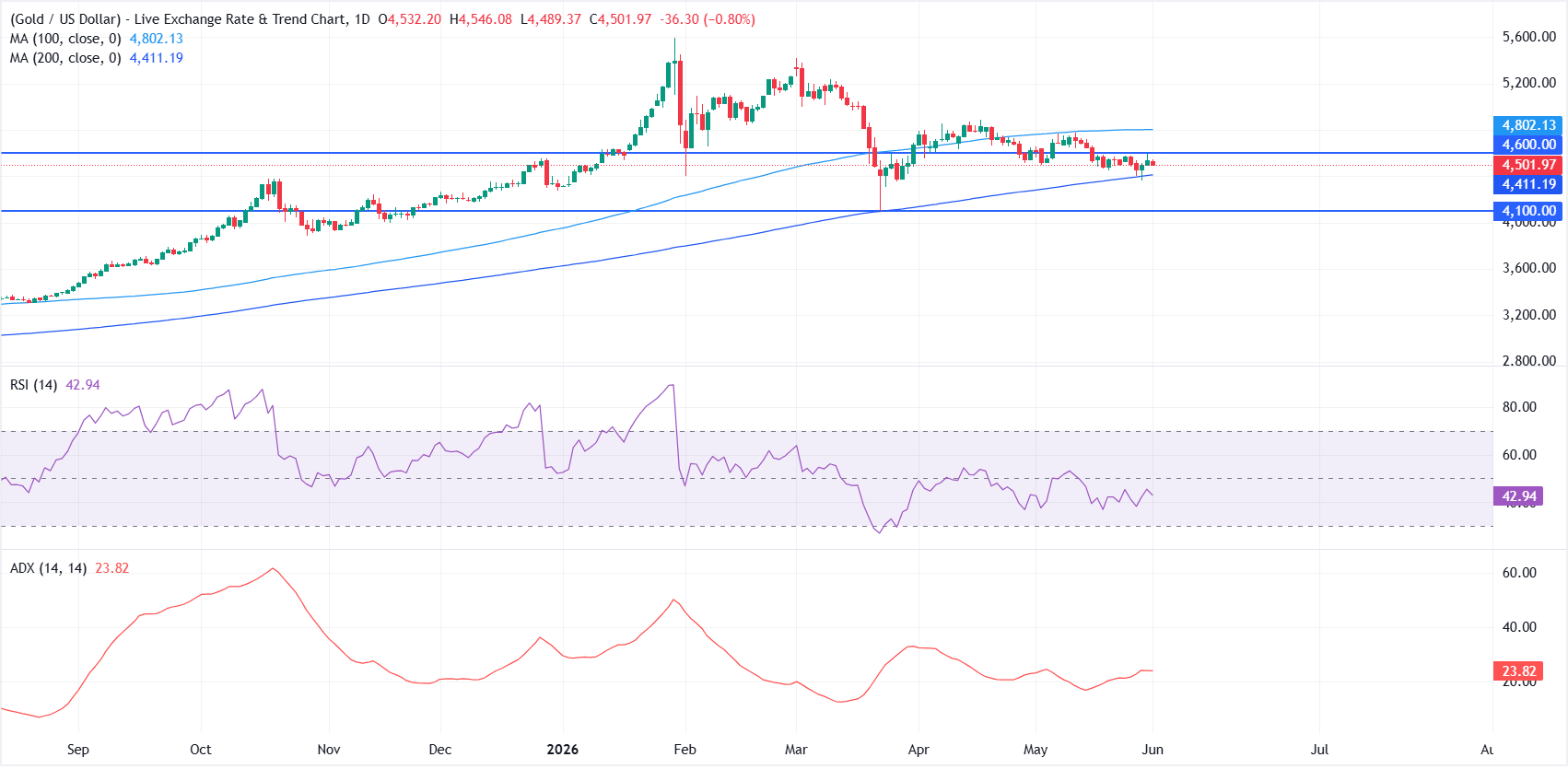
On the daily chart, XAU/USD holds a modest bearish bias, with price retreating below the nearby horizontal resistance at $4,600 while remaining capped well beneath the 100-day Simple Moving Average (SMA) at roughly $4,802.
The 200-day SMA at about $4,411 sits below spot and still underpins the broader uptrend, but the Relative Strength Index (RSI) near 43 and a modest Average Directional Index (ADX) around 24 suggest soft downside pressure in a relatively weak directional environment.
On the topside, initial resistance is seen at the $4,600 horizontal barrier, with a sustained break needed to expose the 100-day SMA near $4,802 as the next bullish objective.
On the downside, immediate support is provided by the 200-day SMA around $4,411, ahead of more substantial structural demand at the $4,100 horizontal level. A daily close below this latter floor would likely reinforce the prevailing bearish tone.
(The technical analysis of this story was written with the help of an AI tool.)
Inflation FAQs
Inflation measures the rise in the price of a representative basket of goods and services. Headline inflation is usually expressed as a percentage change on a month-on-month (MoM) and year-on-year (YoY) basis. Core inflation excludes more volatile elements such as food and fuel which can fluctuate because of geopolitical and seasonal factors. Core inflation is the figure economists focus on and is the level targeted by central banks, which are mandated to keep inflation at a manageable level, usually around 2%.
The Consumer Price Index (CPI) measures the change in prices of a basket of goods and services over a period of time. It is usually expressed as a percentage change on a month-on-month (MoM) and year-on-year (YoY) basis. Core CPI is the figure targeted by central banks as it excludes volatile food and fuel inputs. When Core CPI rises above 2% it usually results in higher interest rates and vice versa when it falls below 2%. Since higher interest rates are positive for a currency, higher inflation usually results in a stronger currency. The opposite is true when inflation falls.
Although it may seem counter-intuitive, high inflation in a country pushes up the value of its currency and vice versa for lower inflation. This is because the central bank will normally raise interest rates to combat the higher inflation, which attract more global capital inflows from investors looking for a lucrative place to park their money.
Formerly, Gold was the asset investors turned to in times of high inflation because it preserved its value, and whilst investors will often still buy Gold for its safe-haven properties in times of extreme market turmoil, this is not the case most of the time. This is because when inflation is high, central banks will put up interest rates to combat it. Higher interest rates are negative for Gold because they increase the opportunity-cost of holding Gold vis-a-vis an interest-bearing asset or placing the money in a cash deposit account. On the flipside, lower inflation tends to be positive for Gold as it brings interest rates down, making the bright metal a more viable investment alternative.













