

EUR/USD Price Forecast: Near-term tone remains bearish as 20-day EMA slopes downwards
- EUR/USD ticks lower to near 1.1633 as US forces strike at Iranian missile launcher sites.
- The US military clarified that strikes were in “self-defense” and not meant to dismiss the ceasefire with Iran.
- US President Trump said that negotiations with Iran are proceeding nicely.
The EUR/USD pair trades marginally lower at around 1.1633 during the Asian trading session on Tuesday. The major currency pair faces slight selling pressure as the US Dollar (USD) attacks some bids due to fears that the United States (US)-Iran negotiations could face a setback.

According to a spokesperson from the US Central Command, US forces conducted strikes in southern Iran on Monday, which were aimed at missile launch sites and Iranian vessels aiming to deploy mines.
However, the US military has clarified that the nature of the strikes was “defensive” and were not meant to end the ceasefire with Tehran.
The event has resulted in a slight recovery in the US Dollar (USD) and a decent one in oil prices. As of writing, the US Dollar Index (DXY), which tracks the Greenback’s value against six major currencies, trades marginally higher to near 99.05.
Meanwhile, US President Donald Trump has stated that negotiations with Iran to end the conflict are “proceeding nicely”, Bloomberg reported.
EUR/USD technical analysis
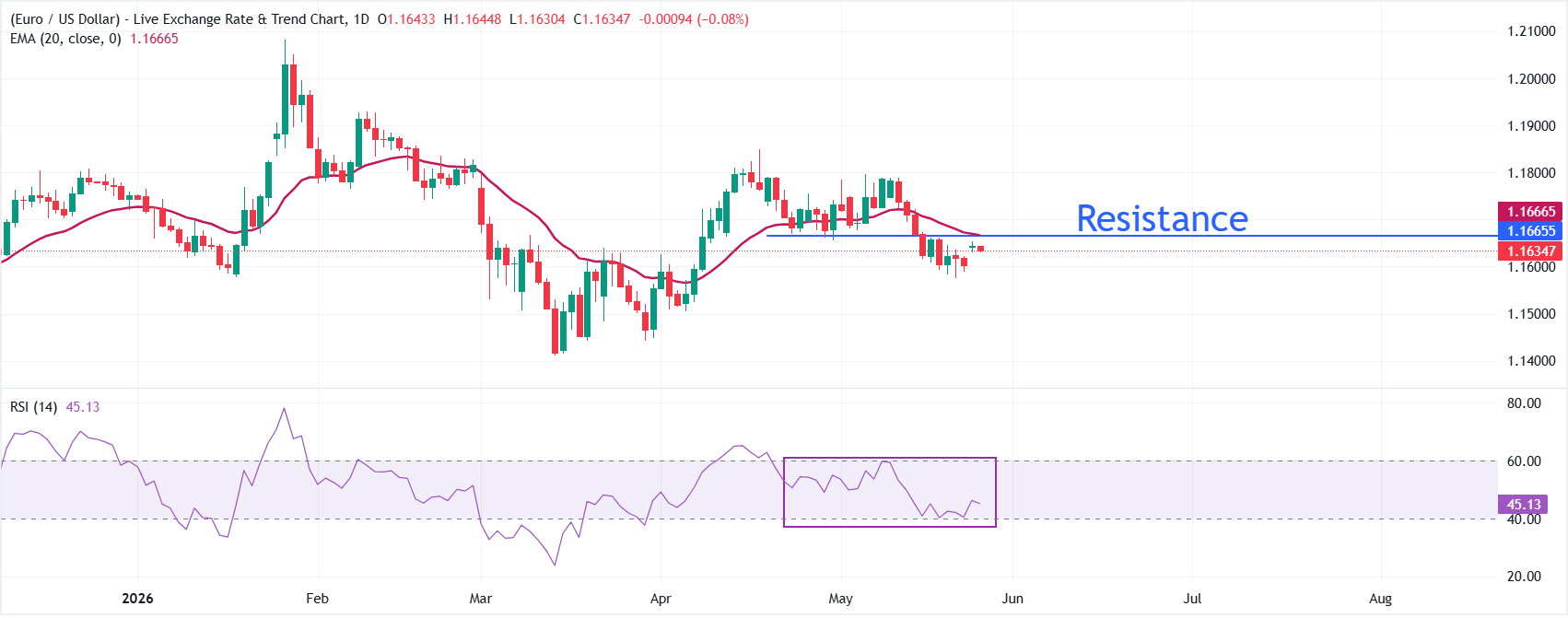
EUR/USD trades slightly lower at around 1.1635, keeping a bearish near-term bias as spot holds below the 20-day Exponential Moving Average (EMA) at 1.1667.
The pair has been grinding lower from early-month highs, and the subdued Relative Strength Index (RSI) around 45.1 hints at fading bullish momentum rather than oversold conditions, suggesting sellers retain the initiative while buyers remain cautious.
On the topside, initial resistance is defined by the 20-day EMA at 1.1667, and a daily close above this dynamic barrier would be needed to ease immediate downside pressure and open the way to a more meaningful recovery towards 1.1700. On the downside, the pair could resume its downside journey if it drops below the May 21 low of 1.1576. Key support area will be 1.1500.
(The technical analysis of this story was written with the help of an AI tool.)
Risk sentiment FAQs
In the world of financial jargon the two widely used terms “risk-on” and “risk off'' refer to the level of risk that investors are willing to stomach during the period referenced. In a “risk-on” market, investors are optimistic about the future and more willing to buy risky assets. In a “risk-off” market investors start to ‘play it safe’ because they are worried about the future, and therefore buy less risky assets that are more certain of bringing a return, even if it is relatively modest.
Typically, during periods of “risk-on”, stock markets will rise, most commodities – except Gold – will also gain in value, since they benefit from a positive growth outlook. The currencies of nations that are heavy commodity exporters strengthen because of increased demand, and Cryptocurrencies rise. In a “risk-off” market, Bonds go up – especially major government Bonds – Gold shines, and safe-haven currencies such as the Japanese Yen, Swiss Franc and US Dollar all benefit.
The Australian Dollar (AUD), the Canadian Dollar (CAD), the New Zealand Dollar (NZD) and minor FX like the Ruble (RUB) and the South African Rand (ZAR), all tend to rise in markets that are “risk-on”. This is because the economies of these currencies are heavily reliant on commodity exports for growth, and commodities tend to rise in price during risk-on periods. This is because investors foresee greater demand for raw materials in the future due to heightened economic activity.
The major currencies that tend to rise during periods of “risk-off” are the US Dollar (USD), the Japanese Yen (JPY) and the Swiss Franc (CHF). The US Dollar, because it is the world’s reserve currency, and because in times of crisis investors buy US government debt, which is seen as safe because the largest economy in the world is unlikely to default. The Yen, from increased demand for Japanese government bonds, because a high proportion are held by domestic investors who are unlikely to dump them – even in a crisis. The Swiss Franc, because strict Swiss banking laws offer investors enhanced capital protection.














