

Trading
Tuklasin ang malawak na hanay ng mga merkado na may competitive na presyo, malalim na liquidity, at advanced na trading tools.
Matuto Pa 
Platform
Mag-trade nang walang sagabal gamit ang malakas na platform ng TMGM, na ginawa para sa bilis, katumpakan, at superior na trading experience.
Matuto Pa Trading Platform
Mga Trading Tools
Academy
Matuto ng mga pangunahing kaalaman sa trading gamit ang mga beginner-friendly na resources, kasama ang mga gabay, webinars, at market insights.
Matuto Pa TMGM Academy
Balita at Analysis
Makakuha ng real-time na mga update sa merkado at expert analysis upang manatiling nangunguna sa mga trading opportunities
Matuto Pa Balita at Analysis
Tungkol
Alamin kung ano ang nagpapangiiba sa TMGM — ang aming global presence, regulatory strength, at commitment sa innovation sa trading.
Matuto Pa Bakit Piliin ang TMGM
Sponsorship
Ripple Price Forecast: XRP recovery runs into headwinds amid fading retail and institutional interest
- XRP struggles to gain momentum above the recently reclaimed $1.30 support on Monday.
- US-listed XRP spot ETFs recorded weekly net outflows for the first time in 14 weeks, while cooling derivatives activity weighs on the recovery outlook.
- XRP faces a weak technical structure defined by a bearish RSI and a persistent MACD sell signal.
Ripple (XRP) holds slightly above $1.30 on Monday, with short-term recovery prospects fading. Strong structural resistance toward $1.40 continues to cap upside, raising the risk of further downside below $1.30.

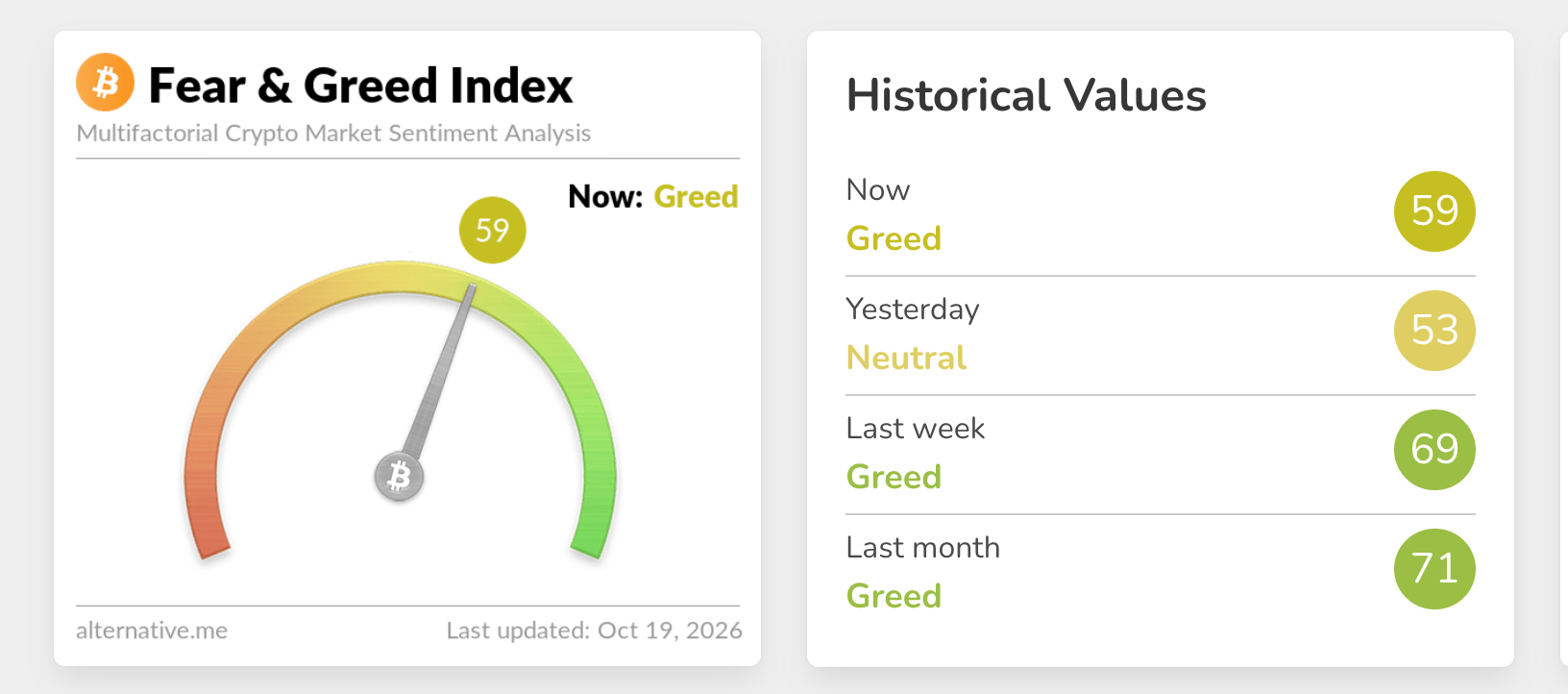
Appetite for digital assets, as in recent weeks, has taken a back seat, as reflected in the crypto Fear & Greed Index at 59 in the Greed territory, up from 53 in the Neutral range the previous day. Broadly, the index has declined from last month’s 71 average, undermining investor risk-on sentiment.
XRP ETFs resume outflows as derivatives activity slows
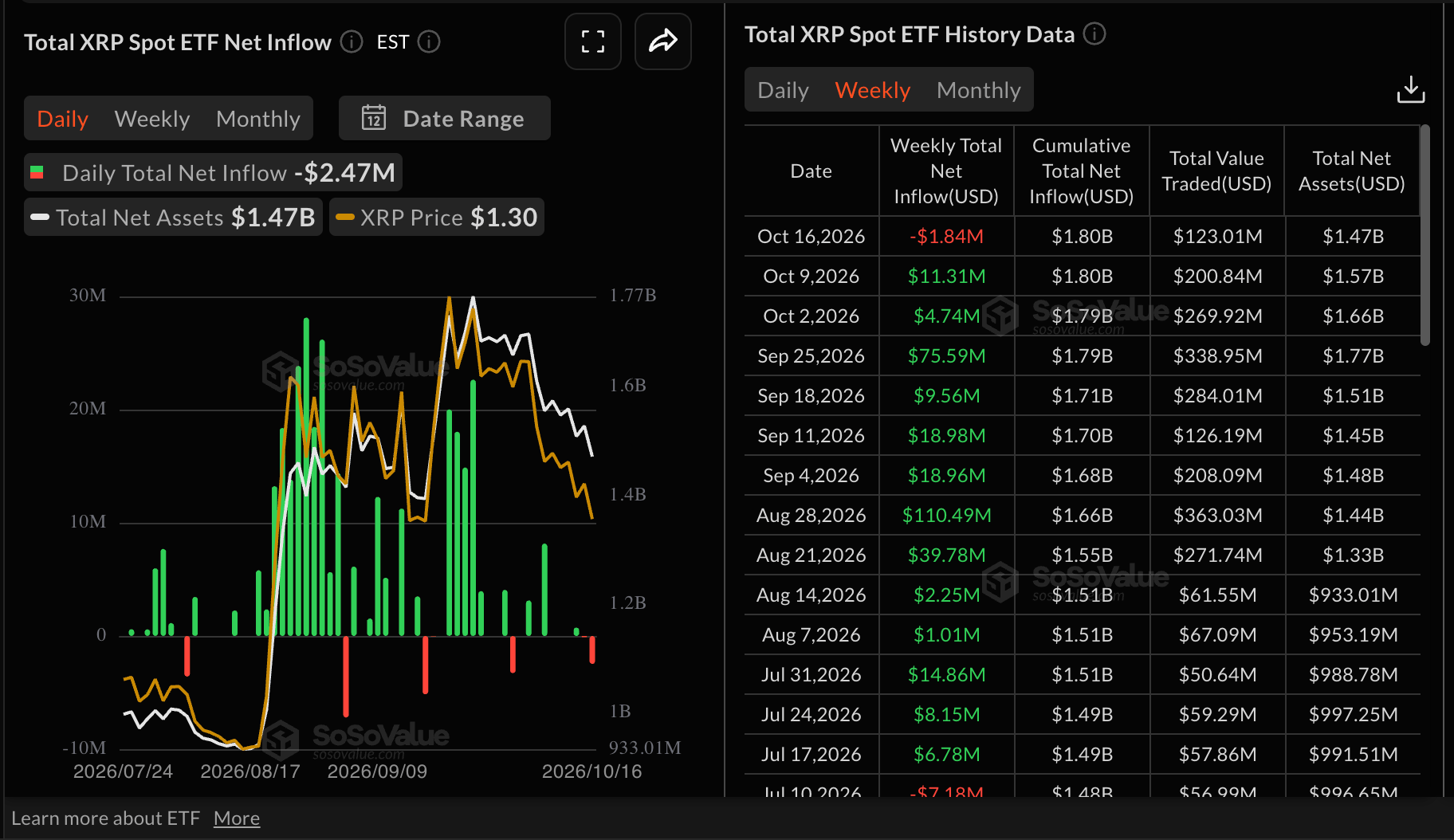
News last week that inflation in the United States (US) continued to accelerate in September compared to August spooked many investors, prompting possible reassessment of portfolios and risk exposure. US-listed spot Exchange-Traded Funds (ETFs) recorded net $1.8 million in outflows last week, the first in 14 weeks, according to SoSoValue.
That said, this shift in flows alone is not enough to confirm a bearish trend. Therefore, this week’s outlook will provide more insight into the direction XRP spot ETFs will take. Moreover, cumulative inflows remain positive at $1.8 billion, with net assets under management at $1.5 billion.
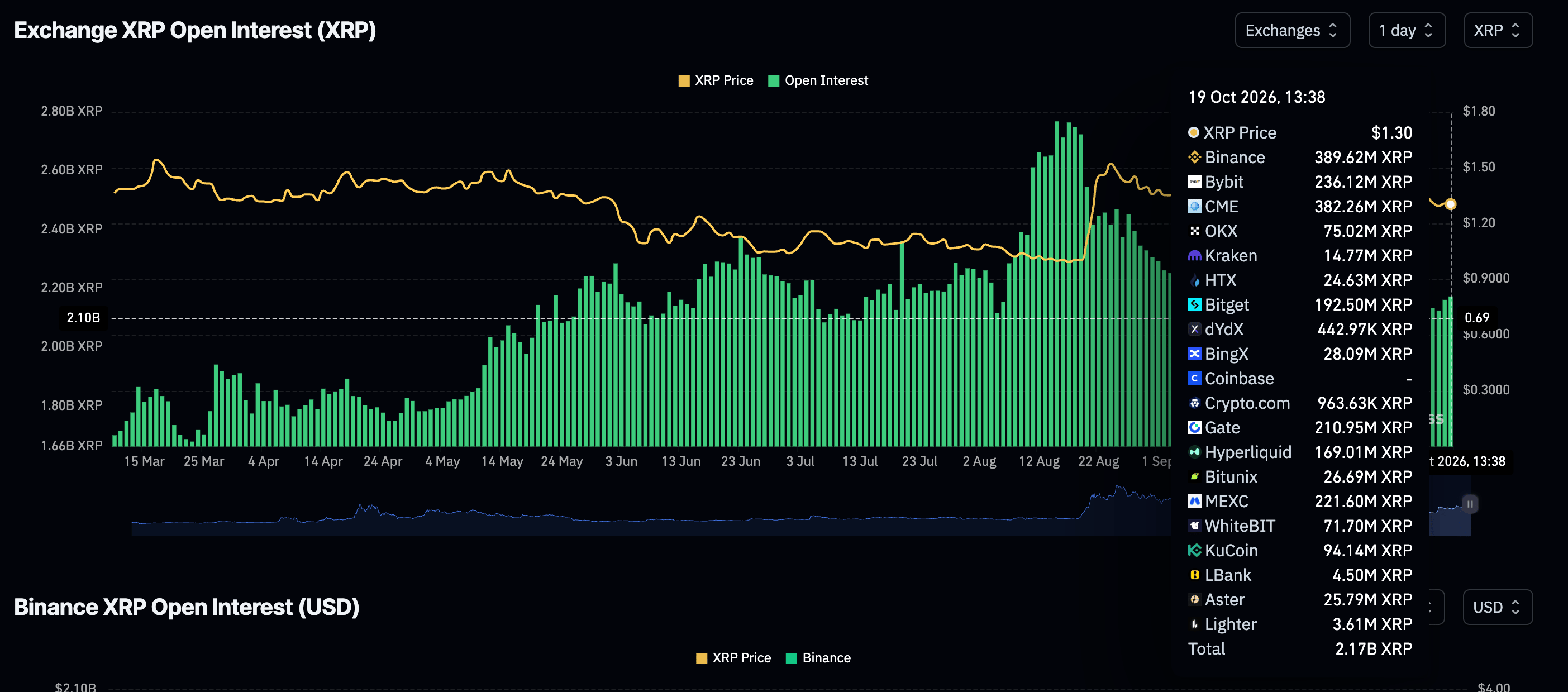
The derivatives market mirrors the fading market sentiment, as perpetual futures Open Interest (OI) averages 2.17 billion XRP on Monday, down from 2.34 billion on October 1. Although gradual, the steady softening in retail demand indicates less tailwind to sustain the recovery. In other words, traders increasingly lack confidence in XRP’s outlook, with many closing positions as OI drops.
Technical analysis: XRP leans bearish despite short-term support
XRP trades above $1.30, extending a bearish near‑term tone as price holds beneath the key Exponential Moving Averages (EMAs). The 100‑day EMA at $1.34 is the first cap overhead, while the 200‑day EMA and the 50‑day EMA at $1.38 form a dense resistance band higher up, reinforcing a market that remains pressured below its medium‑term trend gauges.
Momentum indicators echo this stance, with the Relative Strength Index (RSI) hovering near 37 and Moving Average Convergence Divergence (MACD) in negative territory, suggesting lingering downside risk despite a lack of clear structural support levels from the current tool set.
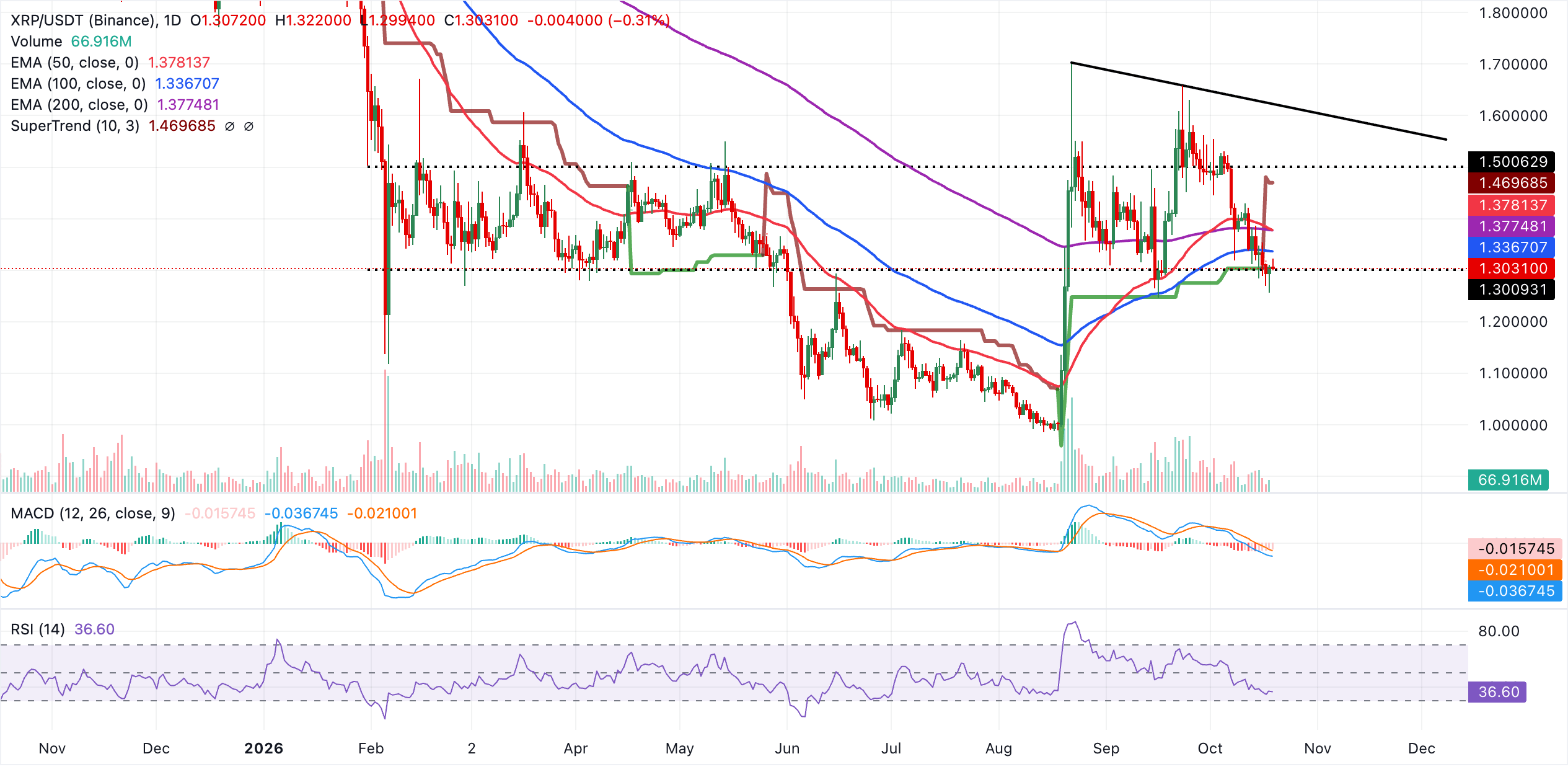
Immediate resistance lies at the 100‑day EMA around $1.34, where a daily close above would be needed to ease the current bearish pressure. Further north, the overlapping 200‑day EMA and the 50‑day EMA at $1.38 define a stronger supply zone, while the SuperTrend line at $1.47 marks a more distant bullish recovery hurdle. As long as XRP trades below this stack of resistance levels, rallies are likely to face selling interest and the broader downside bias remains intact.
(The technical analysis of this story was written with the help of an AI tool. Know more.)
Crypto ETF FAQs
An Exchange-Traded Fund (ETF) is an investment vehicle or an index that tracks the price of an underlying asset. ETFs can not only track a single asset, but a group of assets and sectors. For example, a Bitcoin ETF tracks Bitcoin’s price. ETF is a tool used by investors to gain exposure to a certain asset.
Yes. The first Bitcoin futures ETF in the US was approved by the US Securities & Exchange Commission in October 2021. A total of seven Bitcoin futures ETFs have been approved, with more than 20 still waiting for the regulator’s permission. The SEC says that the cryptocurrency industry is new and subject to manipulation, which is why it has been delaying crypto-related futures ETFs for the last few years.
Yes. The SEC approved in January 2024 the listing and trading of several Bitcoin spot Exchange-Traded Funds, opening the door to institutional capital and mainstream investors to trade the main crypto currency. The decision was hailed by the industry as a game changer.
The main advantage of crypto ETFs is the possibility of gaining exposure to a cryptocurrency without ownership, reducing the risk and cost of holding the asset. Other pros are a lower learning curve and higher security for investors since ETFs take charge of securing the underlying asset holdings. As for the main drawbacks, the main one is that as an investor you can’t have direct ownership of the asset, or, as they say in crypto, “not your keys, not your coins.” Other disadvantages are higher costs associated with holding crypto since ETFs charge fees for active management. Finally, even though investing in ETFs reduces the risk of holding an asset, price swings in the underlying cryptocurrency are likely to be reflected in the investment vehicle too.
Sikat na Artikulo
1Ripple Price Forecast: XRP recovery runs into headwinds amid fading retail and institutional interest2US Dollar: AI jitters soften haven appeal – ING3Swiss Franc: Upside bias holds despite US Dollar rebound - UOB4British Pound hits one-month high against Japanese Yen50.8403: Euro struggles to find a bottom against British Pound as violence shocks France 6New Zealand Dollar extends winning streak against US Dollar, NZ Q3 CPI data in focus7Natural gas: Global price convergence delayed until 2028 - Societe General8Oil: High prices seen easing only gradually – Commerzbank9Australian Dollar: Aussie holds near highs against US Dollar - BBH
LIVE QUOTES


LAHAT TUNGKOL SA TECHNICAL
Ano ang Dark Cloud Cover Pattern at Paano Ito I-trade?
Ano ang Piercing Line Candlestick Pattern at Paano Ito Ipinagte-trade?
Ano ang mga candlestick pattern na Tweezer Top at Bottom?
Inside Bar na Pattern ng Candlestick: Ano Ito, Paano Ito Matutukoy, at Paano Ito I-trade
Hanging Man Candlestick Pattern: Paano Ito Matukoy at I-trade
Paano Gumuhit ng Fibonacci Retracement: Pagsasanay sa Golden Ratio sa Trading
Ano ang RSI, ang Relative Strength Index
Ano ang Scalping sa Trading at Paano Ito Gumagana
Magsimula!
Mag-sign up at ma-access ang Global Markets sa loob ng 3 minuto

Makipag-ugnayan sa Amin









Mga Kontak
Telepono: +61 2 8036 8388
Fax: +61 2 8036 8388
Email: support@tmgm.com
Web: https://www.tmgm.com



Ang impormasyong ibinigay sa website na ito ay pangkalahatang impormasyon lamang at hindi bumubuo ng personal na payong pinansyal. Bago kumilos batay sa anumang impormasyon sa website na ito, dapat mong isaalang-alang ang pagiging angkop ng impormasyon kaugnay ng iyong mga layunin, kalagayang pinansyal, at mga pangangailangan. Ang pag-iinvest sa CFDs at FX Margin Contracts ay may kaakibat na malalaking panganib at hindi angkop para sa lahat ng mamumuhunan. Maaari kang mawalan ng higit pa sa iyong paunang deposito. Wala kang pagmamay-ari o anumang interes sa pinagbabatayang asset. Inirerekomenda namin na humingi ka ng independiyenteng payo at tiyaking lubos mong nauunawaan ang mga panganib na kasangkot bago makipagkalakalan. Mahalaga na basahin at isaalang-alang mo ang dokumento ng pagsisiwalat bago ka kumuha ng anumang produktong nakalista sa website. Ang impormasyon at mga patalastas na inaalok sa website na ito ay hindi nilalayong gamitin ng sinumang tao sa alinmang bansa o hurisdiksyon kung saan ang ganitong paggamit ay labag sa mga lokal na batas at regulasyon. Ang mga Produkto at Serbisyong inaalok sa website na ito ay hindi nilalayong para sa mga residente ng United States, Malaysia, at Thailand.
Ang TMGM ay awtorisado at pinangangasiwaan sa iba't ibang hurisdiksyon.
Ang Trademax Australia Limited, na nag-trading bilang TMGM, ay pinangangasiwaan ng Australian Securities and Investments Commission (ASIC), AFSL no. 436416 at matatagpuan sa Level 28, One International Tower, 100 Barangaroo Avenue, 2000 Sydney, NSW Australia.
Email: support@tmgm.com.au
Ang Trademax Global Limited, na nag-trading bilang TMGM, ay awtorisado at pinangangasiwaan ng Vanuatu Financial Services Commission (VFSC), registration number 40356 at nakarehistro sa 1276, Kumul Highway, Port Vila, Vanuatu, Republic of Vanuatu.
Email: support@tmgm.com
Ang Trademax Global Markets (SE) Limited, na kilala bilang TMGM, ay awtorisado at nire-regulahan ng Financial Services Authority (FSA) ng Seychelles, na may lisensya bilang SD224. Ang kumpanya ay nakarehistro sa Office Blg. 13, Providence Estate ABIS Centre, Mahe, Seychelles.
Email: support@tmgm.com
Ang Trademax Global Markets (International) Pty Ltd, na nag-trading bilang TMGM, ay awtorisado at pinangangasiwaan ng Financial Services Commission, Mauritius (FSC) na may license no. GB22201012, at nakarehistro sa 33, Edith Cavell Street C/o IQ EQ Fund Services (Mauritius) Ltd Port Louis, 11324 Mauritius.
Email: support@tmgm.com
Copyright © TMGM. Lahat ng karapatan ay nakalaan