

XRP Price Forecast: XRP remains pressured despite the launch of institutional-focused Ripple Mint
- XRP retraces from its weekly high at $1.16 and holds $1.10 on Friday amid muted ETF activity.
- Ripple Mint platform launches, with a unified solution for institutions to access, mint, redeem and manage the RLUSD stablecoin.
- XRP’s broader outlook remains bearish, with the RSI sliding into bearish territory and the 50-day EMA capping the upside.
Ripple (XRP) slides toward the short-term $1.10 support on Friday, as broader crypto market sentiment weighs on crypto assets. The sell-off mainly stems from fears of inflation in the United States (US) amid the ongoing war in the Middle East and rising Oil prices.

Simon-Peter Massabni, Business Development Head at XS.com, says that digital assets are facing repricing risks due to rising geopolitical tensions and inflation fears.
“Rising oil prices, renewed inflation concerns, shifting expectations for US monetary policy, and continued institutional capital inflows are all shaping market sentiment,” Massabni said in a comment.
Ripple Mint launches to expand RLUSD access
Ripple announced the launch of Ripple Mint on Wednesday, a platform providing a unified way for institutions to access, mint, redeem and manage the RLUSD stablecoin.
Ripple Mint was designed to address existing gaps in RLUSD execution by offering access to a user interface with built-in control and oversight. The platform also supports programmatic access to enable automation and system-level integration.
Institutions using Ripple Mint can mint and redeem RLUSD directly from the source, bridge RLUSD across chains, track funds throughout the transaction lifecycle, and integrate RLUSD into their internal systems or workflows.
“This expansion also creates stronger utility between XRP and RLUSD together. As RLUSD becomes available across these environments, XRP will increasingly serve as complementary assets for liquidity, settlement, swaps, collateral, and payments activity across supported chains,” Ripple stated in the press release.
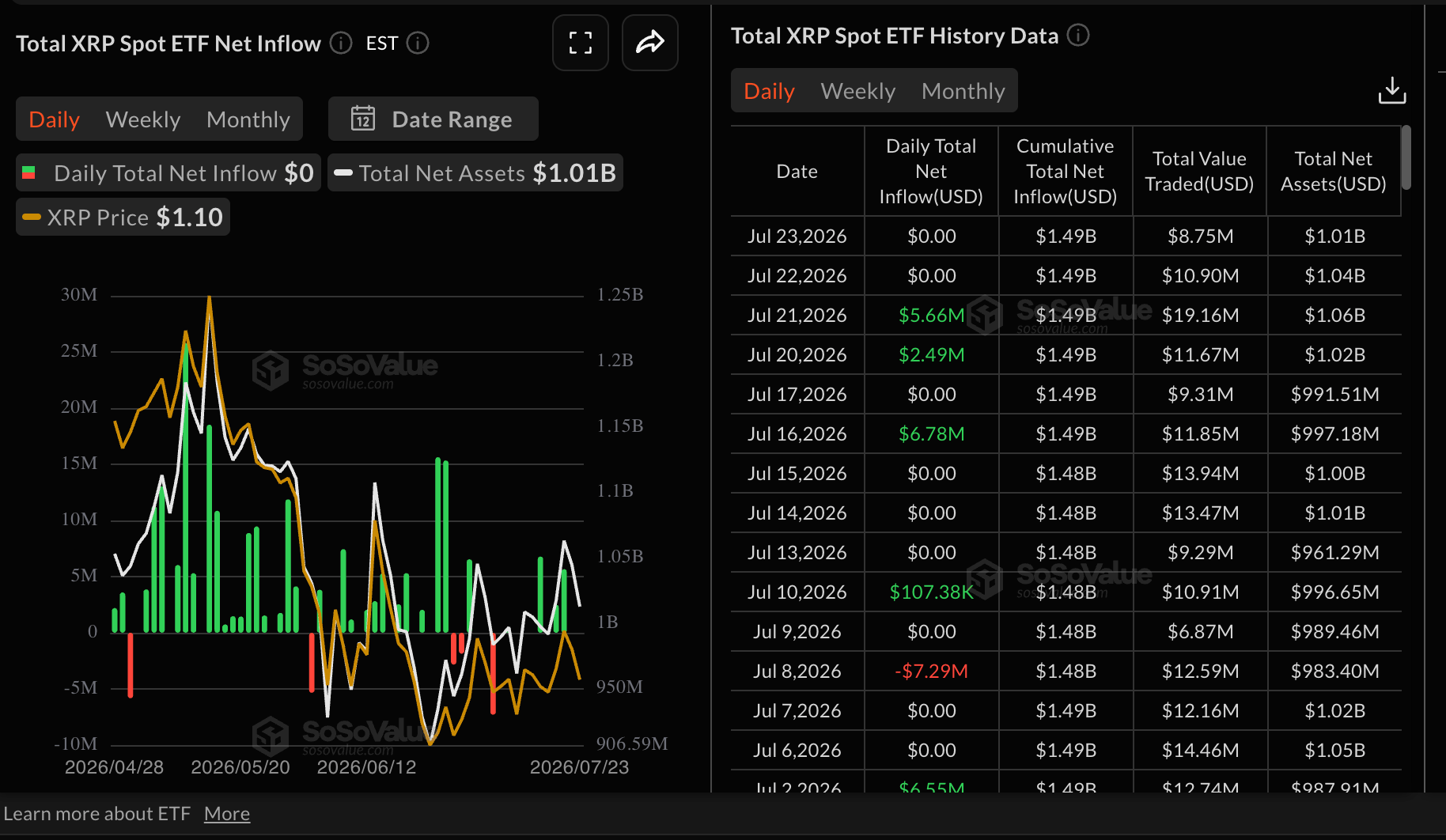
Meanwhile, institutional interest in XRP-related digital assets, such as spot Exchange-Traded Funds (ETFs), is fading, as evidenced by muted activity on Wednesday and Thursday. Cumulative weekly inflows stand at $8 million through Thursday, according to SoSoValue.
“In my view, what we are witnessing is not the beginning of a new bearish cycle, but rather a healthy repricing of risk following a strong rally, provided that institutional demand remains intact and does not give way to broad-based selling pressure,” Massabni added.
Price analysis: XRP bears poised to tighten grip
XRP trades at $1.11, holding in a corrective phase below key moving averages, which keeps the broader bias bearish despite the recent stabilization. Price action remains capped by the 50-day Exponential Moving Average (EMA) at $1.14, with the Parabolic SAR at $1.07 also positioned above spot and reinforcing overhead pressure.
Momentum is mixed, as the Relative Strength Index (RSI) hovers near a neutral 49 while the Moving Average Convergence Divergence (MACD) histogram has turned lower, hinting that bullish attempts are losing traction underneath the dominant downtrend defined by the downward trending moving averages.
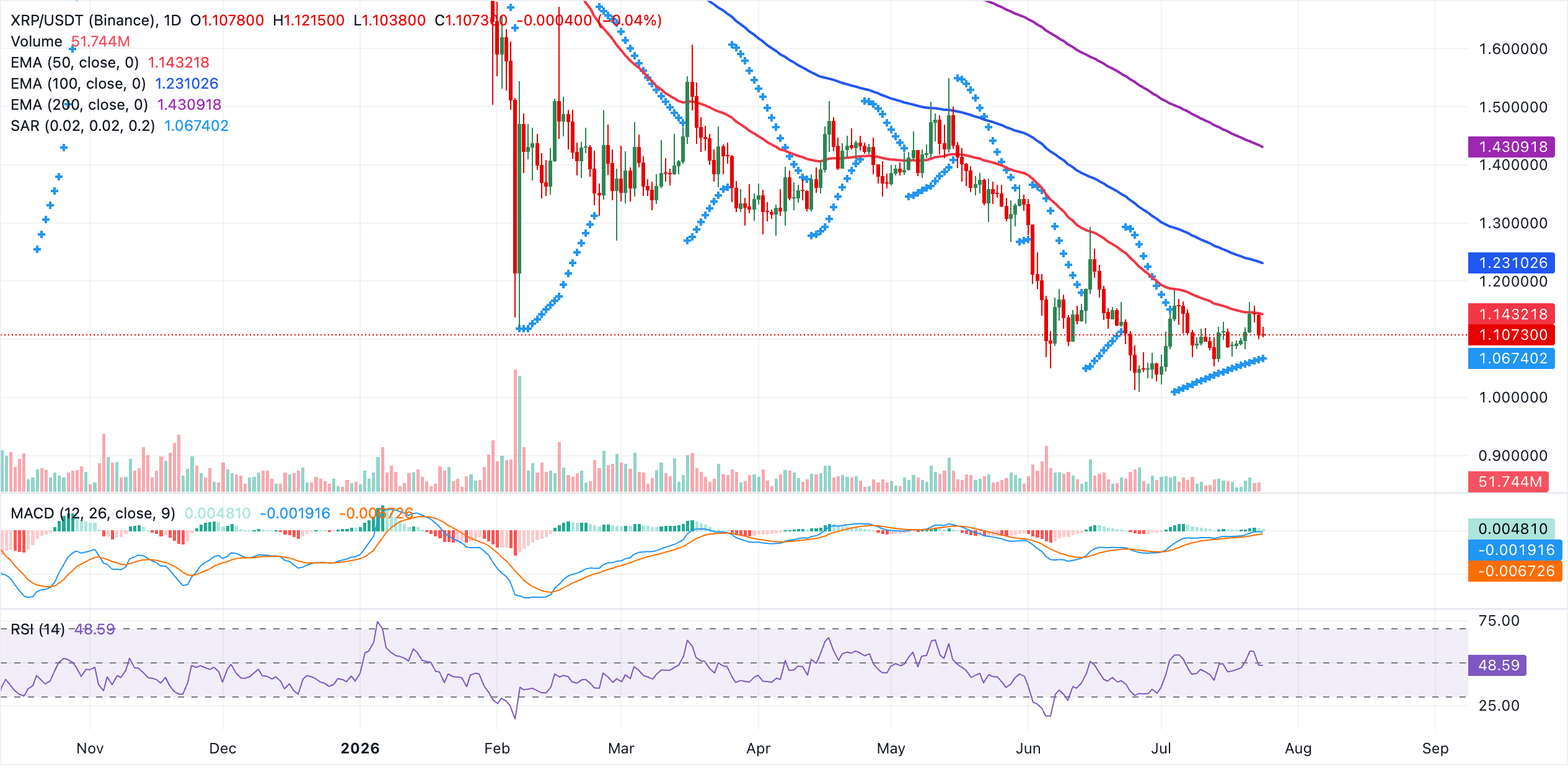
On the topside, initial resistance is seen at the Parabolic SAR level around $1.07, followed by the 50-day EMA at $1.14, where a daily close above would be needed to ease immediate downside pressure. Beyond that, the 100-day EMA at $1.23 and the 200-day EMA near $1.43 form a broader supply band that would likely cap any extended recovery unless buyers regain stronger control.
(The technical analysis of this story was written with the help of an AI tool. Know more.)
Crypto ETF FAQs
An Exchange-Traded Fund (ETF) is an investment vehicle or an index that tracks the price of an underlying asset. ETFs can not only track a single asset, but a group of assets and sectors. For example, a Bitcoin ETF tracks Bitcoin’s price. ETF is a tool used by investors to gain exposure to a certain asset.
Yes. The first Bitcoin futures ETF in the US was approved by the US Securities & Exchange Commission in October 2021. A total of seven Bitcoin futures ETFs have been approved, with more than 20 still waiting for the regulator’s permission. The SEC says that the cryptocurrency industry is new and subject to manipulation, which is why it has been delaying crypto-related futures ETFs for the last few years.
Yes. The SEC approved in January 2024 the listing and trading of several Bitcoin spot Exchange-Traded Funds, opening the door to institutional capital and mainstream investors to trade the main crypto currency. The decision was hailed by the industry as a game changer.
The main advantage of crypto ETFs is the possibility of gaining exposure to a cryptocurrency without ownership, reducing the risk and cost of holding the asset. Other pros are a lower learning curve and higher security for investors since ETFs take charge of securing the underlying asset holdings. As for the main drawbacks, the main one is that as an investor you can’t have direct ownership of the asset, or, as they say in crypto, “not your keys, not your coins.” Other disadvantages are higher costs associated with holding crypto since ETFs charge fees for active management. Finally, even though investing in ETFs reduces the risk of holding an asset, price swings in the underlying cryptocurrency are likely to be reflected in the investment vehicle too.














