

Savdo
Raqobatbardosh narxlar, chuqur likvidlik va ilg‘or savdo vositalari bilan keng turdagi bozorlarni kashf eting.
Batafsil ma’lumot 
Platforma
TMGM’ning tezlik, aniqlik va yuqori savdo tajribasi uchun yaratilgan kuchli platformasi bilan uzluksiz savdo qiling.
Batafsil ma’lumot Savdo platformasi
Savdo vositalari
Akademiya
Boshlovchilar uchun qulay resurslar, jumladan qo‘llanmalar, vebinarlar va bozor tahlillari orqali savdoning asoslarini o‘rganing.
Batafsil ma’lumot Yangiliklar va tahlil
Savdo imkoniyatlaridan oldinda bo‘lish uchun bozor yangilanishlari va ekspert tahlillarini real vaqt rejimida oling
Batafsil ma’lumot Yangiliklar va tahlil
Haqida
TMGMni boshqalardan ajratib turadigan jihatlarni bilib oling — bizning global mavjudligimiz, tartibga solishdagi mustahkamligimiz va savdoda innovatsiyalarga sodiqligimiz.
Batafsil ma’lumot Nega TMGMni tanlash kerak
1.3500: Might act as key barrier for GBP/USD on US NFP day
- The British Pound extends its correction to near 1.3425 against the US Dollar.
- Investors keenly await the US NFP data for September.
- The BoE hiked interest rates by 25 bps to 4% on Thursday.
The British Pound (GBP) trades lower against the US Dollar (USD) on Friday, extending its correction from an almost eight-week high of 1.3500 to near 1.3425 in the European trade. The GBP/USD pair faces pressure as the US Dollar bounces back ahead of the United States (US) Nonfarm Payrolls (NFP) data for October, which will be published at 13:30 GMT.

At press time, the US Dollar Index (DXY), which gauges the Greenback’s value against six major currencies, trades 0.2% higher to near 101.77.
Analysts at MUFG/BTMU highlight that “attention turns to today’s US nonfarm payrolls report, with markets expecting 70k jobs added in October, up from 29k in September.” They note that “stronger-than-expected JOLTS and ADP data suggest a better-than-expected US labour demand, raising the risk of further Fed tightening”.
The US NFP data is expected to influence Federal Reserve’s (Fed) interest rate expectations.
On the British Pound front, the Bank of England (BoE) delivered an interest rate hike of 25 basis points (bps) on Thursday, pushed rates to 4%, the first in 2026. The BoE was anticipated to hike interest rates to contain accelerating inflationary pressures.
GBP/USD Technical Analysis
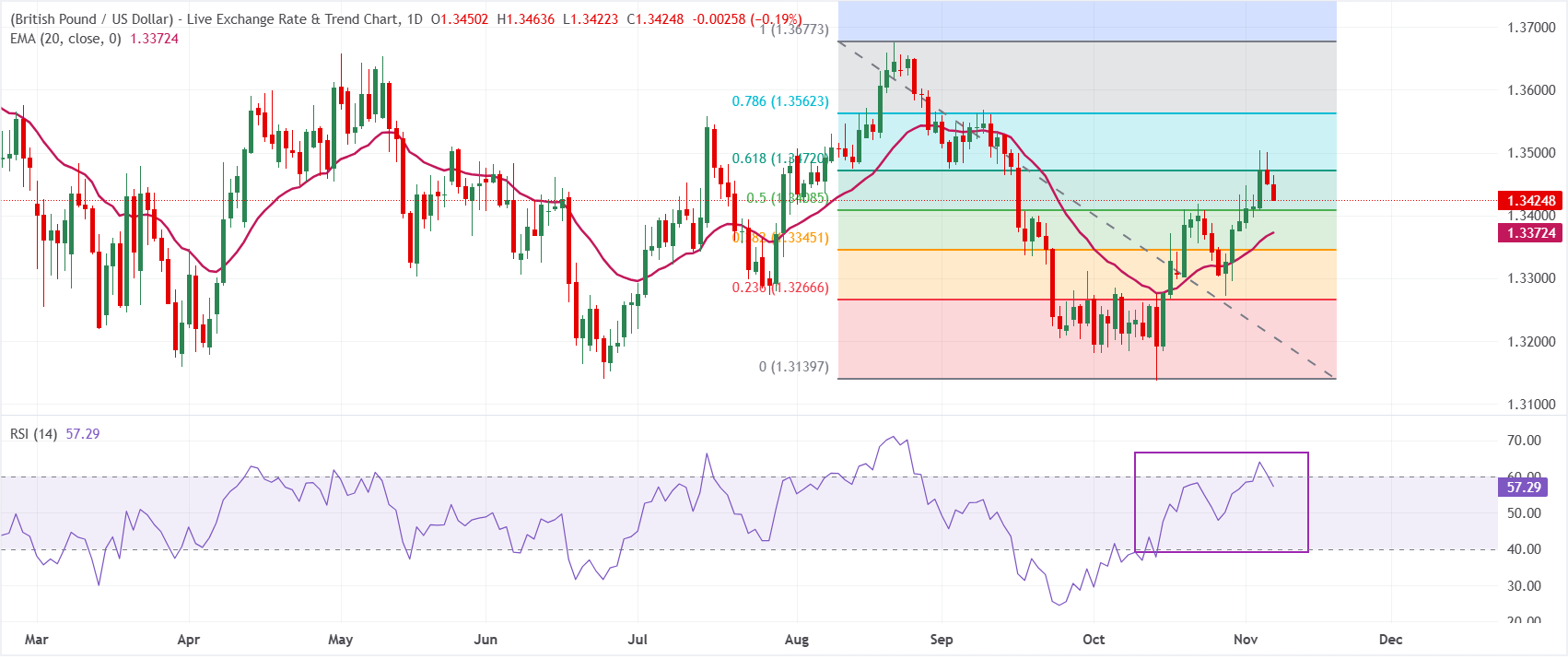
In the daily chart, GBP/USD trades at 1.3425. The pair retains a constructive short-term bias as it holds above the 20-period Exponential Moving Average (EMA) at 1.3372 and the 50% Fibonacci retracement of the latest downswing at 1.3409, suggesting buyers are defending higher ground. The Relative Strength Index (14) at 57 keeps a positive tilt, hinting that upside momentum remains in place while staying shy of overbought territory.
On the topside, immediate resistance is located at the 61.8% Fibonacci retracement near 1.3472, with further hurdles at the 78.6% retracement around 1.3562 and the recent cycle high region close to 1.3677. On the downside, initial support is seen at the 50% retracement at 1.3409, followed by the 20-EMA at 1.3372; a deeper pullback would expose the 38.2% level at 1.3345 and the 23.6% retracement near 1.3267, ahead of more substantial demand around the 1.3140 cycle low.
(The technical analysis of this story was written with the help of an AI tool. Know more.)
Economic Indicator
Nonfarm Payrolls
The Nonfarm Payrolls release presents the number of new jobs created in the US during the previous month in all non-agricultural businesses; it is released by the US Bureau of Labor Statistics (BLS). The monthly changes in payrolls can be extremely volatile. The number is also subject to strong reviews, which can also trigger volatility in the Forex board. Generally speaking, a high reading is seen as bullish for the US Dollar (USD), while a low reading is seen as bearish, although previous months' reviews and the Unemployment Rate are as relevant as the headline figure. The market's reaction, therefore, depends on how the market assesses all the data contained in the BLS report as a whole.
Read more.Next release: Fri Nov 06, 2026 13:30
Frequency: Monthly
Consensus: 65K
Previous: 29K
Source: US Bureau of Labor Statistics
America’s monthly jobs report is considered the most important economic indicator for forex traders. Released on the first Friday following the reported month, the change in the number of positions is closely correlated with the overall performance of the economy and is monitored by policymakers. Full employment is one of the Federal Reserve’s mandates and it considers developments in the labor market when setting its policies, thus impacting currencies. Despite several leading indicators shaping estimates, Nonfarm Payrolls tend to surprise markets and trigger substantial volatility. Actual figures beating the consensus tend to be USD bullish.
Eng yaxshi maqolalar
1Silver Price Forecast: XAG/USD corrects further in countdown to US NFP data2Dow Jones futures fall following steep Wall Street sell-off, NFP data awaited3AUD/USD Price Forecast: Slips below 0.6900 as bearish bias prevails4Germany's Industrial Production rises 0.7% MoM in September, beats 0% estimates5Germany Industrial Production s.a. (MoM) registered at 0.7% above expectations (0%) in September6Canadian Dollar weakens ahead of US, Canadian jobs data releases71.3500: Might act as key barrier for GBP/USD on US NFP day8Solana Price Forecast: Warning signs emerge as SOL's long-term trendline comes under pressure9Indonesian Rupiah struggles as Asian forex shifts

Boshlang!
Ro‘yxatdan o‘ting va 3 daqiqadan kamroq vaqt ichida Global bozorlariga kirish imkoniga ega bo‘ling

Biz bilan bog‘laning









Kontaktlar
Telefon: +61 2 8036 8388
Faks: +61 2 8036 8388
Email: support@tmgm.com
Veb: https://www.tmgm.com



Ushbu veb-saytda taqdim etilgan ma’lumotlar faqat umumiy xususiyatga ega bo‘lib, shaxsiy moliyaviy maslahat hisoblanmaydi. Ushbu veb-saytdagi har qanday ma’lumot asosida harakat qilishdan oldin, ma’lumotning sizning maqsadlaringiz, moliyaviy ahvolingiz va ehtiyojlaringizga mosligini ko‘rib chiqishingiz kerak. CFD va FX Margin shartnomalariga sarmoya kiritish sezilarli xavflarni o‘z ichiga oladi va barcha investorlar uchun mos emas. Siz boshlang‘ich depozitingizdan ko‘proq yo‘qotishingiz mumkin. Siz asosiy aktivga egalik qilmaysiz va unda hech qanday manfaatga ega emassiz. Savdo qilishdan oldin mustaqil maslahat olishni va ishtirok etuvchi xavflarni to‘liq tushunishingizni tavsiya qilamiz. Veb-saytda keltirilgan har qanday mahsulotni xarid qilishdan oldin oshkor qilish hujjatini o‘qib chiqishingiz va ko‘rib chiqishingiz muhimdir. Ushbu veb-saytda taklif etilgan ma’lumotlar va reklama materiallari bunday foydalanish mahalliy qonunlar va qoidalarga zid bo‘ladigan har qanday mamlakat yoki yurisdiksiyadagi shaxslar tomonidan foydalanish uchun mo‘ljallanmagan. Ushbu veb-saytda taklif etilgan Mahsulotlar va Xizmatlar AQSh, Malayziya va Tailand rezidentlari uchun mo‘ljallanmagan.
TMGM turli yurisdiksiyalarda vakolatli va tartibga solinadi.
Trademax Australia Limited, TMGM nomi ostida faoliyat yuritadi, Avstraliya Qimmatli qog‘ozlar va investitsiyalar komissiyasi (ASIC) tomonidan tartibga solinadi, AFSL raqami 436416 va manzili: Level 28, One International Tower, 100 Barangaroo Avenue, 2000 Sydney, NSW Australia.
Email: support@tmgm.com.au
Trademax Global Limited, TMGM nomi ostida faoliyat yuritadi, Vanuatu Moliyaviy Xizmatlar Komissiyasi (VFSC) tomonidan vakolatli va tartibga solinadi, ro‘yxatga olish raqami 40356 va ro‘yxatdan o‘tgan manzili: 1276, Kumul Highway, Port Vila, Vanuatu, Vanuatu Respublikasi.
Email: support@tmgm.com
Trademax Global Markets (SE) Limited, TMGM nomi ostida faoliyat yuritadi, Seyshel orollari Moliyaviy Xizmatlar Boshqarmasi (FSA) tomonidan 224-sonli SD litsenziyasi bilan vakolatli va tartibga solinadi. Kompaniya Office No 13, Providence Estate ABIS Centre, Mahe, Seychelles manzilida ro‘yxatdan o‘tgan.
Email: support@tmgm.com
Trademax Global Markets (International) Pty Ltd, TMGM nomi ostida faoliyat yuritadi, Mauritius Moliyaviy Xizmatlar Komissiyasi (FSC) tomonidan GB22201012 litsenziya raqami bilan vakolatli va tartibga solinadi hamda 33, Edith Cavell Street C/o IQ EQ Fund Services (Mauritius) Ltd Port Louis, 11324 Mauritius manzilida ro‘yxatdan o‘tgan.
Email: support@tmgm.com
Mualliflik huquqi © TMGM. Barcha huquqlar himoyalangan