

Savdo
Raqobatbardosh narxlar, chuqur likvidlik va ilg‘or savdo vositalari bilan keng turdagi bozorlarni kashf eting.
Batafsil ma’lumot 
Platforma
TMGM’ning tezlik, aniqlik va yuqori savdo tajribasi uchun yaratilgan kuchli platformasi bilan uzluksiz savdo qiling.
Batafsil ma’lumot Savdo platformasi
Savdo vositalari
Akademiya
Boshlovchilar uchun qulay resurslar, jumladan qo‘llanmalar, vebinarlar va bozor tahlillari orqali savdoning asoslarini o‘rganing.
Batafsil ma’lumot Yangiliklar va tahlil
Savdo imkoniyatlaridan oldinda bo‘lish uchun bozor yangilanishlari va ekspert tahlillarini real vaqt rejimida oling
Batafsil ma’lumot Yangiliklar va tahlil
Haqida
TMGMni boshqalardan ajratib turadigan jihatlarni bilib oling — bizning global mavjudligimiz, tartibga solishdagi mustahkamligimiz va savdoda innovatsiyalarga sodiqligimiz.
Batafsil ma’lumot Nega TMGMni tanlash kerak
Gold struggles near $3,900 as traders assess Middle East developments,US election risks
- Gold struggles to extend its recovery as Oil rebounds and Fed expectations remain hawkish.
- Traders focus on US midterm elections and employment data for fresh direction.
- Bearish momentum leaves Gold vulnerable to a retest of the $3,870 yearly low.
Gold (XAU/USD) loses momentum on Tuesday as Oil prices rebound after the Wall Street Journal (WSJ) reported a US strike on Iran’s Qeshm Island, dampening optimism over diplomatic efforts that had sent energy prices sharply lower the previous day. At the time of writing, XAU/USD trades around $3,900, down 1% on the day.

Oil prices remain volatile as traders react to shifts in the news flow. West Texas Intermediate (WTI) trades around $97, up 2.23%, after losing nearly 7% on Monday.
The link between Oil prices and interest rate expectations has remained a key driver for Gold since the war began in late February. Higher energy costs add to inflationary pressure, prompting central banks, particularly the Federal Reserve (Fed), to keep interest rates elevated or tighten monetary policy further. Higher borrowing costs tend to weigh on the precious metal by increasing the opportunity cost of holding an asset that offers no yield.
The Fed raised interest rates by 25 basis points (bps) in September before pausing in October, while reaffirming its commitment to restoring price stability. This leaves the door open to additional rate hikes, with the CME FedWatch Tool showing a 75% chance of an increase in December.
Middle East uncertainty, higher Oil prices and a hawkish Fed outlook continue to support demand for the US Dollar (USD), despite its modest retreat from recent highs, adding another headwind for Gold. The US Dollar Index (DXY), which tracks the currency against six major peers, trades around 101.81.
Against this backdrop, Gold has limited scope for recovery without a sustained decline in Oil prices. Such a decline appears uncertain in the near term, given the lack of clarity surrounding US-Iran negotiations. The metal is also vulnerable to further liquidation, as concerns over AI spending weigh on technology stocks and lead some investors to sell Gold to cover losses and meet margin calls.
Traders now turn to a busy week of US employment data, starting with JOLTS Job Openings on Tuesday and ending with Nonfarm Payrolls (NFP) on Friday. Attention also centres on Tuesday’s US midterm elections, which could influence the direction of the US Dollar.
Dollar outlook tied to US midterm outcome and Iran risk
Commerzbank’s Norman Liebke argues that a scenario in which “the Republicans lose their majorities in both chambers” could see the Dollar “come under greater pressure, as the Trump administration would have less political backing overall.” Even if “only the House of Representatives changes hands, the Dollar would likely face some headwinds as well, albeit to a lesser extent,” whereas “if the Republicans retain control of both chambers, this should instead provide support for the Dollar.”
Liebke also stresses that “what happens immediately after the midterms is also likely to be relevant for the Dollar.” In particular, he warns that “if Trump were indeed to escalate the conflict with Iran again and launch another attack on the country, this would initially point to further increases in energy prices and rising risk aversion.” In such a risk-off environment, “the Dollar could benefit from its role as a safe haven, as it did at the beginning of the Iran war.”
Technical analysis: Weak momentum keeps further losses on the table
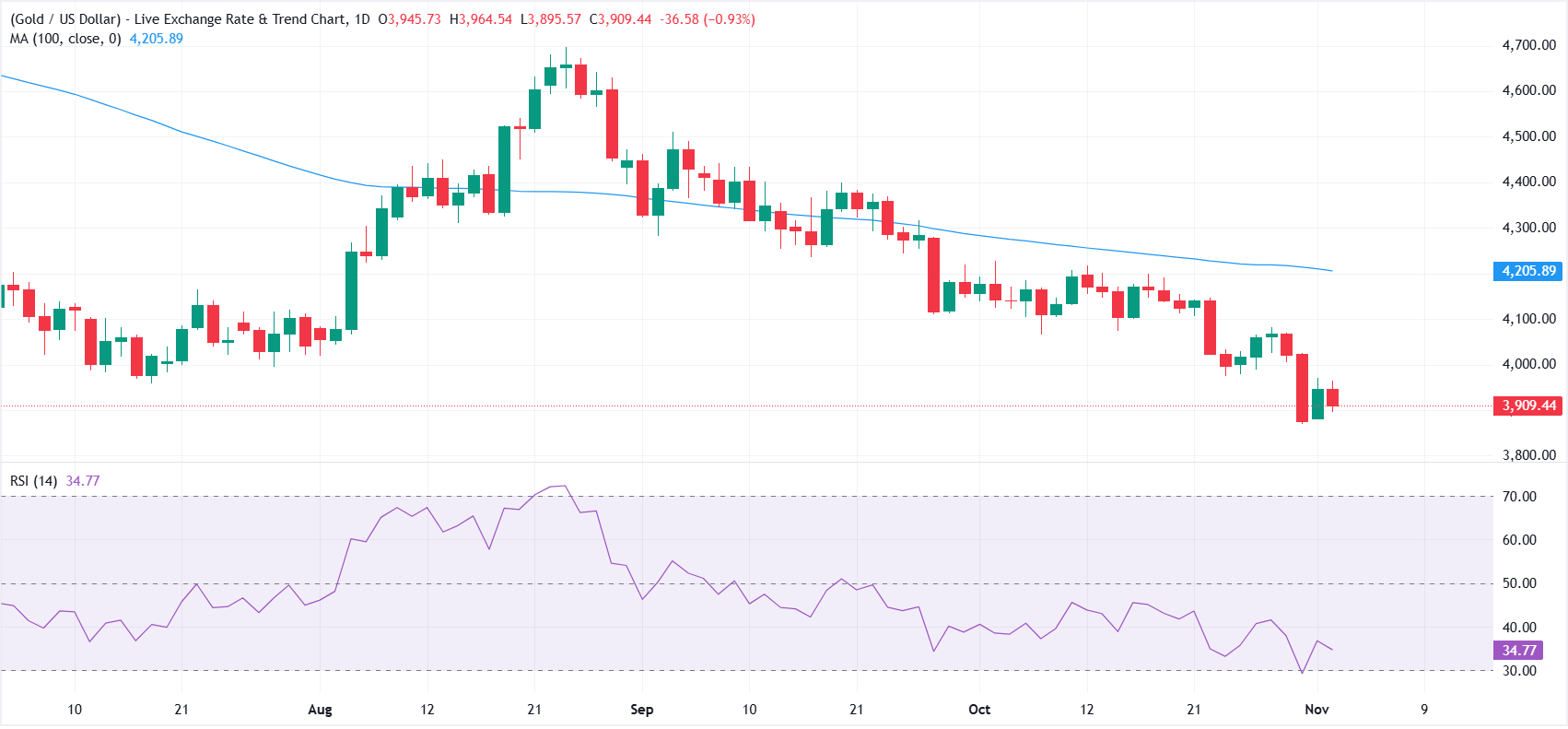
On the daily chart, XAU/USD maintains a bearish outlook as it trades below the 21-day, 100-day and 200-day Simple Moving Averages (SMAs).
The Relative Strength Index (RSI) at 34 hovers just above oversold territory, while the Moving Average Convergence Divergence (MACD) remains below zero with a negative reading, which together hint that downside momentum is still dominant, even if the sell-off is becoming stretched.
On the upside, immediate resistance lies in the $3,950-$4,000 region, followed by the 21-day SMA at $4,092. Above there, the 100-day SMA at $4,210 and a higher horizontal barrier near $4,400 form a broader supply zone, before the 200-day SMA at $4,485 comes into play as a more distant structural ceiling.
On the downside, Gold remains vulnerable to further losses, with immediate support at Friday's yearly low of $3,870. A break below this level could pave the way for further declines.
(The technical analysis of this story was written with the help of an AI tool. Know more.)
Gold FAQs
Gold has played a key role in human’s history as it has been widely used as a store of value and medium of exchange. Currently, apart from its shine and usage for jewelry, the precious metal is widely seen as a safe-haven asset, meaning that it is considered a good investment during turbulent times. Gold is also widely seen as a hedge against inflation and against depreciating currencies as it doesn’t rely on any specific issuer or government.
Central banks are the biggest Gold holders. In their aim to support their currencies in turbulent times, central banks tend to diversify their reserves and buy Gold to improve the perceived strength of the economy and the currency. High Gold reserves can be a source of trust for a country’s solvency. Central banks added 1,136 tonnes of Gold worth around $70 billion to their reserves in 2022, according to data from the World Gold Council. This is the highest yearly purchase since records began. Central banks from emerging economies such as China, India and Turkey are quickly increasing their Gold reserves.
Gold has an inverse correlation with the US Dollar and US Treasuries, which are both major reserve and safe-haven assets. When the Dollar depreciates, Gold tends to rise, enabling investors and central banks to diversify their assets in turbulent times. Gold is also inversely correlated with risk assets. A rally in the stock market tends to weaken Gold price, while sell-offs in riskier markets tend to favor the precious metal.
The price can move due to a wide range of factors. Geopolitical instability or fears of a deep recession can quickly make Gold price escalate due to its safe-haven status. As a yield-less asset, Gold tends to rise with lower interest rates, while higher cost of money usually weighs down on the yellow metal. Still, most moves depend on how the US Dollar (USD) behaves as the asset is priced in dollars (XAU/USD). A strong Dollar tends to keep the price of Gold controlled, whereas a weaker Dollar is likely to push Gold prices up.
Eng yaxshi maqolalar
1Gold: Downside bias holds with limited follow-through – UOB2US Dollar: Midterms pose limited downside – ING3Gold struggles near $3,900 as traders assess Middle East developments,US election risks4British Pound trades flat while US Midterm Elections take centre stage5Crypto Today: Bitcoin, Ethereum, XRP under pressure as investors pull capital6Australian Dollar: Dovish hike weighs on aussie – Commerzbank7Swiss Franc: Gains against Euro toward May high - Societe Generale8AUD/USD Price Forecast: Australian Dollar faces wrath of RBA’s dovish hike9Bitcoin Price Forecast: BTC risks deeper losses as the 200-day EMA comes under pressure

Boshlang!
Ro‘yxatdan o‘ting va 3 daqiqadan kamroq vaqt ichida Global bozorlariga kirish imkoniga ega bo‘ling

Biz bilan bog‘laning









Kontaktlar
Telefon: +61 2 8036 8388
Faks: +61 2 8036 8388
Email: support@tmgm.com
Veb: https://www.tmgm.com



Ushbu veb-saytda taqdim etilgan ma’lumotlar faqat umumiy xususiyatga ega bo‘lib, shaxsiy moliyaviy maslahat hisoblanmaydi. Ushbu veb-saytdagi har qanday ma’lumot asosida harakat qilishdan oldin, ma’lumotning sizning maqsadlaringiz, moliyaviy ahvolingiz va ehtiyojlaringizga mosligini ko‘rib chiqishingiz kerak. CFD va FX Margin shartnomalariga sarmoya kiritish sezilarli xavflarni o‘z ichiga oladi va barcha investorlar uchun mos emas. Siz boshlang‘ich depozitingizdan ko‘proq yo‘qotishingiz mumkin. Siz asosiy aktivga egalik qilmaysiz va unda hech qanday manfaatga ega emassiz. Savdo qilishdan oldin mustaqil maslahat olishni va ishtirok etuvchi xavflarni to‘liq tushunishingizni tavsiya qilamiz. Veb-saytda keltirilgan har qanday mahsulotni xarid qilishdan oldin oshkor qilish hujjatini o‘qib chiqishingiz va ko‘rib chiqishingiz muhimdir. Ushbu veb-saytda taklif etilgan ma’lumotlar va reklama materiallari bunday foydalanish mahalliy qonunlar va qoidalarga zid bo‘ladigan har qanday mamlakat yoki yurisdiksiyadagi shaxslar tomonidan foydalanish uchun mo‘ljallanmagan. Ushbu veb-saytda taklif etilgan Mahsulotlar va Xizmatlar AQSh, Malayziya va Tailand rezidentlari uchun mo‘ljallanmagan.
TMGM turli yurisdiksiyalarda vakolatli va tartibga solinadi.
Trademax Australia Limited, TMGM nomi ostida faoliyat yuritadi, Avstraliya Qimmatli qog‘ozlar va investitsiyalar komissiyasi (ASIC) tomonidan tartibga solinadi, AFSL raqami 436416 va manzili: Level 28, One International Tower, 100 Barangaroo Avenue, 2000 Sydney, NSW Australia.
Email: support@tmgm.com.au
Trademax Global Limited, TMGM nomi ostida faoliyat yuritadi, Vanuatu Moliyaviy Xizmatlar Komissiyasi (VFSC) tomonidan vakolatli va tartibga solinadi, ro‘yxatga olish raqami 40356 va ro‘yxatdan o‘tgan manzili: 1276, Kumul Highway, Port Vila, Vanuatu, Vanuatu Respublikasi.
Email: support@tmgm.com
Trademax Global Markets (SE) Limited, TMGM nomi ostida faoliyat yuritadi, Seyshel orollari Moliyaviy Xizmatlar Boshqarmasi (FSA) tomonidan 224-sonli SD litsenziyasi bilan vakolatli va tartibga solinadi. Kompaniya Office No 13, Providence Estate ABIS Centre, Mahe, Seychelles manzilida ro‘yxatdan o‘tgan.
Email: support@tmgm.com
Trademax Global Markets (International) Pty Ltd, TMGM nomi ostida faoliyat yuritadi, Mauritius Moliyaviy Xizmatlar Komissiyasi (FSC) tomonidan GB22201012 litsenziya raqami bilan vakolatli va tartibga solinadi hamda 33, Edith Cavell Street C/o IQ EQ Fund Services (Mauritius) Ltd Port Louis, 11324 Mauritius manzilida ro‘yxatdan o‘tgan.
Email: support@tmgm.com
Mualliflik huquqi © TMGM. Barcha huquqlar himoyalangan